
Every leader carries a story. Some of those stories are rooted in strength, heritage, and hope. Others are dominated by pain, failure, and the accumulated weight of systems that were not built to support them. The question that determines the trajectory of a career, and often a life, is not which story is true. Both are true. The question is which story you are leading with.
In Episode 052 of the Lunch with Leaders podcast, Adaeze Iloeje-Udeogalanya sits down with Ncazelo Ndlovu, internationally recognised psychologist and creator of the Tree of Life methodology, now used in over 30 countries.
Their conversation explores narrative healing, cultural identity, and what it means to reclaim your story in a world that has often told it for you. For women in STEM navigating environments shaped by systemic bias, cultural erasure, and the invisible weight of proving their worth repeatedly, this episode offers something rare: a framework for healing that starts with what you already carry, not what you lack.
Listen to Episode 052: Ncazelo Ndlovu: A Culturally Sensitive Approach to Trauma and Narrative Healing
What Is the Tree of Life Methodology?
The Tree of Life began in Zimbabwe as a response to a specific and urgent problem: how do you help communities devastated by trauma, including HIV/AIDS, displacement, and violence, talk about their pain without being further overwhelmed by it?
Traditional therapeutic approaches often centre the problem. They invite people to describe their suffering in detail, to examine it, to relive it in the hope of processing it. For many communities, particularly African communities with deeply collective cultural identities, that approach produces more harm than healing. It isolates the person inside their pain and asks them to carry it alone.
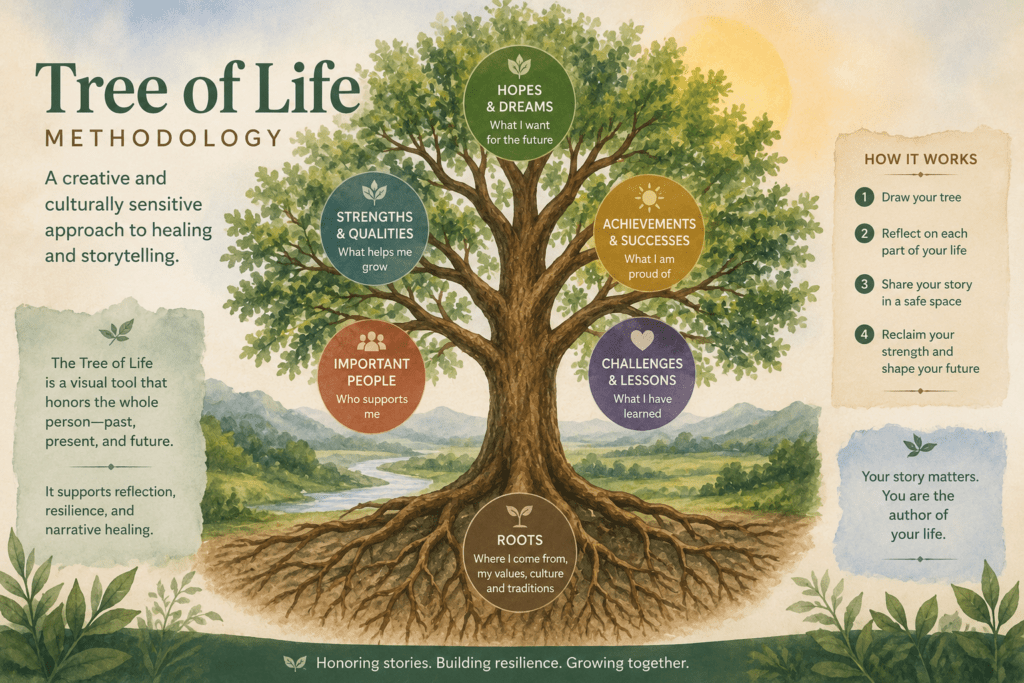
The Tree of Life takes a fundamentally different approach. Rather than starting with the problem, it starts with the person. Using the metaphor of a tree, it invites individuals to explore:
- Roots — the traditions, ancestors, cultural heritage, and community foundations that ground them
- Ground — the daily activities and current realities of their lives
- Trunk — the personal values and qualities that hold them upright
- Branches — the hopes, dreams, and directions they are reaching toward
- Leaves — the significant people in their lives who nourish them
- Fruits — the gifts they have given and received
Each element of the tree builds a picture of a person that is richer, more complex, and more true than any problem-saturated narrative could capture. By the time someone has mapped their tree, they have already begun reconnecting with strengths they had forgotten they possessed.
Today, the Tree of Life methodology operates in more than 30 countries, with applications ranging from refugee communities to corporate leadership development. Its reach is a testament to the universality of its core insight: every person, regardless of how heavy their current story feels, carries roots worth remembering.
Understanding Narrative Therapy: Moving Beyond the Problem Story
The Tree of Life sits within the broader practice of narrative therapy, and understanding that foundation helps clarify why the methodology works so powerfully across such different contexts.
Narrative therapy, developed by Michael White and David Epston, operates on a foundational premise: the person is not the problem. The problem is the problem. When someone experiences prolonged difficulty, trauma, or marginalisation, their identity can become fused with the problem story. They stop being a person who is experiencing difficulty and start being the difficulty itself. That fusion is where healing becomes hardest, because there is no longer any separation between the self and the pain.
Narrative therapy creates that separation. It externalises the problem, treating it as something the person experiences rather than something they are. And in doing so, it opens up space for what Ncazelo calls the second story.
What is the second story?
The dominant story is the problem-saturated narrative. The second story is the alternative narrative that already exists alongside it, the evidence of resilience, capability, hope, and agency that the dominant story has been drowning out.
Every person who has survived difficulty has a second story. Finding it does not mean denying the pain of the first. It means refusing to let the first story be the only story. And in that refusal, something significant shifts.
The Power of Roots: Why Cultural Identity Matters in Healing
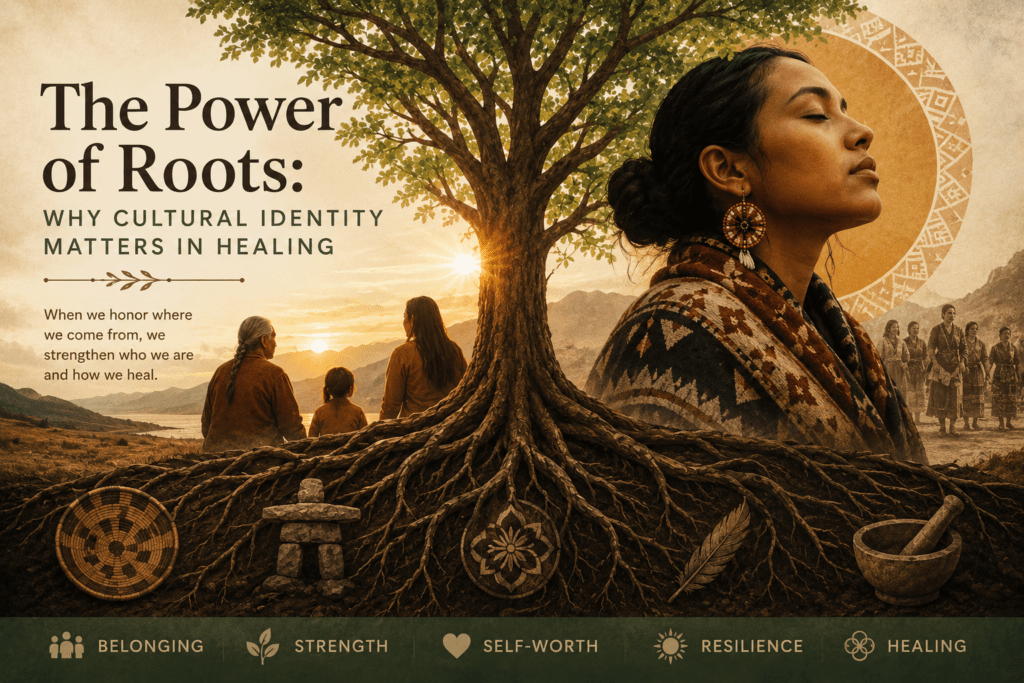
One of the most important and distinctive elements of Ncazelo’s work is its explicit engagement with cultural identity as a healing resource. In many Western therapeutic frameworks, cultural background is acknowledged but rarely treated as an active ingredient in recovery. In the Tree of Life methodology, it is central.
For African women and women of colour in STEM, this distinction carries particular significance. Many have navigated careers in environments that either ignored their cultural identity or treated it as something to manage or minimise. The professional pressure to assimilate, to code-switch, to present a version of yourself that the dominant culture finds legible, is both exhausting and erosive. Over time, it can sever people from the very roots that carry their greatest strength.
Reconnecting with those roots, the ancestors who persevered before you, the traditions that carried your community through difficulty, the values instilled by family and culture, is not nostalgic. It is strategic. As Ncazelo explains, those roots are what keep a tree standing when everything above the ground is being battered by wind. They are what you return to when the professional world strips away the external markers of identity and competence.
Practical ways to reconnect with your roots:
- Write down the names of three ancestors or elder figures whose resilience you carry in some form
- Identify one cultural tradition or value that has shaped how you approach challenges
- Reflect on the community that formed you and what strengths it gave you that you tend to take for granted
- Notice where your professional identity has drifted from your cultural values and ask what it would mean to close that gap
Hear Ncazelo explain the Tree of Life in full: Listen to Episode 052 of Lunch with Leaders
The Role of Witnessing in Community Healing
One of the most moving aspects of the Tree of Life methodology is the practice of witnessing. In individual therapy, healing often happens in private. In the Tree of Life, it happens in community.
After participants map their trees and share their stories, others in the group become witnesses. Witnessing is not passive. It is an active, structured practice of receiving another person’s story with full attention and reflecting back the strengths, values, and hopes you observed in it. In addition, it is the opposite of advice-giving, problem-solving, or comparison. It is simply the radical act of being fully present with someone else’s experience and saying: I see what you carry, and I see how you carry it.
For many women in STEM, this kind of witnessing is something they have rarely experienced in professional settings. The culture of STEM environments tends toward performance, competition, and outcome focus. Moments of genuine, unhurried human presence, where someone’s full story is received rather than evaluated, are rare and therefore deeply impactful when they occur.
What effective witnessing looks like in practice:
- Listening to a colleague’s story without interrupting or redirecting
- Reflecting back the specific strengths and values you observed, not the outcomes they described
- Asking questions that deepen your understanding rather than redirect the conversation toward your own experience
- Resisting the impulse to offer solutions before the person has finished being heard
This practice connects to what Rich Belsky explored in Episode 044 — Rich Belsky: Humanity in Leadership and Bridging the Entrepreneurial Isolation Gap, where genuine human presence was identified as the most irreplaceable element of effective leadership. Witnessing is that presence made structural and intentional.
Re-Authoring Your Leadership Story
The concept of re-authoring, central to narrative therapy, has direct and practical applications for women in STEM navigating career development, leadership transitions, and the ongoing work of building visibility and influence.
Re-authoring means deliberately and consciously rewriting the dominant story of your professional life when that story has become limiting, reductive, or simply untrue. It does not mean manufacturing a false narrative of unbroken success. It means identifying the evidence that the dominant story has been ignoring and building a more complete, more accurate account of who you are and what you are capable of.
For many high-achieving women in STEM, the dominant professional story sounds something like this: I work hard, I deliver results, and I am still not advancing at the rate my male peers are. That story is factually accurate. However, it is incomplete. It omits the mentors you developed, the crises you navigated quietly, the culture you held together, the innovation you drove without adequate credit, and the resilience you have demonstrated in environments that required twice the effort for half the recognition.
Re-authoring your leadership story means bringing all of that back into the account. Not for the sake of self-congratulation, but for the sake of accuracy. Because the story you tell about yourself shapes what you believe is possible, and what you believe is possible shapes every career decision you make from this point forward.
This connects directly to the authority shifts Adaeze outlined in Episode 051 — Season 1 Finale: 50 Episodes of Leading Boldly. The shift from proving to conviction, and from isolation to connection, both require a re-authored sense of self, one that leads with strength rather than seeking to overcome perceived deficit.
Questions for re-authoring your leadership story:
- What has the dominant story about your career been leaving out?
- Where have you demonstrated resilience that you have not given yourself credit for?
- What values have consistently guided your decisions, even in difficult moments?
- What would your story look like if it were told by someone who saw your full contribution clearly?

Applying Narrative Healing in Professional Settings
Ncazelo’s work has expanded beyond traditional therapeutic contexts into leadership development, corporate environments, and professional communities. The Tree of Life methodology adapts naturally to these settings because the core human need it addresses, the need to be seen fully rather than reduced to a performance metric, is as present in organisations as it is in clinical settings.
For leaders in STEM, the methodology offers specific and practical applications:
In team leadership: Building a team culture where people feel seen as full human beings, not just as contributors to a deliverable, requires creating space for the kind of honest, witnessed storytelling that the Tree of Life facilitates. Leaders who create that space consistently report stronger team cohesion, lower attrition, and higher quality of work.
In mentorship and sponsorship: Effective mentorship, as explored across multiple Season 1 episodes, requires genuine curiosity about the whole person, not just their professional performance. The Tree of Life framework gives mentors and sponsors a structured way to understand mentees more completely and advocate for them more specifically.
In personal leadership development: Mapping your own tree, identifying your roots, naming your values, articulating your hopes, is a powerful diagnostic tool for understanding where you are drawing strength from and where the connection to your own foundations has weakened. That awareness is the starting point for the kind of authentic leadership that Ncazelo, DeeDee Fisher, and Adaeze have all pointed toward across different episodes this season.
Conclusion
Ncazelo Ndlovu’s work is a reminder that healing and leadership are not separate domains. Both require honest self-knowledge, the courage to look clearly at what you carry, and the willingness to tell a story about yourself that is more complete than the one difficulty has been writing on your behalf.
The Tree of Life gives you the structure to do that work, to map your roots, name your values, articulate your hopes, and receive witnessing from a community that sees your strength clearly. For women in STEM who have spent careers in environments that reduced them to performance metrics and overlooked the full complexity of what they bring, that structure is not just therapeutic. It is transformative.
Your roots are deeper than the resistance you have faced. Your story is richer than the problem-saturated version that has sometimes dominated it. And your second story, the one full of resilience, agency, and hard-won wisdom, is already there waiting to be told.
Start with your roots. Everything else grows from there.
Learn more about Ncazelo’s work at phola.org and connect with her on LinkedIn.