What happens when you combine 25 years of engineering expertise, a doctorate in ministry, a passion for Black history, and an unshakeable belief that every capable human being deserves access to STEM? You get Dr. Antonia Arnold-McFarland, one of the most quietly impactful leaders in the STEM community today.
In Episode 060 of the Lunch with Leaders podcast, Adaeze Iloeje-Udeogalanya sits down with Dr. Tony, as she is warmly known, to explore how engineering principles apply far beyond the lab, why storytelling and legacy preservation are leadership responsibilities, and what it actually takes to build a STEM pipeline that leaves nobody behind. This conversation is rich, grounded, and full of practical wisdom that applies to every woman in STEM regardless of where she is in her career.
Listen to Episode 060: Dr. Antonia Arnold-McFarland: The United Shades of STEM
Engineering Has Always Been About People
Dr. Tony opens the conversation with a reframe that challenges how most STEM professionals think about their work. Engineering, she argues, is not fundamentally about products or processes. It is about people.
Without people, engineering means nothing. Every system built, every problem solved, every process improved ultimately exists to make life better for human beings. Yet the culture of STEM education and professional development often buries that human dimension beneath technical complexity, leaving students and professionals disconnected from the deeper reason their work matters.
This disconnection has consequences. STEM professionals who lose sight of the human dimension of their work also lose the motivation, empathy, and community orientation that produce the most meaningful impact. Dr. Tony has spent 25 years building that connection back in, working with students, professionals, and communities to ensure that technical brilliance serves humanity rather than existing in isolation from it.
Her message to everyone listening is direct: whatever you build, whoever you serve, keep the end user at the centre. The end user is always a person. That clarity changes everything about how you approach your work.
Systems Thinking as a Life Skill
One of the most practically powerful segments of this episode is Dr. Tony’s breakdown of how engineering problem-solving methodology applies directly to personal and professional challenges.
She calls it decomposing the problem, and it works like this. When you face a large, overwhelming challenge, the instinct is often to either attack it all at once or avoid it entirely. Neither approach produces results. Instead, Dr. Tony recommends breaking the problem into its major component parts, then breaking each of those parts into smaller, more granular elements, until you reach the level where you can identify specific, controllable factors.
She uses the body as an analogy. Your body is a system. It has a circulatory system, a respiratory system, a nervous system, and each of these interacts with the others. When something goes wrong, you do not treat the entire body at once. You diagnose which subsystem is failing, identify the root cause within that subsystem, and address it specifically.
The same logic applies to career challenges, relationship dynamics, financial problems, and mental health struggles. Break the big problem down. Identify what you can control. Focus your energy on those controllable factors. Mitigate what you cannot control. Accept what will resolve on its own timeline.
A practical framework for applying systems thinking to your own challenges:
- Name the big problem clearly in one sentence
- Break it into three to five major component areas
- Within each area, identify the specific factors that contribute to it
- Ask which factors you can directly control or influence
- Focus your action on those specific factors first
- Identify what needs mitigation rather than solution
- Accept what will resolve without your intervention
This framework does not promise that every problem gets solved. Some problems cannot be solved, only managed. But the clarity that comes from decomposing a problem is transformative on its own, because clarity is what makes action possible.
What It Means to Be a Contemporary Griot
This section of the episode introduces a concept that gives the entire conversation its deepest resonance. Dr. Tony describes herself as a contemporary griot, a role that combines her engineering precision with a calling she says found her rather than one she chose.
A griot, in West African tradition, is the oral historian and storyteller of a community. The griot knows the history, preserves the narrative, and ensures that the wisdom of the past reaches the people who need it in the present and future. Every community has someone who plays this role informally, the family elder who knows every ancestor’s story, the community member who remembers how things got to where they are.
Dr. Tony plays this role formally and intentionally. She helps families, communities, and organisations collect and document their histories before they are lost. She explains why this matters with characteristic clarity: you cannot understand where you are going until you understand how you got to where you are. Context is data. History is context.
For STEM professionals, this principle applies in two directions.
Outwardly, it means understanding the historical context of the communities you serve and the institutions you work within. Inwardly, it means knowing your own story well enough to tell it with accuracy and intention.
Dr. Tony makes a point that connects directly to the leadership development work across this season of Lunch with Leaders: the narrative that defines you should be told by you. When you do not tell your own story, others tell it for you, and their lens may not be accurate. Own your narrative. Document your journey. Preserve what you have learned so that the people who come after you can stand on it rather than start from scratch.
She also notes that AI now makes this more accessible than ever before. You can simply record yourself speaking and let AI help you document and structure the content. The technology that many fear is also the technology that makes legacy preservation democratically available to everyone.
Hear Dr. Tony explain the griot tradition in her own words: Listen to Episode 060 of Lunch with Leaders
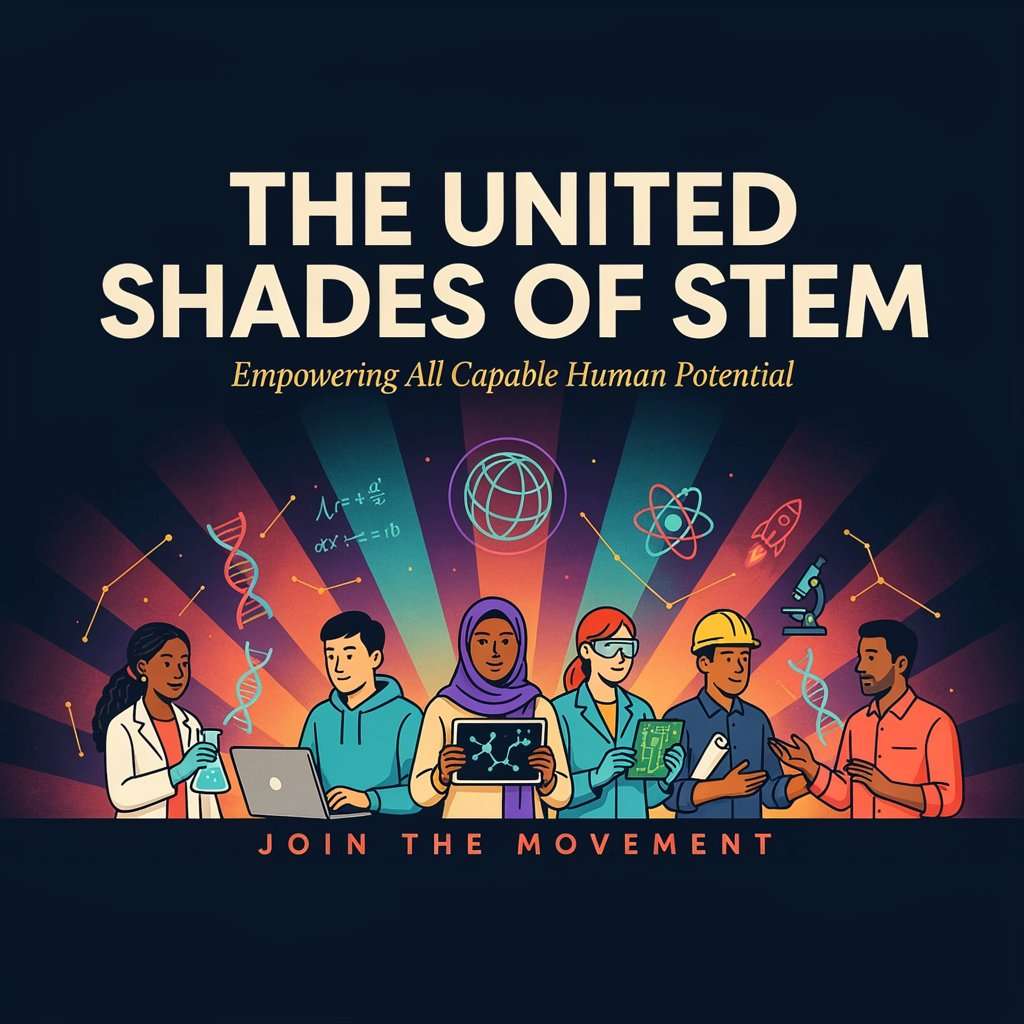
United Shades of STEM: A Mission Built on Strategic Partnership
Dr. Tony founded United Shades of STEM because she saw a problem that individual organisations could not solve alone: fragmentation in the STEM nonprofit ecosystem.
Across the country, dozens of STEM organisations work toward the same goals, expanding the pipeline, empowering underrepresented students, and building pathways into technical careers. Yet many of these organisations operate in isolation, duplicating efforts, competing for the same limited funding, and reaching the same populations without the scale or scope that genuine change requires.
United Shades of STEM exists to change that dynamic by bringing STEM organisations together to partner strategically, align on common goals, and pool resources for greater impact. The mission is to expand the STEM talent pipeline through strategic partnering, empowering all capable human potential to innovate, improve, and globally impact people and the planet.
The all-inclusive framing is deliberate. Dr. Tony pushes back strongly against the narrative that elevating underrepresented groups diminishes others. STEM needs every capable brain it can access. The problems facing humanity, from climate change to healthcare to infrastructure to the ethical governance of AI, are too large and too complex for any homogenous group to solve alone. Diversity in the pipeline is not a charity project. It is a technical necessity.
Recent initiatives under the United Shades of STEM umbrella include:
- A three-week Black History STEM expo in partnership with a Greensboro library, featuring Katherine Johnson’s daughter and a co-founder of the National Society of Black Engineers
- Community STEM expos exposing youth to robotics, AI, life sciences, and environmental engineering
- Programming at the Garner Community Centre in Raleigh serving youth on a regular basis
- Strategic alignment with the National Society of Black Engineers to expand reach and programming
Each of these initiatives reflects the same core principle: you cannot build the future without involving all of the people who will live in it.
The Future of Work Requires New Thinking
Dr. Tony brings a practitioner’s perspective to the question of what skills will matter most in the rapidly evolving job market, and her answer challenges some of the assumptions that currently dominate career advice.
Twenty years ago, nobody was talking about cybersecurity as a career field. The field emerged because problems emerged that demanded people who could address them. The same pattern will repeat. New problems will create new roles, new expertise, and new disciplines that do not yet have names.
Given that reality, Dr. Tony argues that rigidly pursuing a single defined career path is less useful than developing the foundational capabilities that allow you to adapt across changing contexts.
Those capabilities include:
- Adaptability — the willingness to pivot when the landscape changes rather than defending a position that is becoming obsolete
- Systems thinking — the ability to see how components interact and to diagnose problems at the level of their root causes
- Digital and AI fluency — not necessarily deep technical expertise, but enough working knowledge to leverage tools effectively and know when to seek deeper expertise
- Interdisciplinary collaboration — the ability to work productively with people from different disciplines, recognising that most meaningful problems require multiple forms of expertise to solve
- Relationship building — knowing who knows what, so that when you encounter a problem outside your expertise, you know exactly who to reach out to
She also makes a point that often gets lost in conversations about AI and automation: the trades are not going anywhere. We need plumbers, electricians, and construction workers to build the data centres that run the AI systems everyone is talking about. Not every future-proof career is digital. Every capable human has a contribution to make.
This connects to the framework explored in Episode 056 — Bradley Hunt: The Difference Between Managing and Leading, where Bradley emphasised that the skills enabling others to act and cultivating genuine followership are foundational regardless of the specific technical landscape. Dr. Tony’s interdisciplinary vision extends that principle outward: the leaders who matter most are the ones who can bridge disciplines, communities, and capabilities rather than dominating within a single lane.
The Arnold Legacy Center: Turning Blueprint into Mission
Dr. Tony shares the story behind the Arnold Legacy Center with quiet pride. Named for her parents, Raymond and Mary Arnold, both schoolteachers who spent their careers not just teaching inside classrooms but coaching people on how to build a life, the center is an attempt to operationalise the blueprint they left behind.
The center runs the Arnold Family Legacy Scholarship, launched on the day of her father’s passing in 2020. Rather than receiving flowers, the family chose to create something purposeful in his memory. The scholarship cycle runs from November 1st to March 31st, with winners announced in June.
Beyond the scholarship, the center aims to give young people not just educational support but a transformative framework for navigating life. It applies the engineering tools Dr. Tony has spent 25 years mastering to the challenge of helping people reach their fullest potential, with the honest acknowledgment that unexpected things will always happen, and the goal is to build people who can navigate through them rather than be derailed by them.
Learn more at arnoldlegacycenter.com.
The Legacy Dr. Tony Is Building
When Adaeze asks Dr. Tony about the legacy she hopes to leave, her answer is simple and specific: she wants people to envision a better version of themselves and never lose sight of that vision. Not just to envision it, but to feel genuinely equipped and empowered to reach it.
And then, she adds something that reframes legacy itself: she wants the people she reaches to feel a conviction that they owe something back. Not out of obligation, but out of gratitude for what community made possible for them. Common unity is her definition of community. And in that definition, everyone who benefits from the ecosystem of support has a responsibility to contribute to it.
That is the kind of compounding impact that changes pipelines, institutions, and futures. Not one person doing everything, but every person doing their part.
This connects to the financial and professional urgency explored in Episode 059 — Million Dollar Mistakes: The Hidden Math Behind Career Stagnation, where Adaeze makes the case that the cost of staying still compounds over time. Dr. Tony’s work is the positive mirror of that argument: the impact of giving back also compounds, and the community that invests in each other consistently produces more than any individual could generate alone.
Conclusion
Dr. Antonia Arnold-McFarland is proof that a career built on technical excellence and a life built on community, legacy, and purpose are not competing priorities. They are the same thing, seen from different angles.
Her work spans engineering, education, history preservation, nonprofit leadership, and scholarship funding, and the thread running through all of it is consistent: every capable human being deserves access to the tools, the knowledge, and the community support necessary to reach their fullest potential. Not some shades of humanity. All shades.
Apply systems thinking to your biggest challenge this week. Document one piece of your story that you have been carrying in memory rather than writing down. Find one community that sees your full potential and invest in it. And ask yourself whether you are building something that the people who come after you can stand on.
That is the legacy Dr. Tony is building. It is the one you can start building today.
Listen to the full conversation with Dr. Antonia Arnold-McFarland: Episode 060: The United Shades of STEM
Connect with Dr. Tony:
Catch up on these connected episodes: