
Getting promoted into management feels like the reward for years of high performance. Then the reality sets in. The skills that made you exceptional as an individual contributor — your ability to execute independently, your instinct to take ownership, your drive to get things done — suddenly become the very habits that undermine your effectiveness as a leader.
In Episode 046 of the Lunch with Leaders podcast, Adaeze Iloeje-Udeogalanya sits down with Erin Tracy, leadership coach and people-first advocate, to unpack the most common and costly mistakes new managers make. Together, they explore burnout, boundary-setting, generational dynamics, and what it actually means to lead people rather than simply manage tasks.
Listen to Episode 046: Practical Advice and Strategies for New Managers
1. The Trap High Performers Fall Into When They Become Managers
High performers earn management roles precisely because they deliver. They take ownership, solve problems, and never let things fall through the cracks. Unfortunately, those same qualities become serious liabilities the moment they step into a leadership role.
Erin Tracy identifies the central trap clearly: over-responsibility.
Here is what it looks like in practice:
- A team member struggles with a task, and the manager steps in to solve it instead of coaching them through it
- A deadline feels uncertain, so the manager takes over rather than holding the team accountable
- Work does not meet the expected standard, so the manager does it themselves rather than developing the person who fell short
Each response feels efficient in the short term. Over time, however, they create a bottleneck where every problem flows back to the manager rather than being resolved within the team. The consequences compound quickly:
- Team members stop developing because they never work through challenges independently
- Good people disengage because they feel disempowered
- The manager burns out carrying a load that was never meant to be carried by one person
This dynamic also distorts what servant leadership actually means. Genuine servant leadership empowers others to grow. Over-responsible leadership, even when well-intentioned, does the opposite.
Try this: The next time a team member brings you a problem, resist the impulse to solve it. Ask instead: “How would you approach this?” That single question shifts the dynamic from dependency to development.

2. The Post-it Note Challenge: A Simple Tool for Self-Awareness
Knowing that over-responsibility is a problem and actually catching yourself doing it in real time are two different things. Erin introduces a practical tool for bridging that gap.
How the Post-it Note Challenge works:
- Keep a stack of Post-it notes on your desk
- Every time you default to “I’ll do it” or absorb a task you could have redirected to your team, write it on a note
- At the end of each week, count the notes
- Do not try to change your behaviour in week one — simply observe and record
- In week two, use what you observed to redirect at least one task per day back to your team
The power of this exercise lies not in the counting but in the awareness it creates. Most over-responsible leaders have no idea how frequently they step in unnecessarily, because each individual instance feels justified in the moment. The Post-it notes make the invisible pattern visible — and once you see a pattern clearly, you can change it deliberately.
3. Understanding Generational Dynamics in the Modern Workplace
For the first time in history, four generations share a single workplace simultaneously:
- Baby Boomers: shaped by loyalty, hierarchy, and long-term institutional commitment
- Generation X: independent, sceptical of institutions, self-reliant
- Millennials: purpose-driven, collaborative, values-conscious
- Generation Z: boundary-aware, digitally native, outcome-focused over hours-focused
Managing across that range requires genuine curiosity and deliberate communication rather than assumptions or judgment. Misunderstandings between generations are almost inevitable without intentional dialogue.
Erin is particularly thoughtful about Generation Z, whose boundary-setting and values around work-life balance often generate frustration among older colleagues and managers. Rather than framing Gen Z’s approach as a lack of commitment, she reframes it as something older generations could learn from.
Gen Z watched what happened when previous generations gave everything to their careers without protecting their health, time, and personal lives. Their insistence on boundaries is not entitlement. It is a response to evidence.
How to apply this: When generational friction arises in your team, approach it with curiosity before judgment. Ask what values are driving the behaviour you are observing. Open, respectful dialogue across generational lines consistently produces better outcomes than enforced conformity to a single standard.
Hear Erin and Adaeze explore generational dynamics in full: Listen to Episode 046 of Lunch with Leaders

4. Setting Boundaries Through Communication, Not Ultimatum
Boundaries in leadership get discussed most often in the context of personal wellbeing. Erin extends the conversation into how boundaries function as a communication and relationship management tool within teams.
Practically, communication-based boundary-setting means:
- Giving advance notice when your capacity is limited, rather than withdrawing abruptly when overwhelmed
- Explaining the reasoning behind your limits rather than simply enforcing them
- Framing boundaries around shared outcomes, such as protecting the quality of your work and your team’s performance, rather than purely personal preference
For women in STEM, this carries particular weight. Women who set boundaries in professional environments frequently face pushback that their male counterparts do not. Framing boundaries as a leadership practice rather than a personal stance changes both the internal experience of setting them and the way they land with others.
Try this: Identify one boundary you have been avoiding enforcing. Write down how you would communicate it proactively, framing it around shared outcomes. Then have that conversation this week. The first time is always the hardest. It becomes easier with practice.
5. The Power of Micro-Conversations in Leadership
One of the most underused tools in a manager’s repertoire is the micro-conversation: the brief, informal check-in that happens in the flow of daily work rather than in a scheduled meeting.
Most organisations treat team check-ins as a crisis response. By that point:
- Engagement has already dropped
- A key person is already at resignation risk
- Performance has already deteriorated to the point of formal intervention
- Trust has already eroded
Micro-conversations as a proactive routine prevent that deterioration entirely. They keep the manager genuinely connected to what team members experience before it reaches a breaking point.
Beyond engagement, consistent micro-conversations serve as a leadership pipeline tool. They create the informal visibility that allows managers to identify:
- Which team members are ready to take on more responsibility
- Which are struggling with challenges they have not yet raised formally
- Where development opportunities exist within the team
This intelligence is impossible to gather from quarterly reviews alone.
How to apply this: Commit to three brief informal check-ins with team members per week. Walk over to where someone is working. Ask one genuine question about what they are working through. Listen without immediately pivoting to solutions. The goal is connection and awareness, not information extraction.
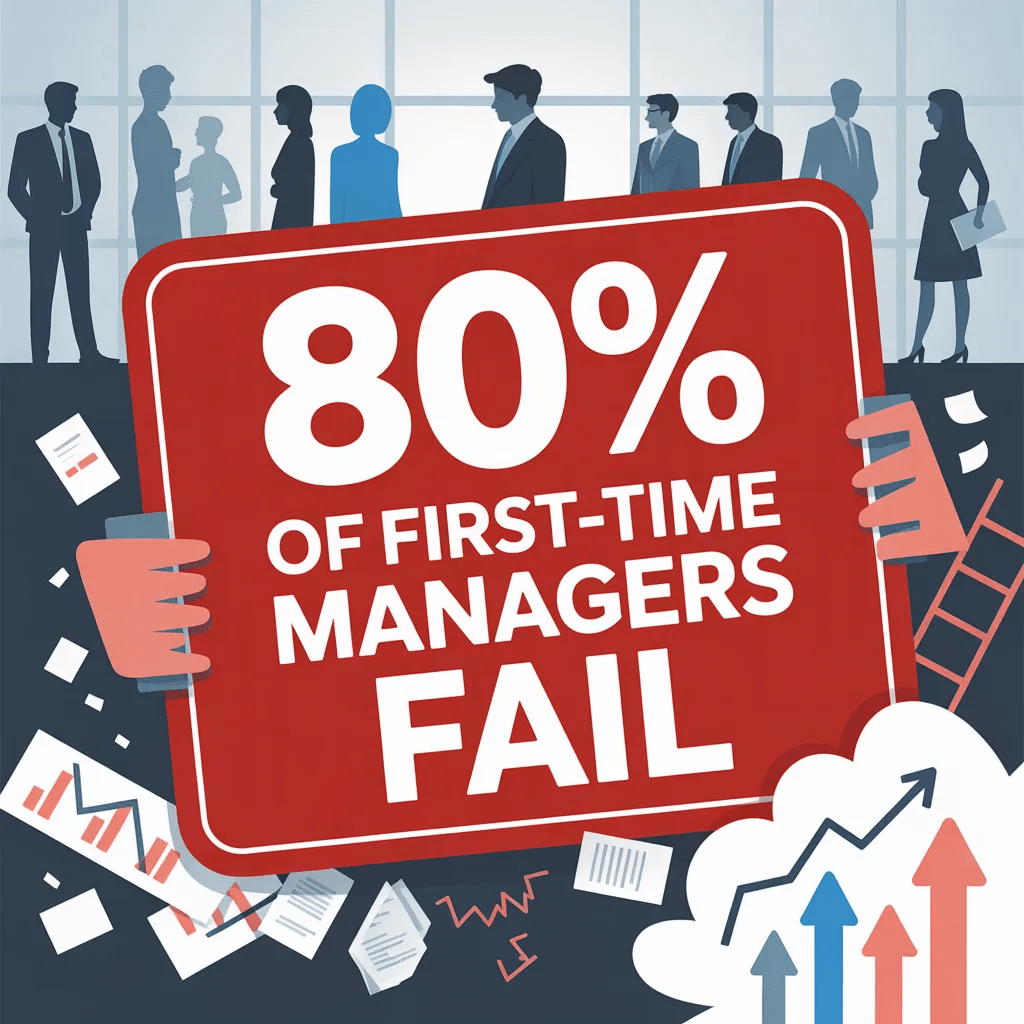
6. Why 80% of First-Time Managers Fail and What Organisations Get Wrong
The statistic Erin shares in this episode is striking: 80% of first-time managers fail within their first two years.
That is not a small attrition rate. It is a systemic failure of how organisations approach management transitions.
The root cause is consistent and predictable:
- Organisations promote their best individual contributors into management
- They provide little to no training in people management skills
- They assume that someone who excels at doing the work will naturally excel at developing others who do the work
- They offer support only after problems surface, rather than building capability proactively
The skills required for individual excellence and the skills required for management excellence are genuinely different. Technical mastery, speed, and personal output are the currencies of individual performance. Listening, coaching, delegating, developing others, and managing conflict are the currencies of management performance. Expecting one to automatically produce the other sets new managers up to fail before they begin.
What good organisations do instead:
- Identify leadership potential early and begin development before promotion
- Provide structured training in people management skills at the point of transition
- Build mentorship and coaching support into the first year of management
- Create proactive cross-training programmes so leadership pipelines are built intentionally rather than reactively
As Adaeze explored in Episode 045 — The Broken Rung: Visibility and Support for Women in STEM, the systems organisations build around promotion and development determine who advances and who stagnates. The 80% failure rate among new managers is a systems problem, not a people problem.
If you are a new manager: Do not wait for your organisation to provide the training you need. Seek out mentors, coaches, and communities actively. The African Women in STEM network exists as exactly this kind of resource.
7. What People-First Leadership Actually Looks Like in Practice
People-first leadership is a phrase that gets used frequently and defined rarely. Erin Tracy gives it concrete meaning in this episode.
People-first leadership is not about being nice or avoiding difficult conversations. It means:
- Centring your leadership decisions around the development and wellbeing of your team, not just the completion of tasks and processes
- Seeing your team members as whole people, not just contributors to output metrics
- Checking in where people work, not just where you work, so you see their challenges firsthand before making decisions that affect them
- Developing people proactively, rather than waiting until a gap in capability becomes a crisis
- Creating psychological safety so that team members can raise concerns, share ideas, and admit mistakes without fear of punishment
The business case for people-first leadership is not soft. Organisations that centre their people consistently produce better customer outcomes, stronger retention numbers, higher engagement scores, and more resilient cultures. When people feel genuinely valued and supported, they invest more, contribute more, and stay longer.
Contrast this with task-first and process-first environments, where people are treated as a means to an output. Those environments produce compliance in the short term and disengagement in the long term. The turnover costs alone make people-first leadership an obvious business priority, quite apart from the ethical case for it.
This connects directly to what Rich Belsky explored in Episode 044 — Rich Belsky: Humanity in Leadership and Bridging the Entrepreneurial Isolation Gap, where he makes the case that human dynamics, not business mechanics, determine whether organisations succeed or fail over time. People-first leadership is the operational expression of that principle.
Your Action Steps as a New or Developing Manager
Here is a practical summary of everything Erin Tracy recommends:
- Track your “I’ll do it” moments: Run the Post-it Note Challenge for two weeks to build self-awareness about over-responsibility patterns
- Delegate and empower intentionally: Ask “How would you solve it?” before stepping in to solve problems for your team
- Practice proactive communication: Set and communicate boundaries early, clearly, and around shared outcomes rather than personal preference
- Prioritise people over process: Check in with team members where they work, see their challenges firsthand, and make decisions with that context
- Commit to micro-conversations: Make daily small check-ins a routine, not a crisis response
- Advocate for your own leadership training: Do not wait for a promotion to start developing people management skills. Seek mentorship, coaching, and community now
Frequently Asked Questions
What is the biggest leadership trap for high performers?
Taking on too much. High achievers instinctively step in to solve problems and absorb tasks rather than redirecting them back to the team. Over time, this creates a bottleneck, disempowers team members, and burns the manager out. The shift from doing to developing is the central challenge of the transition into management.
How do I build self-awareness about harmful leadership habits?
Use tools like the Post-it Note Challenge to make invisible patterns visible. Track specific behaviours, such as how often you default to “I’ll do it,” over a defined period. Observable data makes change possible in a way that good intentions alone never do.
How do generational differences affect team dynamics?
Different generations hold different values around time, boundaries, work-life balance, and professional identity. Misunderstandings are common unless managers approach generational difference with curiosity and create space for open, respectful dialogue rather than enforcing conformity to a single generational standard.
Why do so many new managers fail within their first two years? Organisations promote high performers without equipping them with people management skills. Individual excellence and management excellence require different capabilities, and assuming one produces the other automatically sets new managers up to fail. The solution is early development, structured training, and proactive support rather than reactive intervention after problems emerge.
How do I set boundaries at work without damaging professional relationships?
Communicate boundaries proactively and frame them around shared outcomes rather than personal preference
How do I find leadership development support if my organisation does not provide it?
Seek it externally. Mentors, executive coaches, professional communities like African Women in STEM, and peer networks all provide the development support that many organisations fail to offer. Do not wait for your organisation to prioritise your growth. Take ownership of it yourself and build the skills before you need them urgently.
Conclusion
The transition from high performer to effective manager is one of the most challenging professional shifts anyone makes. It requires unlearning the habits that produced past success and building an entirely different set of capabilities in their place. Most organisations provide minimal support for this transition, and the 80% failure rate among new managers reflects exactly that gap.
Erin Tracy’s episode is a practical, honest resource for navigating that transition more deliberately. From the Post-it Note Challenge to micro-conversations, from generational dialogue to people-first leadership, every insight she shares is immediately actionable.
The goal is not to become a perfect manager overnight. It is to become a more self-aware one today, a more intentional one tomorrow, and a more effective one over the months and years that follow. That development is a practice, not a destination. Start where you are, with one small change, and build from there.
Listen to the full conversation with Erin Tracy: Episode 046 — Erin Tracy: Practical Advice and Strategies for New Managers
Catch up on these connected episodes too: