
You have done everything right. You deliver exceptional work, you exceed your targets, you hold your team together through every difficult quarter, and yet the promotion keeps going to someone else. Your manager calls it a lack of executive presence. Your skip-level mentions visibility. Nobody tells you exactly what to fix, and nobody tells you why someone with a thinner track record keeps moving ahead of you.
This is not a performance problem. It is a structural one. In Episode 045 of the Lunch with Leaders podcast, Adaeze Iloeje-Udeogalanya draws on the 2025 McKinsey Women in the Workplace report to name this structure precisely, challenge the myths that keep women stuck inside it, and offer a clear, actionable path forward for women in STEM who are done waiting to be noticed.
Listen to Episode 045: The Broken Rung: Visibility and Support for Women in STEM
What the Broken Rung Actually Means
The broken rung is not a metaphor for general career difficulty. It describes a specific, measurable structural failure: the first promotion to manager. According to the 2025 McKinsey Women in the Workplace report, only 93 women receive that first managerial promotion for every 100 men. Among women of colour, that number drops to 74.
That gap, seemingly small at the entry point, compounds dramatically over time. Every subsequent leadership level draws from the pool created at the level below it. When women are systematically underrepresented at the first rung of management, their underrepresentation widens at every level above it. By the time you reach the C-suite, the cumulative effect of that single missed step has filtered out the majority of women who were qualified, ambitious, and ready to lead.
Understanding this matters because it changes the diagnosis entirely. The pipeline does not leak at the senior levels because women suddenly lose ambition or capability. It leaks at the very first step, and everything above that is a consequence of what happened at the bottom.
Dismantling the Ambition Myth
One of the most persistent and damaging narratives used to explain the gender gap in STEM leadership is the ambition gap: the suggestion that women simply want senior roles less than men do, and that the disparity in representation reflects a difference in aspiration rather than a difference in opportunity.
Adaeze challenges this directly, and the data supports her. Research shows that when women receive equal sponsorship, equal access to high-visibility opportunities, and equal advocacy in promotion discussions, the gap disappears. Not shrinks. Disappears.
That finding is decisive. If the gap were driven by ambition, it would persist regardless of sponsorship. The fact that sponsorship eliminates it entirely tells you exactly what is actually causing the disparity: not a shortage of ambition among women, but a shortage of advocacy for them. Women are not less driven. They are less sponsored.
This distinction matters profoundly for how women navigate their careers and how organisations design their promotion processes. If the problem is ambition, the solution is individual. If the problem is sponsorship, the solution is structural. The evidence points unambiguously toward the latter.
The takeaway: Stop internalising the ambition myth. Your desire for advancement is not the variable that needs fixing. The sponsorship and advocacy infrastructure around your career is.
The Invisible Tax Nobody Talks About
Beyond the sponsorship gap, Adaeze introduces another structural burden that quietly drains the professional capital of high-performing women in STEM: the invisible tax.
The invisible tax refers to the unrewarded, non-KPI-aligned work that women disproportionately perform to hold teams and organisations together. Organising the team offsite. Mentoring the junior colleague who is struggling. Mediating the conflict between two team members before it escalates. Ensuring that the new hire feels included. Remembering the birthdays, sending the check-ins, maintaining the relational fabric that keeps a team functional.
This work is real. It is valuable. Without it, teams deteriorate, cultures erode, and organisations lose talent. And yet it rarely appears in performance reviews, never features in promotion conversations, and consistently fails to translate into the kind of visibility that drives career advancement.
The result is that women spend significant professional energy on work that does not count in the systems designed to evaluate and reward contribution. Meanwhile, that energy could be directed toward the high-visibility, KPI-aligned deliverables that actually move promotion conversations forward.
Recognising the invisible tax is not about refusing to contribute to team culture. It is about making conscious choices about where your professional energy goes, and ensuring that the work you invest in actually connects to the outcomes that decision-makers measure and reward.
The takeaway: Audit how you spend your professional time and energy. Identify how much goes toward invisible tax work versus high-visibility, impact-driven contributions. Then make deliberate choices about where to invest and where to pull back.
Hear Adaeze break down the McKinsey data and the invisible tax: Listen to Episode 045 of Lunch with Leaders.
The Difference Between a Mentor and a Sponsor
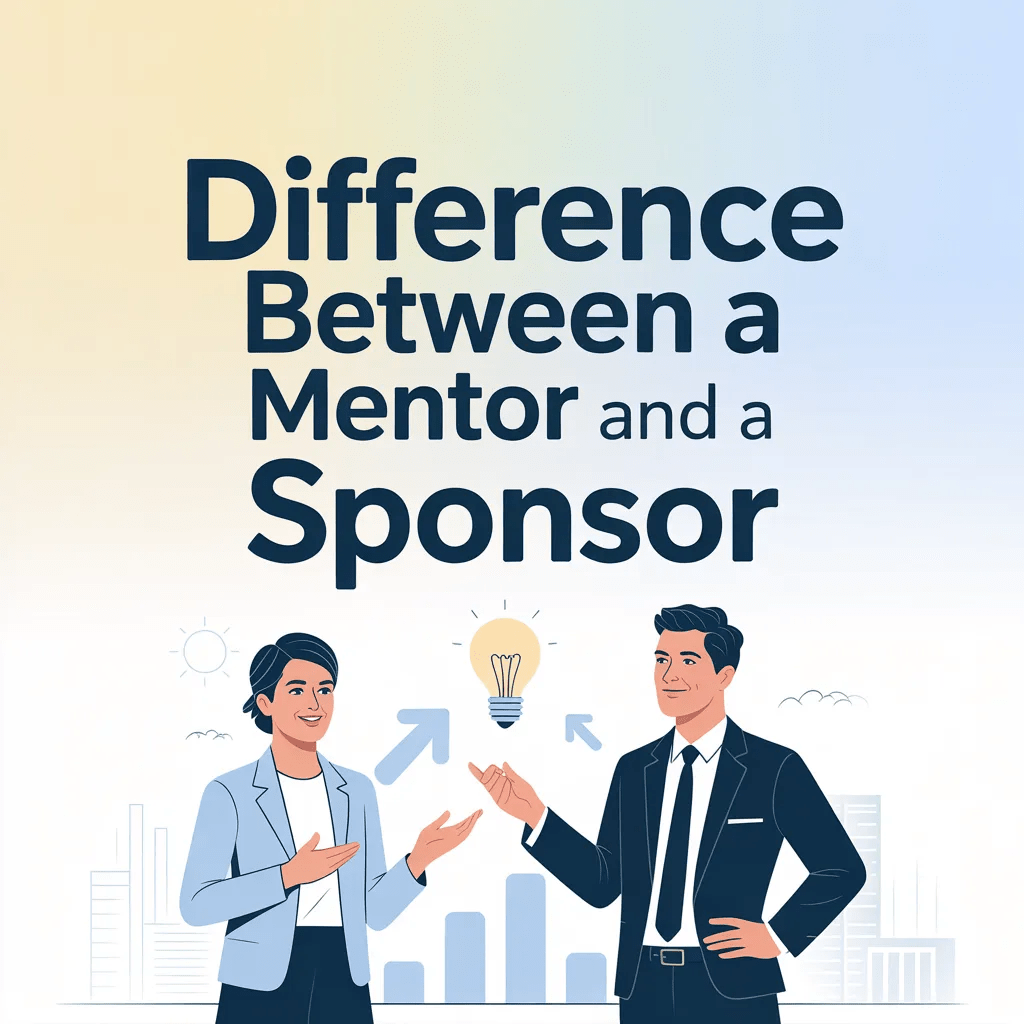
This distinction is one of the most practically important concepts in the episode, and one of the most frequently misunderstood in conversations about career advancement.
A mentor advises you. A mentor listens to your challenges, offers perspective from their own experience, helps you think through decisions, and provides guidance when you ask for it. Mentorship is valuable. It is also insufficient on its own for career advancement.
A sponsor advocates for you. A sponsor uses their political capital, their influence, and their presence in rooms you are not yet in to put your name forward for opportunities. When a promotion discussion happens and your sponsor is at the table, they do not just passively support you if asked. They actively argue for you, remind the room of your impact, and make the case that you are ready.
The difference is directional. A mentor talks to you. A sponsor talks about you. And at the level where promotion decisions actually get made, it is the people talking about you who determine what happens next.
Many women in STEM invest heavily in mentorship relationships and wonder why their careers are not advancing at the rate they expected. Often, the missing element is not more advice. It is advocacy. The question is not whether you have people who believe in you. It is whether those people have the influence and the access to act on that belief in the spaces where it matters.
The takeaway: Assess your current professional relationships honestly. Count your mentors and count your sponsors separately. If you have plenty of the former and very few of the latter, closing that gap is your most urgent career development priority.
Why Performance Alone Will Never Be Enough
Adaeze opens the episode with a story that will resonate deeply with high-performing women in STEM. A client of hers consistently delivered exceptional work, exceeded every metric, and was repeatedly told she needed more executive presence and visibility. Nobody defined what that meant. Nobody gave her a specific skill to develop. The feedback was a door with no handle.
This pattern is not unusual. It reflects a fundamental truth about how advancement actually works at senior levels, one that contradicts everything most high-performing women have been taught to believe. Doing excellent work is necessary. It is not sufficient.
As Adaeze explored in Episode 043: Breaking the AI Double Standard for Women in STEM, and as she laid out in detail in the 10% Rule episode, technical excellence and consistent delivery account for only a fraction of what drives career advancement. The remainder depends on visibility, positioning, strategic relationships, and ensuring that the right people connect your name to your impact.
The leaders who advance are not always the best performers in the room. They are the ones whose performance is most visible to the people making advancement decisions. That visibility does not happen by accident. It requires deliberate, consistent, strategic action, and it requires doing that action even when it feels uncomfortable.
The takeaway: Shift your question from “how do I do better work?” to “how do I ensure the right people see and understand the work I am already doing?” Both matter. At senior levels, the second question matters more.
How to Build Visibility That Actually Moves Careers Forward
Visibility without strategy is noise. Strategic visibility, directed at the right people, framed around the right outcomes, and delivered through the right channels, is what actually shifts promotion conversations.
Adaeze offers three concrete approaches for building this kind of visibility:
Frame your impact in the language of leadership priorities
When you communicate your contributions, connect them explicitly to the outcomes that senior decision-makers care about: revenue growth, cost reduction, risk mitigation, talent retention, operational efficiency. Saying “I led the project” tells a story about activity. Saying “I led the initiative that reduced onboarding time by 30%, saving the department an estimated 200 hours per quarter” tells a story about impact. The second version gives decision-makers something they can repeat and argue with in a promotion discussion.
Send intentional accomplishment updates
Do not wait for performance review season to surface your wins. Send brief, well-framed updates to senior leaders when significant milestones are reached. This does not need to be a lengthy report. A few sentences that connect a recent outcome to a business priority keeps your name and your impact present in the minds of the people who make decisions about your career. Consistency matters more than frequency.
Make well-positioned contributions in high-visibility settings
Speak up in meetings where senior leaders are present, not to fill airtime, but to contribute a perspective that demonstrates strategic thinking. Ask the question that nobody else asked but everyone needed to hear. Connect a current challenge to a broader organisational pattern. Each of these moments plants a marker in the minds of decision-makers that associates your name with clear, confident, strategic thinking.
This connects directly to what Rich Belsky explored in Episode 044: Rich Belsky: Humanity in Leadership and Bridging the Entrepreneurial Isolation Gap. Building the relationships that make advocacy possible requires showing up authentically and consistently, not just performing competence when the stakes are highest.
How to Find and Activate Your Sponsors
Finding sponsors requires a different approach than finding mentors. Sponsorship relationships develop from demonstrated performance and strategic relationship-building, not from formal matching programmes or introductory coffees.
Start by identifying the senior leaders in your organisation who have visibility into your work, who hold influence in promotion discussions, and whose professional values align with yours. Then focus on making your impact visible to those specific people through the framing and communication strategies above. Sponsorship develops when a senior leader sees your impact clearly enough, and trusts your potential deeply enough, to stake their own credibility on advocating for you.
Once a sponsor relationship begins to develop, make it easy for them to advocate for you. Brief them on your career goals explicitly. Share your most significant recent contributions in the language of business impact. Let them know where you want to go so that when the relevant opportunity arises, they have the information they need to make the case immediately and convincingly.
If no existing senior leader in your current organisation fits this description, expand your search. Professional associations, industry networks, and communities like African Women in STEM all offer access to senior professionals who may be positioned to sponsor women outside their immediate organisations. Sponsorship does not always come from within your direct reporting line.
Frequently Asked Questions
What exactly is the broken rung and why does it matter?
The broken rung refers to the first missed promotion to manager, where only 93 women advance for every 100 men, and only 74 women of colour. This single gap at the entry point to management compounds at every subsequent level, producing the dramatic underrepresentation of women seen in senior leadership across STEM industries.
What is the difference between a mentor and a sponsor?
A mentor advises you directly, sharing guidance and perspective in conversations with you. A sponsor advocates for you in rooms where you are not present, using their influence and political capital to argue for your advancement. Both relationships have value, but sponsorship is the one that most directly drives promotion outcomes.
Why does hard work alone not lead to promotion?
Promotion decisions happen in rooms where your work needs to be represented by someone with influence and access. If the right people do not know your name, your impact, and your readiness for the next level, excellent performance alone cannot advocate for itself. Visibility and sponsorship bridge that gap.
What is the invisible tax?
The invisible tax refers to the unrewarded, non-KPI-aligned work that women disproportionately perform to maintain team cohesion and culture. This work rarely appears in performance reviews and does not translate into the kind of visibility that drives career advancement, despite being genuinely valuable to the organisation.
Is the ambition gap real?
No. Research shows that when women receive equal sponsorship and advocacy, the promotion gap disappears entirely. The disparity in advancement reflects a gap in sponsorship, not a gap in ambition or desire for leadership.
Conclusion
The broken rung is not a mystery, and it is not your fault. It is a structural failure that begins at the first promotion to manager and compounds at every level above it, producing the dramatic underrepresentation of women in STEM leadership that the 2025 McKinsey report documents so clearly.
However, understanding the structure does not mean accepting it passively. It means navigating it with the strategic clarity that the moment requires. Stop relying on performance alone. Start building the visibility, the sponsorship, and the strategic relationships that actually determine who advances and who stagnates.
Audit your network for real sponsors. Frame your impact in the language of leadership priorities. Share your wins consistently and intentionally. Reduce the invisible tax by directing your energy toward work that actually counts in the systems that measure and reward it.
The ladder is broken at the first rung. That does not mean you stop climbing. It means you find a different way to get your foot on it, and you do it with strategy, community, and complete clarity about what you are building toward.
Listen to the full episode and start building your visibility strategy: Episode 045: The Broken Rung: Visibility and Support for Women in STEM
Catch up on these connected episodes too: