
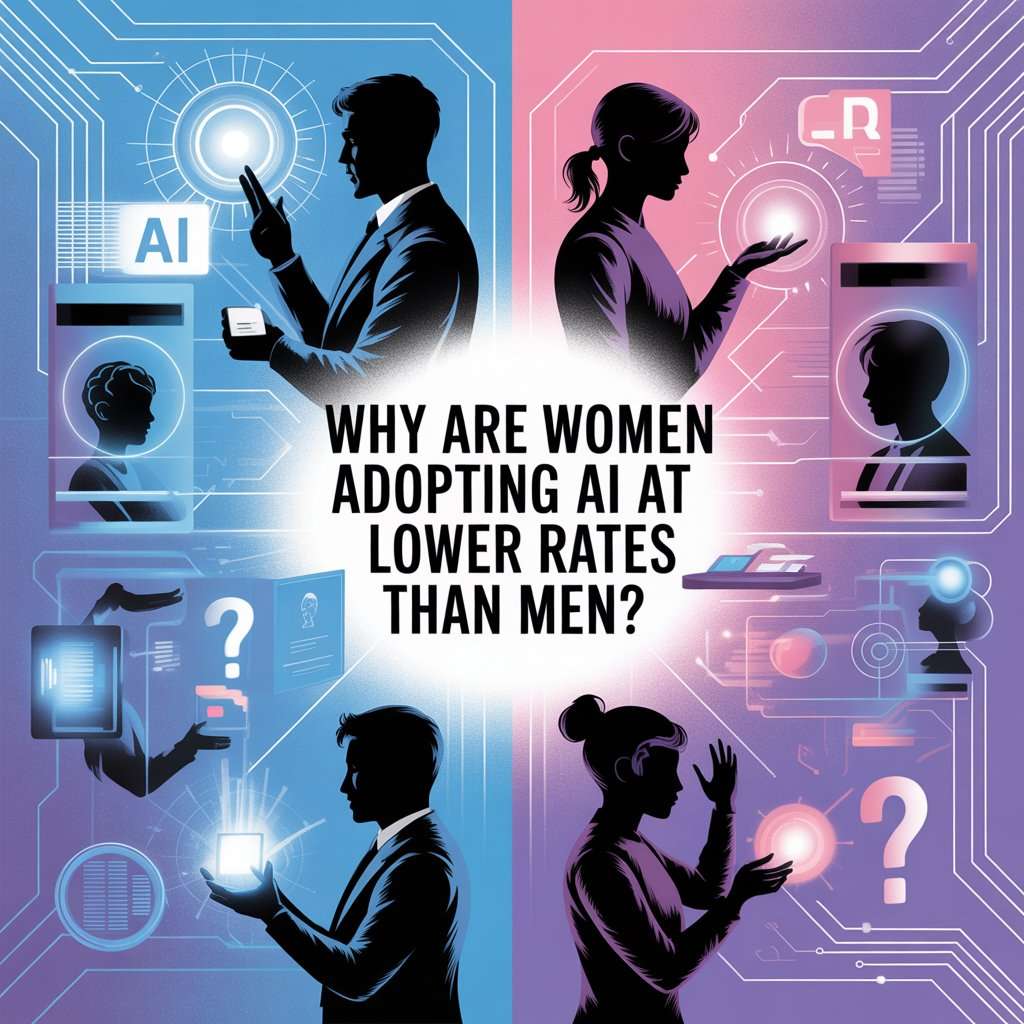
Generative AI is reshaping the workplace faster than most organisations can keep up with. Tools like Claude, ChatGPT, Copilot, and Gemini are changing how people write, analyse, communicate, and lead. Yet while this revolution accelerates, a troubling pattern is emerging: women are being left behind, not because they lack the skills, but because they are holding back from adopting the tools that are quietly redefining professional value.
In Episode 041 of the Lunch with Leaders podcast, Adaeze Iloeje-Udeogalanya draws on research from Harvard Business School and the World Economic Forum to unpack the gender gap in AI adoption. The numbers are stark, the reasons are specific, and the stakes are too high to ignore.
Listen to Episode 041: Why Are Women Adopting AI at Lower Rates Than Men?
Step 1: Confront the Numbers Honestly
Before addressing the problem, it helps to understand its full size. Research reveals that women are adopting generative AI at 25% lower rates than men. Beyond adoption, women hold only 26% of global AI-related jobs, despite facing higher risks of job automation than their male counterparts.
Read that again. The group most at risk of being displaced by AI is the same group least likely to be building fluency in it. That is not a coincidence. It is a pattern shaped by specific, identifiable barriers — and identifying them is the first step to dismantling them.
Furthermore, this gap does not reflect a lack of capability. Women in STEM are highly educated, technically skilled, and professionally accomplished. Something else is driving the hesitation, and that something else deserves a clear-eyed examination.
Step 2: Name the Real Reasons Behind the Hesitation
Two primary barriers drive the AI adoption gap among women, and both are rooted in values rather than ability.
The first is ethical concern. Many women hesitate to use AI tools because they worry about whether the technology is being used responsibly. Questions about data privacy, bias in AI systems, and the broader social implications of automation are not abstract concerns for most women in STEM. They are professional and moral considerations that shape decision-making. Ironically, the very conscientiousness that makes women strong leaders is the same quality causing them to pause before adopting a tool that their less-cautious colleagues are already running with.
The second barrier is the fear of judgment. Specifically, many women worry about being seen as cheating if they use AI to support their work. This fear is not irrational. In many professional environments, women face higher scrutiny than their male peers, and the risk of being perceived as taking shortcuts carries real professional consequences.
However, while both concerns are understandable, neither justifies staying on the sidelines. The cost of inaction now far outweighs the risk of imperfect adoption.

Step 3: Understand What Is Actually at Stake
The gender gap in AI adoption is not just a personal career issue. It is an economic and systemic one. As organisations build AI strategies, launch AI-related initiatives, and hire for AI-adjacent roles, the professionals who demonstrate fluency and proof of work in this space will win the opportunities. Those who cannot demonstrate that fluency will increasingly be passed over, regardless of their broader experience.
Additionally, there is a workplace bias at play that makes this even more urgent for women. In most organisations, men are promoted based on their potential. Women, by contrast, are judged on their past performance. This means that a man who expresses interest in leading an AI project may be given the opportunity to grow into it. A woman with the same interest but no visible AI track record may be quietly overlooked in favour of someone who appears more ready on paper.
Consequently, waiting until you feel fully prepared before engaging with AI publicly is a strategy that will cost you opportunities you cannot easily get back. Visibility and proof of work matter now, in real time, not after you have privately mastered every tool.
Hear Adaeze break down the economic stakes in full: Listen to Episode 041 of Lunch with Leaders
Step 4: Reframe AI as a Force Multiplier, Not a Replacement
One of the most important reframes in this episode is the distinction between what AI can and cannot do. AI will not replace your humanity. It cannot replicate your years of leadership experience, your deep domain expertise, your ability to manage complex stakeholder relationships, or your judgment in high-stakes moments.
What it can do is amplify everything you already bring. Think of AI as a force multiplier, a tool that takes your existing expertise and extends its reach, speed, and scale. A leader who understands her field deeply and also knows how to use AI effectively can produce, analyse, and communicate at a level that simply was not possible before. That combination is extraordinarily powerful, and it is available to every woman willing to build the fluency.
Moreover, the ethical concerns that cause many women to hesitate are actually an asset in this context. The AI space desperately needs leaders who think carefully about responsible use, about bias, about human impact. Your instinct to ask those questions before diving in is not a weakness. Rather, it is the precise quality that makes you a better AI leader than someone who adopted without thinking. The goal is not to abandon that instinct, but to channel it into leadership rather than avoidance.
Step 5: Get Uncomfortable on Purpose
Knowing that AI matters is not enough. Taking deliberate, consistent action is what actually builds fluency. Adaeze’s first action step in this episode is direct: choose one generative AI tool and use it consistently for the next 30 days.
The key word is consistently. Trying a tool once, getting an imperfect result, and walking away proves nothing except that you tried it once. Real fluency comes from repeated use across different types of tasks. Over time, you learn when to trust the output and when to override it with your own judgment. That calibration is itself a leadership skill, and it only develops through practice.
Start with work-related tasks that feel manageable. Draft a document. Summarise a long report. Prepare talking points for a presentation. Use the output as a starting point, not a final product, and apply your own expertise to refine it. Before long, the tool stops feeling foreign and starts feeling useful. That shift, from uncomfortable to capable, is exactly where you need to be.
This connects directly to what Dwain Robinson modelled in Episode 040 — Dwain Robinson: Bridging the Gap in Special Education: the willingness to step into unfamiliar territory, not because it is easy, but because the problem on the other side is worth solving.
Step 6: Build Visible Proof of Work
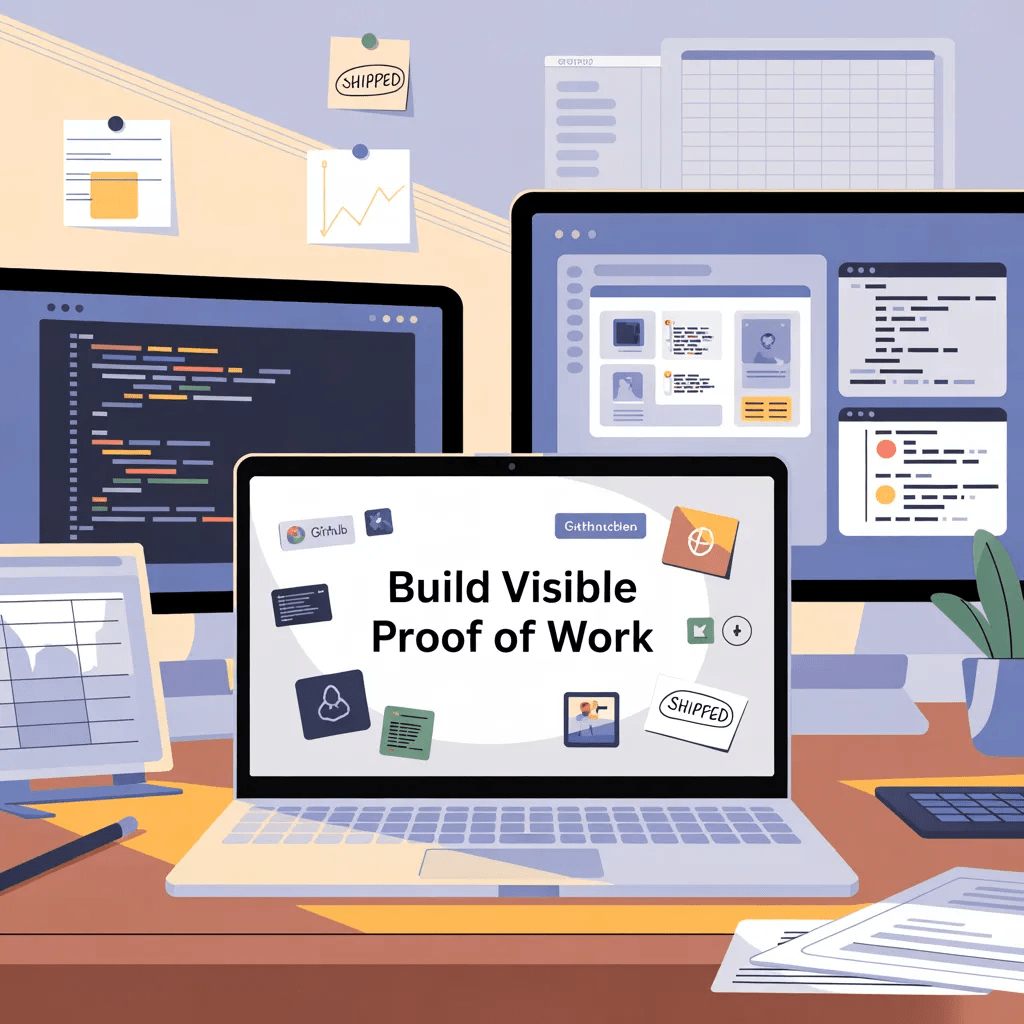
Building AI fluency privately will not protect your career. Decision-makers need to see it. Therefore, alongside developing your skills, you need to make your AI engagement visible in professional spaces.
This does not require announcing every tool you use or performing expertise you have not yet built. Instead, it means letting your AI-assisted work speak in the right rooms. Share insights from an AI-supported analysis in a team meeting. Mention in a stakeholder update that you used AI to model different scenarios. Raise a thoughtful question about AI ethics in a leadership discussion. Each of these small, visible moments builds a picture of someone who is engaged, informed, and ready for more.
As Adaeze explored in Episode 039 — The 10% Rule: Why Hard Work Alone Won’t Get You Promoted in Leadership, productivity accounts for only 10% of career success at senior levels. Visibility and positioning drive the rest. In the context of AI, this principle is especially urgent. The leaders who get tapped for high-visibility AI projects are not necessarily the most technically advanced. They are the ones who have made their fluency visible to the people making those decisions.
Step 7: Find Your AI Community and Stop Navigating This Alone
The AI landscape changes fast. New tools, new capabilities, new use cases, and new risks emerge constantly. Trying to keep up with all of it in isolation is both exhausting and unnecessary.
Instead, find a community of women who are actively building their AI skills and share what you are learning. The African Women in STEM network is one such community — a space where women can exchange knowledge, share best practices, pool resources, and support each other through the learning curve. Collective intelligence moves faster than individual effort, and in a space that is evolving as rapidly as AI, that speed matters.
Beyond knowledge sharing, community also provides accountability. When you commit to learning something alongside others who are doing the same, you are far more likely to follow through than if you are relying solely on personal motivation. Find your people, show up consistently, and build this skill with others rather than in isolation.
Conclusion
The gender gap in AI adoption is real, it is measurable, and it carries serious long-term consequences for women in STEM who do not act now. However, it is also entirely closeable, not through a single dramatic move, but through consistent, deliberate, visible action taken one step at a time.
Your ethical instincts are an asset, not a barrier. Also, your expertise is the foundation that makes AI genuinely powerful in your hands. Your leadership experience is exactly what the AI era needs more of, not less. The only thing standing between where you are now and where you need to be is the willingness to get uncomfortable on purpose and start building.
The future of work is being shaped right now. Step into it with intention, with community, and with the full weight of everything you already know.
Ready to close the gap? Listen to Episode 041 now: Why Are Women Adopting AI at Lower Rates Than Men?
Catch up on these connected episodes too: