
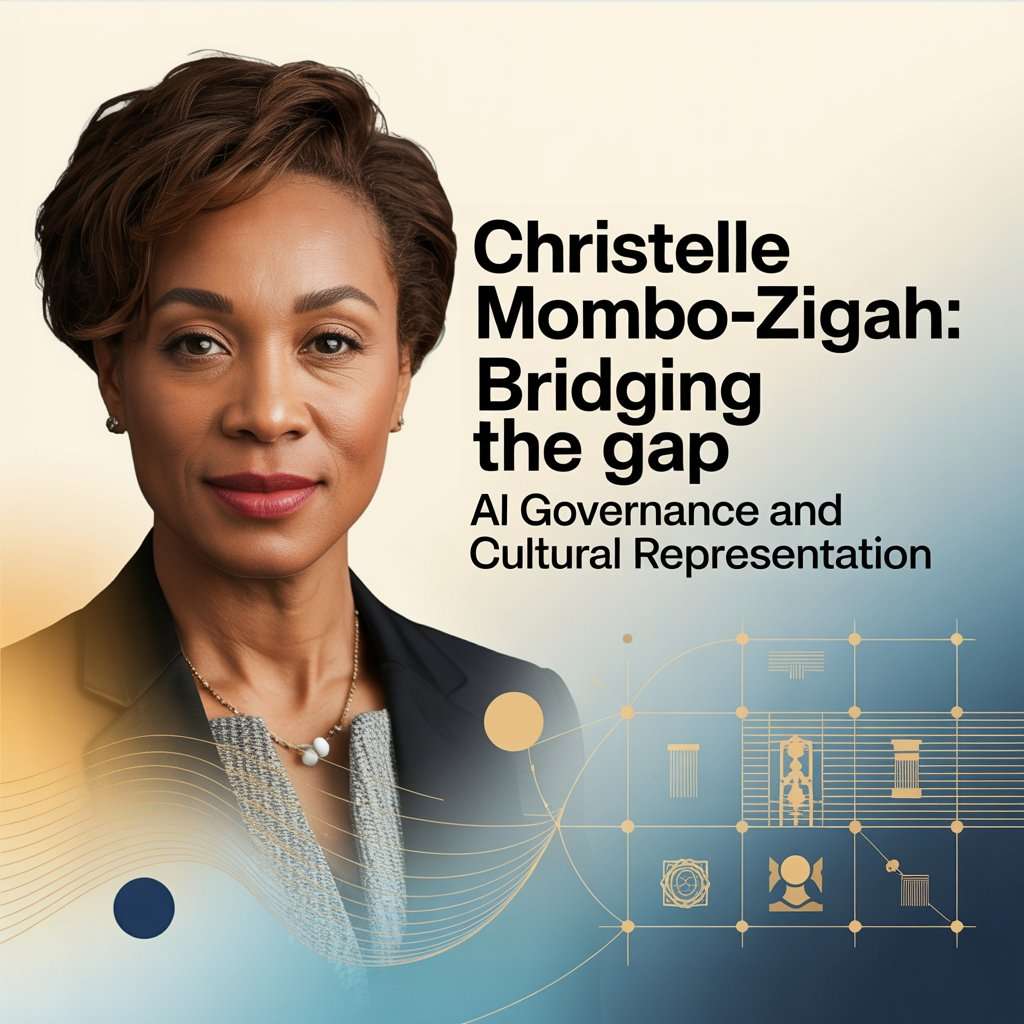
What happens when the technology built to connect people erases them instead? For Christelle Mombo-Zigah, that question stopped being theoretical the moment a collaboration tool automatically removed her afro during a video call. That experience did not just frustrate her. It radicalised her.
In Episode 042 of the Lunch with Leaders podcast, Adaeze Iloeje-Udeogalanya sits down with Christelle, a global tech leader and AI founder, to explore the urgent intersection of artificial intelligence, cultural identity, and governance. From co-founding FairScan AI to launching Style My Crown, Christelle’s journey from AI user to AI builder is a masterclass in turning personal harm into systemic change.
Listen to Episode 042: Christelle Mombo-Zigah: Bridging the Gap, AI Governance and Cultural Representation

Step 1: Name the Problem
Before solving any problem, you must first be willing to name it clearly. Christelle does exactly that with the term digital colorism: the pattern by which AI systems distort, erase, or diminish the cultural and physical identities of Black and brown people.
During the COVID pandemic, collaboration tools automatically erased her afro in video calls. AI headshot generators lightened her skin tone without her consent. These were not isolated glitches. They were symptoms of a much deeper structural failure: AI systems trained on data that did not adequately represent the full range of human appearance, identity, and experience.
Critically, digital colorism is not just an aesthetic problem. In healthcare, AI diagnostic tools trained on predominantly light-skinned datasets produce less accurate results for darker-skinned patients. As Christelle explains, this translates directly into misdiagnoses and preventable deaths in Black and brown communities. That is not a minor software bug. That is a life-or-death governance failure.
How to apply this: Pay attention to the moments when technology does not work for you in the way it works for others. Notice when a tool produces outputs that feel wrong, reductive, or simply absent of your reality. Those moments of friction are data. They point toward gaps that someone needs to fill — and that someone could be you.
Step 2: Stop Optimising Broken Tools and Start Building Your Own
Once Christelle recognised the pattern of digital colorism, her first instinct was to find workarounds. She tried to optimise the tools she had, to adjust settings, to find filters, to make the existing technology work for her experience. Eventually, however, she arrived at a conclusion that changed everything: optimising someone else’s broken tool gives you no real agency.
That realisation pushed her from user to builder. Rather than continuing to adapt herself to systems that were not designed with her in mind, she began designing systems that started with her cultural context as the baseline. That shift in orientation is the foundation of everything she has built since.
This is a principle that extends far beyond AI tools. Across industries and institutions, women of colour in STEM consistently encounter systems, structures, and standards that were not built with them in mind. The conventional response is to adapt, to work around the gaps, to make yourself fit. Christelle’s example offers a different response entirely: build something better.
How to apply this: Identify one tool, system, or process in your professional life that consistently fails to serve your experience. Ask honestly whether the gap is fixable from the inside, or whether it points to a deeper structural absence. If it is the latter, that absence is an opportunity. Someone needs to build the solution. It might as well be you.

Step 3: Understand Why AI Governance Is Failing and Who Needs to Fix It
FairScan AI, the responsible AI governance platform Christelle co-founded, exists because the current governance landscape has a critical blind spot. Most AI safety policies are written by people who have not personally experienced the harms those policies are meant to prevent.
Consequently, the frameworks being built to govern AI reflect a narrow set of perspectives. They are shaped primarily by people whose identities were well-represented in the training data. These are people who have never had their skin lightened by an algorithm. They have never been misdiagnosed because a medical AI could not read their body accurately. As a result, those frameworks miss things. They miss them not because the people writing them are malicious. Rather, lived experience is irreplaceable, and its absence creates gaps. No amount of technical expertise can fully compensate for those gaps.
This is precisely why the presence of Black women and women of colour in AI governance is not a diversity initiative. It is a safety requirement. The people most harmed by AI bias are the most qualified to identify it, name it, and design systems that prevent it.
How to apply this: If you work in or adjacent to AI, actively seek out governance conversations and insert your perspective into them. You do not need a formal governance title to ask hard questions in a product meeting, to flag a bias risk in a model review, or to advocate for more diverse training data. Your presence in those conversations is not optional. It is necessary.
Hear Christelle explain the governance gap in her own words: Listen to Episode 042 of Lunch with Leaders

Step 4: Use AI as a Strategic Multiplier, Not Just a Productivity Tool
Throughout the episode, Christelle consistently reframes how women should think about AI. Most conversations about AI adoption focus on productivity: how to draft faster, summarise quicker, or automate repetitive tasks. While those applications have value, they represent only a fraction of what AI makes possible for women who are building careers and ventures in competitive spaces.
Used strategically, AI allows you to build in public by documenting and sharing your expertise at a pace that would otherwise require a full content team. It also allows you to outsource tasks that do not require your specific judgment. That frees your time and attention for the work that genuinely needs you. Perhaps most powerfully, AI accelerates market intelligence. It compresses research and learning that would traditionally take years into a much shorter timeline. That acceleration makes it possible to enter rooms that once required decades of credentialing.
For women in STEM who are building ventures, seeking advancement, or trying to establish authority in new spaces, this is transformative. AI does not level the playing field entirely. However, used with intention and strategic clarity, it significantly narrows the gap between where you are and where you are trying to go.
As Adaeze explored in Episode 041 — Why Are Women Adopting AI at Lower Rates Than Men?, the gender gap in AI adoption carries serious professional consequences. Christelle’s work illustrates the flip side of that reality: women who do adopt AI strategically gain access to opportunities and influence that simply were not available before.
How to apply this: Move beyond using AI for basic productivity tasks. Identify one strategic application: building your public profile, accelerating research in a new domain, or generating market intelligence for a venture you are building. Use AI to do in weeks what would otherwise take months, and invest the time you save into the work that only you can do.
Step 5: Reclaim Cultural Ownership in Digital Spaces
Style My Crown, Christelle’s virtual try-on platform for Black hair, was not built as a side project. It was built as an act of reclamation.
The beauty industry has long profited from Black hair, Black aesthetics, and Black cultural identity. Yet it has rarely returned that value to Black communities. Digital beauty platforms have largely replicated this dynamic. They offer tools that centre European beauty standards. Most treat Black hair as an afterthought, if they address it at all. Style My Crown challenges that pattern directly. It celebrates Black identity, serves Black consumers, and aims to return financial ownership of the Black beauty market to Black hands.
Launching during Black History Month was a deliberate choice. It placed the platform’s debut within a moment of cultural recognition and amplified its message about who gets to define, profit from, and celebrate Black beauty in digital spaces.
Beyond the product itself, Style My Crown represents a broader principle: cultural representation in technology is not just about inclusion. It is about ownership. Being included in someone else’s platform is meaningful. Building your own is transformative.
How to apply this: Examine the digital spaces you inhabit professionally and personally. Ask who built them, whose experiences they centre, and who profits from them. Then ask what it would look like to build something that genuinely centres your community, not as a niche add-on, but as the core design assumption. That question is where the most important ventures begin.
Step 6: Raise the Next Generation of Builders, Not Just Consumers
One of the most forward-looking moments in Christelle’s conversation with Adaeze involves her approach to raising her daughters. Rather than simply limiting their screen time, she actively redirects their relationship with technology from passive consumption to active creation.
Her daughters build apps. They write and self-publish books. They engage with digital tools not as entertainment but as instruments of expression and creation. In doing so, Christelle is giving them something that most children who grow up consuming technology never receive: the experience of being a maker rather than an audience.
This matters because the children who grow up understanding how to build with technology will be the ones who shape it. If the next generation of AI builders looks more like the full diversity of humanity than the current generation does, the systems they build will be more accurate, more equitable, and more humane. That outcome does not happen by accident. It happens because people like Christelle make deliberate choices about how they raise and mentor young people.
How to apply this: Think about the young people in your life, whether your own children, mentees, students, or community members. Find one way to shift their relationship with technology from consumption to creation this month. It does not need to be complex. Encourage them to build something simple, solve a small problem, or create something that did not exist before. That single shift in orientation plants a seed that can grow into something significant.
This connects to what Dwain Robinson shared in Episode 040 — Dwain Robinson: Bridging the Gap in Special Education, where he built GoalBridge from his lived experience as a parent navigating broken systems. Both Dwain and Christelle model the same fundamental principle: the people closest to a problem are the most qualified to solve it.
Step 7: Borrow Courage From Community and Stop Building Alone
Black women who build in underrepresented spaces face real and specific challenges. Navigating AI governance requires thick skin and strategic clarity. Launching a cultural tech platform without traditional venture backing demands resourcefulness and resilience. Co-founding a responsible AI company while the mainstream industry moves fast and breaks things takes courage. None of these paths are easy. More importantly, none of them should be walked alone.
Christelle is direct about the role community plays in her work. Coalitions of like-minded builders provide more than moral support. They shorten the learning curve by pooling knowledge. In addition, they reduce the cost of getting started by sharing resources. They open doors through collective networks that no individual could access alone. And sometimes, they introduce you to your next co-founder.
For women in STEM who are building, leading, or simply trying to stay current in a rapidly changing landscape, community is not a soft benefit. It is a strategic asset. The African Women in STEM network exists precisely to provide this kind of support: a space where women can borrow courage from each other, share what they are learning, and build with the backing of a community that wants to see them succeed.
How to apply this: Identify one community you can commit to showing up in consistently, not just passively observing, but actively contributing. Share what you know. Ask the questions you are afraid to ask alone. Offer the connection that might help someone else. That kind of reciprocal community is what makes bold moves feel possible, and what makes the inevitable hard moments survivable.
Conclusion
Christelle Mombo-Zigah’s episode is one of the most urgent and galvanising conversations in the Lunch with Leaders catalogue. Her work sits at the intersection of everything that matters most in the current moment, This includes AI governance, cultural identity, digital equity, and the question of who gets to shape the technology that is shaping all of us.
Her message is clear and unambiguous. Stop waiting for a seat at a table that was not built for you. Also, stop optimising tools that treat your identity as an afterthought. Stop consuming technology passively while others use it to build power, influence, and wealth.
Instead, name the harms you experience clearly and precisely. Build solutions that start from your lived experience. Use AI strategically to accelerate your impact. Reclaim cultural ownership in digital spaces. Raise the next generation to create rather than consume. And do all of it within a community of people who are building alongside you.
The AI era is being designed right now. The only question is whether the people most affected by its failures will be in the room when the decisions get made. Whether they will be building their own rooms entirely.
Listen to the full conversation with Christelle Mombo-Zigah: Episode 042 — Christelle Mombo-Zigah: Bridging the Gap, AI Governance and Cultural Representation
Catch up on these connected episodes too: