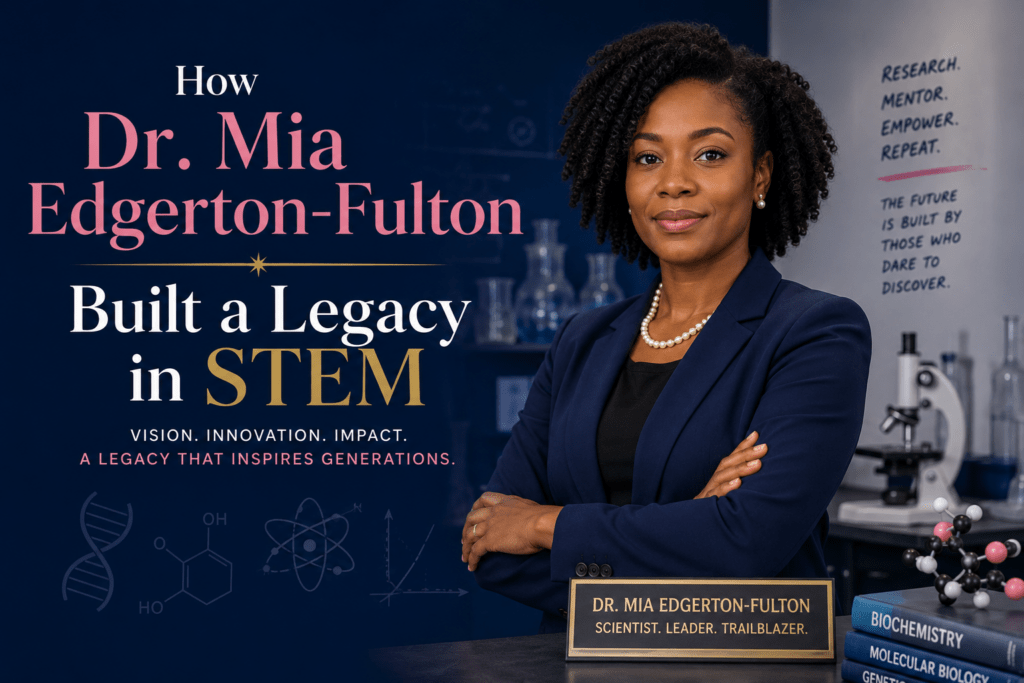
What does a career in STEM actually look like when you refuse to be confined by it? For Dr. Mia Edgerton-Fulton, the answer is a biomedical science career that has expanded into entrepreneurship, education, mentorship, and brand building, all at once.
In Episode 036 of the Lunch with Leaders podcast, Dr. Mia joins host Adaeze Iloeje-Udeogalanya to talk about founding NeuroPlex, launching Scholarly Scouts, navigating rejection in biotech, and why authenticity is the most underrated career strategy in STEM. Her story is a practical blueprint for any woman in STEM who wants to do more than survive her field. She wants to shape it.
1. Recognise That Your Science Career Does Not Have to Stay in the Lab
The first and most important mindset shift Dr. Mia models is this: a background in STEM is not a box. It is a foundation.
Dr. Mia is a biomedical scientist by training, but her career trajectory has taken her into entrepreneurship through NeuroPlex, her biotech venture focused on natural medicinal solutions, and into education through Scholarly Scouts, her mentorship initiative for students navigating the graduate school application process. Neither of those ventures required her to leave science. They required her to expand what she believed science could do.
This matters especially for women in STEM who feel the pull toward broader impact but worry that stepping outside the traditional academic or research path means leaving their expertise behind. It does not. It means leveraging it differently.
How to apply this: Ask yourself honestly where your knowledge could create value outside its current container. You do not have to have a fully formed plan. Start with the problem you keep noticing and the population you keep wanting to serve. Dr. Mia saw gaps in mentorship access for students from under-resourced communities. She saw an opportunity to create natural health solutions from her research background. Both of those observations became ventures.
2. Let Rejection Redirect You, Not Define You
Entering the biotech space as a woman, and particularly as a Black woman, means encountering a lot of doors that do not open on the first knock. Dr. Mia is honest about this in the episode.
Her framing, however, is worth paying close attention to: “It’s going to be a lot of people that are going to say no starting out, but just because it’s rejection doesn’t mean it’s over. Sometimes rejection is protection.”
This is not toxic positivity. It is a practical strategy for staying in the game long enough to find the doors that are actually right for you. Dr. Mia went on to win pitch competitions and secure support from the National Science Foundation, neither of which would have happened if early rejections had caused her to stop.
How to apply this: Keep a record of your rejections alongside your wins. Not to dwell on them, but to track the full picture of what building something actually looks like. Most founders and leaders who eventually break through have rejection histories that would surprise you. The ones who succeed are simply the ones who did not let rejection be the last word.
This connects directly to the conversation in Episode 035 — The Confidence Myth: Rethinking Leadership Mindset and Influence for Women in STEM, where Adaeze breaks down how real confidence is built through action and experience, not through avoiding difficulty. Rejection is part of that experience, not a detour from it.
3. Build Your Brand Before You Think You Are Ready
One of the most consistent barriers women in STEM face when it comes to visibility is the belief that they need to have more, achieve more, or know more before they are qualified to share their journey publicly. Dr. Mia pushes back on this directly.
She talks about the importance of showing up online and in professional spaces even when the audience is small, even when the post does not go viral, even when not everyone engages. Her point is precise: “Sometimes everybody isn’t going to give you 500 likes and that’s okay. Regardless, someone sees it and it resonates with someone.”
Visibility in STEM is not just a personal career tool. It is a community resource. When Dr. Mia shows up as a scientist who looks like her, she is filling a gap that she herself experienced growing up: “I never saw a scientist, let alone one that looks like me.” That visibility has ripple effects that go far beyond the individual.
How to apply this: You do not need a polished personal brand strategy to start. You need consistency and honesty. Share the experiment that failed, the lesson from the pitch that did not land and the milestone, however small it feels. Building a brand is not about performing success. It is about authentic storytelling that lets others see themselves in your journey.
Hear Dr. Mia share her journey in her own words: Listen to Episode 036 of Lunch with Leaders
4. Master the Art of Communicating Your Science to Non-Scientists
This is one of the most underdeveloped skills among STEM professionals, and one of the most critical for anyone who wants to build a venture, attract funding, lead a team, or influence policy.
Dr. Mia is clear about what works: “The way to do that is think big picture wise… connect with people in a way where they can resonate with the experience.”
Investors do not fund mechanisms. They fund impact. The person sitting across from you at a pitch meeting or a stakeholder briefing does not need to understand the molecular pathway. They need to understand why it matters, who it helps, and what changes because of it. Getting to that level of clarity requires you to understand your own work more deeply, not less.
How to apply this: Practice explaining your work without jargon to someone completely outside your field. Not as a dumbing-down exercise, but as a discipline. If you cannot explain the human impact of what you are working on in two minutes to a non-scientist, that is a communication gap worth closing. Start with the problem. Move to the solution. End with the stakes.
This skill also underpins the leadership presence conversation in Episode 032 — Stop Over-Explaining and Start Leading with Conviction. The ability to communicate with clarity and conviction, without drowning your audience in detail, is a leadership skill as much as it is a science communication skill.
5. Seek Mentorship and Perspective Outside Your Own Field
One of the more counterintuitive pieces of advice Dr. Mia offers in this episode is about where to look for support and guidance when you are building something new.
The instinct for many scientists and researchers is to seek mentors who are deeply embedded in their specific field. That makes sense for technical guidance. But for entrepreneurship, strategy, and navigating new spaces, some of the most valuable perspective comes from people who are not in your lane at all.
Dr. Mia is direct about this: “Always be willing to be open-minded and don’t think that just because someone is not in your particular area or your space that they can’t bring value to what you’re trying to do.”
A founder from a completely different industry may have cracked the exact distribution problem you are facing. An educator outside STEM may have insights on community building that translate directly to your mentorship initiative. A communications professional may help you see your own story in a way that your scientific peers cannot.
How to apply this: Audit your current network and mentorship relationships. Ask yourself honestly whether everyone in your circle thinks the way you do, operates in the same space, and faces the same kinds of challenges. If the answer is yes, that is a signal to actively seek out perspectives from adjacent fields. The diversity of thought that comes from cross-disciplinary relationships is one of the most underused assets available to women building in STEM.
6. Use Mentorship as Both a Receiving and a Giving Practice
Scholarly Scouts, Dr. Mia’s mentorship initiative, was born directly from her own experience of not having adequate guidance during the graduate school application process. She grew up in a small town with limited access to the kind of strategic support that makes a real difference at that stage, and she decided to build what she did not have.
Her description of the work is telling: “This is where the real work happens when you truly help shape the trajectory of students because they’re at a point where they’re finding themselves.”
Mentorship in this framing is not a transaction. It is a point-of-intervention that can alter someone’s entire trajectory. And for women in STEM who have navigated systems that were not designed with them in mind, the institutional knowledge and lived experience you carry is genuinely rare and genuinely valuable to the next generation.
How to apply this: You do not need to build a formal initiative to mentor meaningfully. Start with one student, one conversation, one honest account of how you navigated a challenge they are currently facing. The formalisation can come later. What matters first is the willingness to make your experience available to someone who needs it.
7. Embrace Pivots as Part of the Plan, Not a Departure From It
Perhaps the most quietly powerful message in Dr. Mia’s episode is this one: your career does not have to look like a straight line to be successful. In fact, it probably should not.
Her own path has moved through research, entrepreneurship, education, and community building, and she does not present any of those transitions as failures or detours. They are simply the shape that a dynamic, responsive career takes when you stay honest about where your energy and impact belong.
Her words on this are straightforward: “Life is dynamic. It always changes. And it’s all about us adjusting to what’s going on in our lives.”
This is an important message for women in STEM who have been trained, explicitly or implicitly, to believe that the only valid career path is the one that moves in a single direction toward a single destination. The pressure to stay on a narrow track can cause talented people to stay in roles and environments that no longer serve them, long past the point where a pivot would have been generative.
How to apply this: Treat each pivot as a data point, not a setback. Ask what it is teaching you, what it is making possible, and what it is preparing you for. Dr. Mia’s entrepreneurial work grew directly from her scientific expertise. Her mentorship work grew directly from her own unmet needs as a student. Nothing was wasted. It was all preparation.
8. Let Authenticity Lead
Everything in Dr. Mia’s episode circles back to one core principle, and she states it plainly: “Authenticity leads the way. As long as you’re authentic and you’re genuine, the right opportunities will come to you.”
This is not a soft statement. It is a strategic one. In a professional landscape where women in STEM are often pressured to perform confidence, shrink their personalities to fit rooms that were not built for them, or present a curated version of success, authenticity is an act of resistance and a competitive advantage at the same time.
The right collaborators, funders, mentees, and communities are attracted to people who are genuinely themselves. Performing a version of yourself that you think others want to see is exhausting, unsustainable, and ultimately less effective than simply being clear about who you are and what you are building.
How to apply this: Return regularly to the question of whether what you are presenting publicly, professionally, and personally actually reflects who you are and what you care about. Not as a perfectionism exercise, but as a calibration check. Authenticity is not a destination. It is a practice.
Conclusion
Dr. Mia Edgerton-Fulton’s career is proof that a STEM background is not a ceiling. It is a springboard. From founding a biotech venture to building a mentorship pipeline for underserved students, she has demonstrated that the most impactful scientists are often the ones who refuse to stay only in the lab.
The lessons from her episode are practical, specific, and immediately applicable, whether you are a graduate student figuring out your next step, a mid-career professional wondering whether to take the entrepreneurial leap, or a senior leader thinking about the legacy you want to leave.
Reject the rejections that are really redirections. Build your visibility before you feel ready. Communicate your science like it matters to people, because it does. Seek perspective from outside your field. Give back through mentorship. Embrace the pivots. And above all, lead with who you actually are.
Listen to the full conversation with Dr. Mia: Episode 036 — Dr. Mia Edgerton-Fulton: Building Influence in Biotech and The NeuroPlex Blueprint for Empowering Scholars