
AI is not coming. It is already here. And the biggest challenge most organisations face is not the technology itself — it is getting people to actually use it.
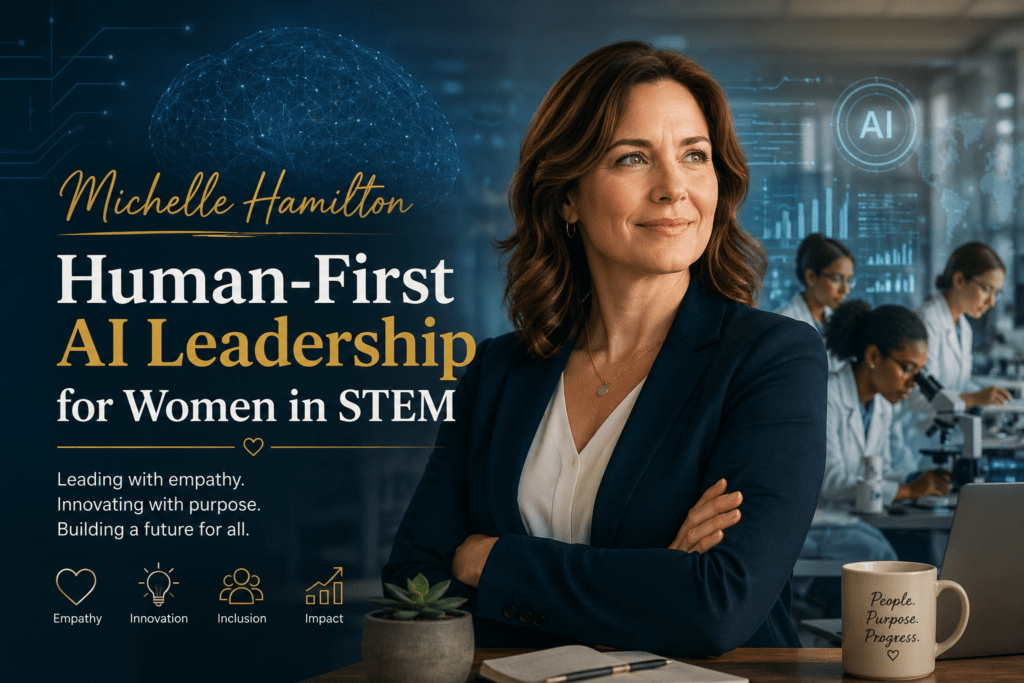
In Episode 038 of the Lunch with Leaders podcast, Adaeze Iloeje-Udeogalanya sits down with Michelle Hamilton, AI adoption strategist and Head of AI Adoption and Change Management at AnswerRocket. Michelle brings a refreshingly human lens to a conversation that is too often dominated by technical jargon and hype.
From practical tips for overcoming AI intimidation to a fascinating parallel between glass sculpting and AI strategy, this episode is a masterclass in leading with clarity, curiosity, and confidence in a space that is moving faster than most organisations can keep up with.
Listen to Episode 038: Michelle Hamilton: Human-First Leadership in AI Adoption
Step 1: Understand the Real Problem With AI Adoption
Before you can lead effectively in the AI space, you need to understand where the actual breakdown is happening. And according to Michelle, it is not where most people think.
The conversation around AI in most organisations focuses on tools, platforms, and investment. Companies are spending significant money on AI technology. But spending on technology and actually integrating it into how people work are two very different things. As Michelle explains, the biggest risk in AI right now is the gap between what organisations invest in and what their workforce actually adopts.
That gap is not a technology problem. It is a people problem. It is driven by fear, poor change management, and rollouts that prioritise IT infrastructure over human experience. When employees feel intimidated, confused, or left behind by AI implementation, they disengage. The tools sit unused. The investment fails to deliver. And the organisation falls further behind.
How to apply this: Whether you are a leader overseeing an AI rollout or an individual contributor trying to find your footing in an AI-enabled workplace, start by asking the human question first. Who is affected by this change? What are they afraid of? What do they need to feel capable and supported? The answers to those questions matter more than the technical specifications of the tool you are implementing.
Step 2: Shift From IT-Led to Human-First Implementation
The traditional model for rolling out new technology in organisations is IT-led. A tool gets selected, a training session gets scheduled, a policy gets written, and employees are expected to adapt. This model has always had limitations. In the context of AI, it is particularly inadequate.
Michelle advocates for a fundamentally different approach: meeting employees where they are. Rather than starting with the technology and working backward to the people, a human-first approach starts with the people and works forward to the technology. It asks what employees actually need to do their jobs better, what barriers are getting in the way, and how AI can genuinely serve those needs rather than simply being added to the workflow as an additional burden.
This approach requires a different kind of leadership than most organisations are used to. It requires people who can translate between the technical and the human, who can hold space for uncertainty and resistance, and who can build the kind of trust that makes people willing to try something new even when it feels uncomfortable.
How to apply this: If you are in a position to influence how AI is introduced in your organisation, push for adoption strategies that centre the employee experience. Advocate for piloting tools with real users before full rollout, building feedback loops that surface genuine concerns, and framing AI not as a replacement for human expertise but as a tool that extends it. The framing matters as much as the functionality.
Step 3: Reframe Your Relationship With AI Personally
Before you can lead others through AI adoption, you have to work through your own relationship with the technology. And for many women in STEM, that relationship is more complicated than it might appear on the surface.
Michelle is honest about the intimidation factor. AI moves fast. The language around it can feel exclusionary. And there is a persistent cultural narrative that positions AI as the domain of a particular kind of technologist, one that does not always look like the women listening to this podcast.
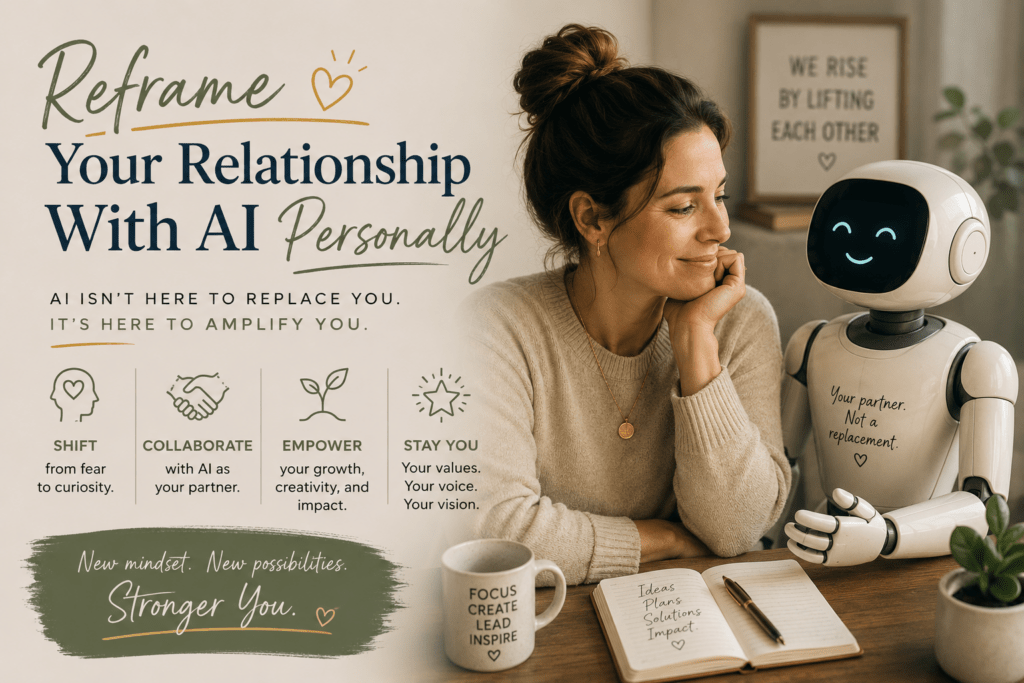
Her reframe is simple and powerful: today is the worst AI is ever going to be. Every day it gets a little bit better, a little more capable, a little easier to use. Which means there is no perfect moment to start. The best time to begin building your relationship with AI is right now, with whatever level of comfort or discomfort you currently have.
How to apply this: Start with curiosity rather than competence. You do not need to understand how large language models work to begin using AI effectively. What you need is a willingness to experiment, to try things, to see what works and what does not, and to build familiarity through repeated, low-stakes interaction. That is where confidence comes from — not from waiting until you feel ready, but from starting before you do.
This connects directly to what Adaeze explored in Episode 037 — The Comfort Trap: How Being “Too Valuable” Can Stall Your Leadership and Career Growth. The same principle applies: waiting for certainty before acting is not caution. It is stagnation dressed up as preparation.
Hear Michelle share her human-first approach in full: Listen to Episode 038 of Lunch with Leaders
Step 4: Start Small, Start Personal, Start Now
One of the most practical and immediately actionable pieces of advice in this episode is Michelle’s recommendation to begin your AI journey with personal, low-stakes tasks rather than jumping straight into high-pressure professional applications.
Her example is disarmingly simple: take a picture of your pantry and ask your AI to suggest recipes. Plan a trip. Ask for book recommendations. Use it to brainstorm a gift for a friend. The specific task does not matter. What matters is that you begin interacting with AI in an environment where the stakes are low enough that getting it wrong is not a problem, only a learning experience.
This matters because the skills you build through casual personal use, knowing how to frame a prompt, how to iterate on a response, how to push back when the output is not quite right, are exactly the skills you will apply when you bring AI into your professional work. The muscle is the same. You are just building it in a lower-pressure environment.
How to apply this: Choose one personal task this week and use AI to help you with it. Do not overthink the choice. The goal is simply to interact, to get comfortable with the back-and-forth, and to notice what happens when you experiment without pressure. Once that feels natural, bring the same iterative approach to one work task. Then another. That is how adoption actually happens — incrementally, experientially, and on your own terms.
Step 5: Name Your AI and Make It Conversational
This step might feel small, but the psychology behind it is significant.
Michelle’s first practical homework for listeners is to name their AI. Her own AI assistant is called George. The act of giving your AI a name shifts the dynamic of the interaction in a subtle but meaningful way. It moves the experience from transactional to conversational. And conversational interactions tend to produce better outputs, because you engage differently when you are talking with something rather than querying it.
This is part of a broader principle Michelle articulates throughout the episode: the more human you make your AI interactions, the more useful they become. Voice mode is another expression of this. Rather than typing prompts at a desk, Michelle uses AI voice mode while driving to brainstorm, debrief after meetings, and think through problems out loud. The AI becomes a thinking partner, available in the pockets of time that would otherwise be unproductive.
How to apply this: Go into the settings of whichever AI tool you use and give it a name today. Then try one voice mode session this week, even if it is just five minutes of thinking out loud during a commute or a walk. Notice how differently you engage when the interaction feels more like a conversation and less like a search query. That shift in engagement is where the real value of AI starts to show up.
Step 6: Bring Your Existing Strengths Into the AI Space
One of the most empowering threads running through Michelle’s conversation with Adaeze is the argument that women, and particularly women in STEM, already possess many of the skills that matter most in the AI era. Not in spite of their backgrounds, but because of them.
Michelle draws a striking parallel between her background as a glass sculptor and her work in AI strategy. Both disciplines, she explains, require a clear vision of the outcome you are working toward, a deep understanding of the constraints you are working within, and an iterative process of testing, adjusting, and refining. You cannot force glass to do something the physics will not allow. You cannot force AI to produce value without understanding what it can and cannot do. In both cases, the practitioner who succeeds is the one who works with the material rather than against it.
For women in STEM, this parallel matters. The analytical thinking, the comfort with complexity, the ability to hold multiple variables simultaneously, the communication skills that come from translating technical work for non-technical audiences — these are precisely the capabilities that effective AI leadership requires.
How to apply this: Stop waiting for a specific AI credential or technical qualification before you claim space in this conversation. The skills you already have are relevant. Audit what you bring to the table: systems thinking, stakeholder communication, iterative problem-solving, change management. Then start connecting those existing strengths explicitly to the AI conversations happening in your organisation. You are more prepared than you think.
This theme runs through Episode 036 — Dr. Mia Edgerton-Fulton: Building Influence in Biotech and The NeuroPlex Blueprint for Empowering Scholars, where Dr. Mia similarly demonstrates how a scientific background translates into entrepreneurial and leadership value far beyond the laboratory.
Step 7: Position Yourself as an Architect of the AI Era, Not a Bystander
The final and most important shift Michelle advocates for is one of identity. The question is not whether AI will change your field. It will. The question is whether you will be someone who shapes that change or someone who adapts to it after the fact.
Michelle is direct in her encouragement to women: lean into your strengths as communicators and leaders. Be the person in your organisation who bridges the gap between technical capability and human adoption. Be the one who asks the questions about impact, about equity, about who gets left behind when AI is rolled out without a human-first lens. Those questions need to be asked, and the people who ask them well are the ones who build lasting influence in this space.
As she frames it, the opportunity for women right now is not just to use AI. It is to lead the conversation about how AI gets used, who it serves, and what values it reflects. That is an architectural role, and it is wide open.
How to apply this: Identify one conversation about AI in your organisation or professional community where your voice is currently absent. A working group, a planning meeting, a policy discussion. Make a deliberate decision to show up to that conversation and bring your full perspective, not just your technical knowledge but your human insight, your communication skills, and your understanding of what adoption actually requires. That is what leadership in the AI era looks like.
Conclusion
AI is not a threat to women in STEM. It is an invitation. An invitation to lead differently, to bring a human lens to a conversation that desperately needs one, and to claim space in a space that is still being defined.
Michelle Hamilton’s episode is a reminder that the most important skills in the AI era are not purely technical. They are human. The ability to communicate with clarity, to build trust across difference, to manage change with empathy, and to hold a clear vision while navigating real constraints — these are the skills that will determine who shapes the future of AI in organisations, and who simply watches it unfold.
You do not need to wait for a qualification, a title, or a perfect moment of readiness. Start with your pantry. Name your AI. Try voice mode on your commute. And then bring that same spirit of curious, iterative, human-first engagement into every professional conversation about AI that you are part of.
Listen to the full conversation with Michelle Hamilton: Episode 038 — Human-First Leadership in AI Adoption
Catch up LinkedIn: Michelle Hamilton
- Instagram: @sparkaistrategy
- Facebook: Spark AI Strategy