
You have been putting in the work. Long hours, strong results, consistent delivery. You show up, you perform, and you wait for the right people to notice. But the promotion has not come. The high-visibility project went to someone else. And you are starting to wonder whether working harder is even the answer anymore.
It is not. And in Episode 039 of the Lunch with Leaders podcast, Adaeze Iloeje-Udeogalanya explains exactly why. Your actual productivity, the work you deliver every single day, accounts for just 10% of your career success. The other 90% is about something most high-performing women in STEM have been actively avoiding: being seen.
This episode is your practical guide to changing that.
Listen to Episode 039: The 10% Rule: Why Hard Work Alone Won’t Get You Promoted in Leadership
Step 1: Acknowledge That Invisibility Is Not a Virtue
The first thing to name honestly is where this pattern comes from. Most high-achieving women did not wake up one day and decide to make themselves invisible. They were taught, directly or indirectly, that talking about their work was arrogant. That letting the results speak for themselves was the humble, professional, respectable thing to do. That good work would eventually be recognised without having to draw attention to it.
That belief is not just unhelpful. It is actively costing you.
When you deflect praise, give vague five-word answers about what you do, and stay quietly in the background while your work delivers results, you are not being humble. You are withholding information from the people who make decisions about your career. Decision-makers cannot advocate for someone they cannot clearly see. And if the clearest picture they have of you is that you complete tasks reliably, that is the ceiling they will assign to you.
How to apply this: The next time someone asks what you have been working on, resist the instinct to minimise. Do not say “oh, just the usual” or “nothing major.” Practice giving a real answer, one that reflects what you actually contributed and why it mattered. That is not bragging. That is professional communication.
Step 2: Replace “Self-Promotion” With “Positioning”
A significant part of what makes visibility feel uncomfortable for women in STEM is the language attached to it. Self-promotion sounds boastful. It carries connotations of ego, of overstating, of making yourself bigger than you are. No wonder so many high-performers want nothing to do with it.
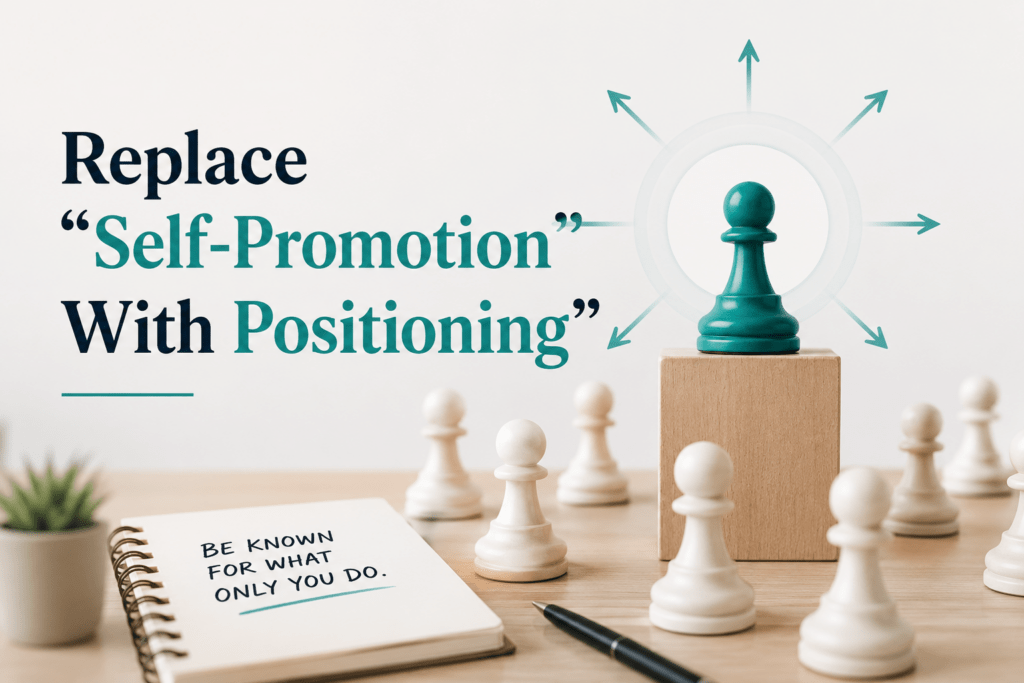
Adaeze offers a reframe that changes everything: stop calling it self-promotion and start calling it positioning.
Positioning is not about inflating your value. It is about ensuring that the accurate picture of your value reaches the people who need to see it. It is a leadership responsibility, not a personality trait. When you position yourself effectively, you are not doing something uncomfortable or ethically ambiguous. You are doing your job as someone who wants to grow and lead.
How to apply this: Every time you feel the resistance that comes with “I don’t want to seem like I’m bragging,” replace the thought. Ask instead: do the decision-makers in my organisation have an accurate picture of what I contribute? If the answer is no, that is not humility. That is a communication gap — and closing it is your responsibility.
This mindset connects directly to what Adaeze unpacked in Episode 037 — The Comfort Trap: How Being “Too Valuable” Can Stall Your Leadership and Career Growth. Staying quiet about your contributions is another form of the same trap — remaining comfortable in a role while the requirements for advancement pass you by unnoticed.
Step 3: Absorb the 10% Rule and Rethink Where You Invest Your Energy
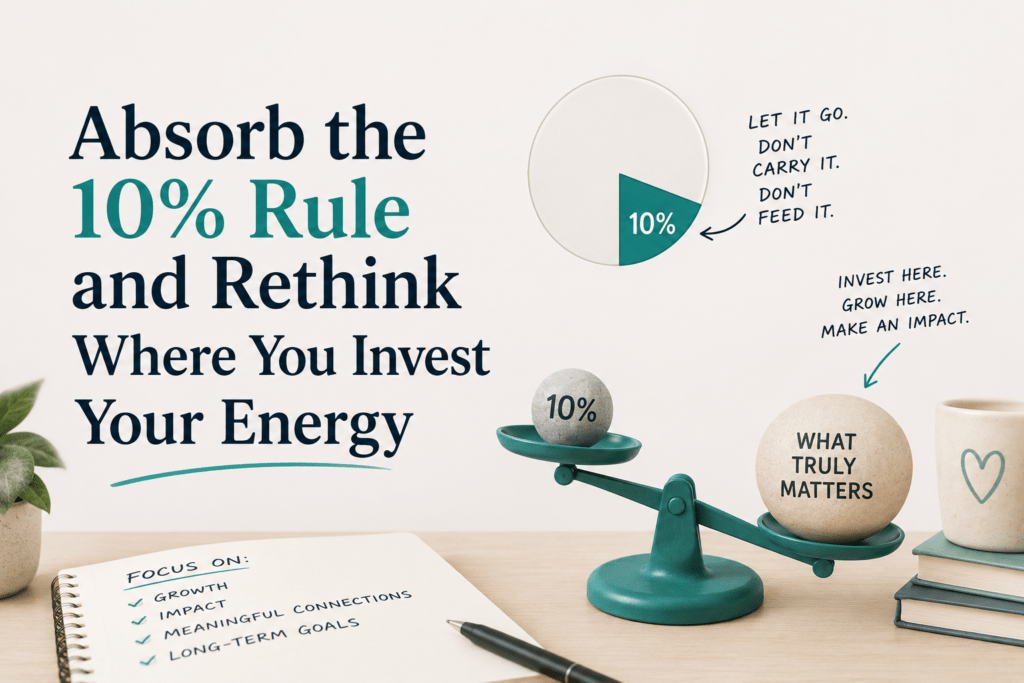
Here is the number that reframes everything: your actual productivity, the quality of your technical output, your ability to deliver on tasks, accounts for approximately 10% of your career success at senior levels. The remaining 90% comes from visibility, positioning, personal brand, and strategic relationships.
This is not an opinion. It is a pattern that plays out consistently across organisations and industries, and Adaeze has seen it up close through her work with mid-career and senior women in STEM.
Think about what this means practically. If you are spending 95% of your professional energy on delivery and 5% on visibility and positioning, you are investing heavily in the smallest driver of advancement and barely touching the largest one. You are optimising for the wrong metric.
How to apply this: Do an honest audit of where your professional energy currently goes. Not where you think it should go, but where it actually goes. How much time and intentionality do you bring to making your work visible, building strategic relationships, and shaping how others perceive your leadership potential? If that number is close to zero, that is where the work is.
Hear Adaeze break down the 10% Rule in full: Listen to Episode 039 of Lunch with Leaders
Step 4: Track Your Wins Before You Need Them
One of the most practical assignments Adaeze gives in this episode is deceptively simple: write down three significant things you have delivered or accomplished in the last 30 to 90 days.
Most high-performers cannot do this easily. Not because the wins are not there, but because they have never made a habit of capturing them. Achievements get completed and immediately forgotten as the next task takes over. Performance review season arrives and suddenly you are trying to reconstruct months of impact from memory, and the result is always a thinner, vaguer account than the reality deserved.
Tracking your wins is not an exercise in ego. It is a professional practice that ensures you always have accurate, specific, and compelling material available when visibility opportunities arise, whether that is a performance review, a conversation with a senior stakeholder, or a chance encounter with a decision-maker who asks what you have been working on.
How to apply this: Start this week. Do not wait for performance review season. Open a document, a note on your phone, a journal, whatever works for you, and write down three things you have delivered in the last 30 to 90 days. Be specific. Include the context, the action you took, and the impact it had. Then make this a weekly habit. Five minutes at the end of each week to capture what you delivered and why it mattered.
Step 5: Upgrade the Language You Use About Your Own Work
This step is where positioning becomes visible in the most immediate and practical way. The words you use to describe your work shape how others perceive your leadership, often more powerfully than the work itself.
There is a significant difference between saying “I supported the team on the project” and “I led the cross-functional team that delivered the project.” Both sentences might describe the same reality. But only one of them communicates leadership. Only one of them positions you as someone operating at the next level.
Adaeze is specific about this in the episode: passive words like “managed,” “supported,” “assisted,” and “helped” consistently undercut the impact of what you are describing. Active leadership words like “led,” “designed,” “drove,” “built,” and “delivered” communicate agency, ownership, and authority.
How to apply this: Go back to the list of wins you wrote in Step 4. Read through each one and look for passive language. Anywhere you wrote “I helped” or “I was involved in” or “I worked on,” ask whether that accurately reflects your contribution. If you led, say you led. Also, if you designed, say you designed. If you drove the outcome, say you drove it. This is not exaggeration. It is precision — and precision in how you describe your work is a leadership skill.
Step 6: Use AI to Help You Articulate Your Value
Here is where technology becomes a practical tool for positioning, and it is one of the most underused applications of AI for professional women in STEM.
Many women find it genuinely difficult to write about their own accomplishments in a way that feels both accurate and appropriately strong. There is a persistent inner editor that softens the language, hedges the claims, and pulls back from anything that feels too bold. AI tools like Claude, ChatGPT, or Gemini can help you work around that inner editor.
The approach is straightforward. Describe what you did in plain, honest language, exactly as you would tell a trusted colleague, and ask the AI to help you reframe it using strong leadership language appropriate for a performance review, a senior stakeholder update, or a LinkedIn post. The AI is not inventing anything. It is helping you translate your real contributions into the language of leadership.
How to apply this: Take one item from your wins list and paste it into an AI tool with a simple prompt: “Help me reframe this accomplishment using strong, active leadership language suitable for a senior audience.” Review the output, keep what rings true, adjust what does not, and use the result as a starting point. This is not about letting AI speak for you. It is about using it to overcome the internal resistance that keeps your real contributions undersold.
This approach pairs naturally with what Michelle Hamilton shared in Episode 038 — Human-First Leadership in AI Adoption, where she encourages women in STEM to start using AI for practical, low-stakes tasks and build from there. Articulating your professional value is exactly the kind of task AI is well-suited to support.
Step 7: Make Visibility a Consistent Practice, Not a Once-a-Year Event
The biggest mistake most professionals make with positioning is treating it as something you do during performance review season and then forget about for the rest of the year. That approach almost never works, because by the time the review comes around, decision-makers already have a fixed perception of who you are and what you contribute. A single document cannot undo twelve months of invisibility.
Visibility is a practice. It happens in the small, consistent moments across the year: the meeting where you share a strategic perspective instead of staying quiet, the email where you briefly highlight the outcome of a project you led, the conversation with a senior leader where you mention what you are working on and why it matters, the post on LinkedIn where you share a lesson from your professional experience.
None of these moments is dramatic on its own. But accumulated over weeks and months, they build a clear, consistent, and compelling picture of who you are as a leader. That picture is what gets you advocated for, considered for advancement, and invited into high-visibility opportunities.
How to apply this: Choose one small visibility action to take this week. Not a complete personal brand overhaul, just one thing. Share an update on a project outcome with a stakeholder who needed to know. Write one post that reflects your professional perspective. Ask to present your team’s work in a meeting where you would normally stay in the background. Do it once. Then do it again next week. That is how the 90% gets built.
Conclusion
Hard work matters. It will always matter. But at the level you are trying to reach, hard work is the baseline, not the differentiator. Every person competing for the same opportunities as you is also working hard. What separates the ones who advance from the ones who plateau is not the quality of their output. It is the visibility of their leadership.
The 10% Rule is not a reason to work less. It is a reason to invest more deliberately in the part of your career that you have been undervaluing. Stop waiting for your work to speak for itself. Start positioning yourself with the same intention and precision you bring to everything else you do.
Track your wins. Upgrade your language. Use the tools available to you. And show up consistently in the spaces where decisions about your career are being made, not just in the spaces where the work gets done.
You are not the best-kept secret in your organisation. Not anymore.
Listen to the full episode and start positioning yourself for what is next: Episode 039 — The 10% Rule: Why Hard Work Alone Won’t Get You Promoted in Leadership
Book a Strategy Call: If you’re ready to stop being the best-kept secret, book a complimentary Authority Shift strategy call with Adaeze (link in show notes).
Visit the African Women in STEM Website
Watch Adaeze Iloeje-Udeogalanya’s TEDX Talk on YouTube





1 thought on “The 10% Rule: Why Hard Work Alone Will Never Get You Promoted”
Pingback: How to Lead a Team When You Are Younger Than Everyone Else - African Women in STEM