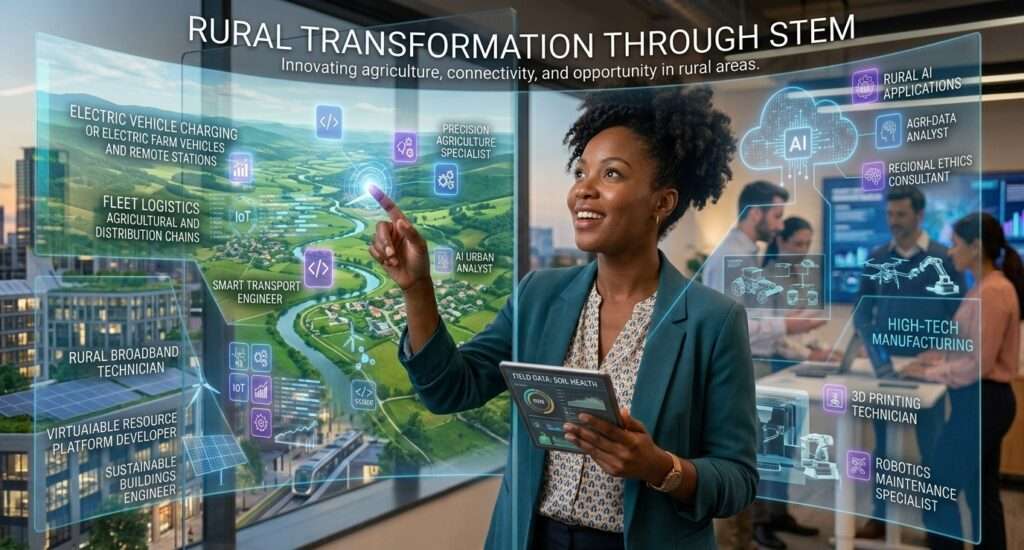
When people talk about STEM, the conversation usually gravitates toward Silicon Valley, research universities, and gleaming tech campuses in major cities. Rural communities rarely make the headline. Yet some of the most meaningful STEM work happening right now is taking place far from those centres, in villages, farming communities, and small towns that most people overlook entirely.
STEM is not just changing what happens in laboratories and boardrooms. It is changing what happens in daily life for communities that never had access to reliable healthcare, clean energy, quality education, or economic opportunity. And in Africa, where by 2030 the continent will hold the world’s largest youth population, that transformation carries enormous stakes.
This article explores exactly how STEM reshapes rural communities, why it matters more urgently than most people realise, and what role women in STEM play in making that transformation stick.
The Problem STEM Is Solving in Rural Areas
Rural communities face a specific set of challenges that do not appear on most corporate radar screens. Healthcare facilities sit hours away from many villages. Farmers grow food without access to real-time weather data or soil analysis. Children learn in classrooms without qualified science teachers or functioning laboratories. Women and girls carry disproportionate burdens in water collection, caregiving, and subsistence farming, which limits their time and opportunity for education.
These are not small problems. They compound across generations. A girl who cannot access quality science education in a rural school never becomes the engineer who could have designed a better water system for her community. A farmer who lacks access to climate data makes planting decisions that a single drought wipes out. The cycle continues.
STEM breaks that cycle. However, it only does so when communities at the centre of the problem participate in building the solutions. That distinction matters enormously.
Agriculture: Feeding Communities With Better Data
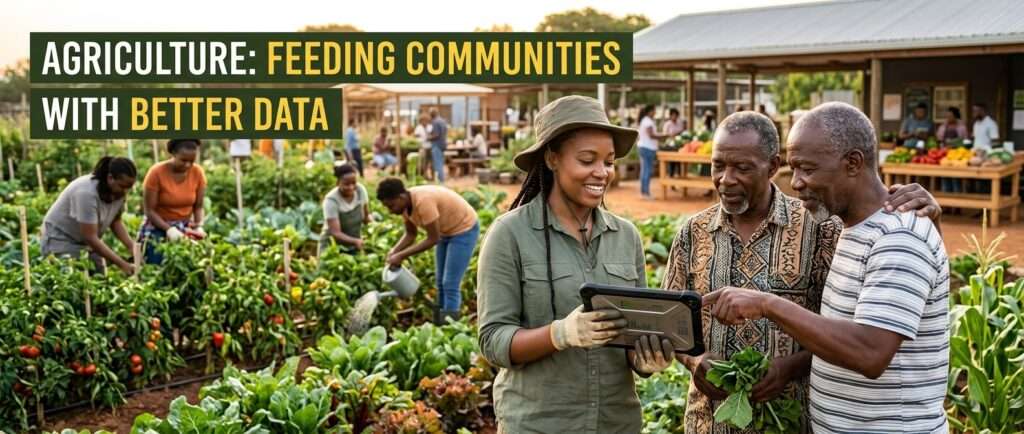
Agriculture employs the majority of rural populations across Africa and other developing regions. Yet most smallholder farmers make critical decisions based on instinct, tradition, and guesswork rather than data.
STEM is changing that fundamentally. Soil sensors now measure nutrient levels and moisture content in real time. Drone technology maps crop health across large areas in hours rather than days. Mobile applications deliver weather forecasts, planting calendars, and pest management advice directly to farmers’ phones in local languages.
Research-driven innovation continues to shape how communities respond to long-standing development challenges, from health and food security to climate resilience, jobs, and sustainable industry. Climate-smart farming systems, youth-led agribusinesses, and locally rooted nutrition solutions are among the most promising innovations emerging right now across the continent.
The impact is direct. A farmer who knows three days in advance that a dry spell is coming adjusts her planting schedule and protects her harvest. A cooperative that shares soil analysis data across twenty small farms optimises fertiliser use and reduces cost. These are not theoretical improvements. They represent the difference between a family eating well and a family not eating at all.
Healthcare: Bringing Medical Access to Remote Areas
Distance kills in rural healthcare contexts. A pregnant woman who lives four hours from the nearest hospital faces risks that her urban counterpart never encounters. A child with malaria who cannot reach treatment within hours faces consequences that proper early care would have prevented entirely.
STEM addresses this gap in several ways. Telemedicine platforms connect rural patients with doctors in distant cities through smartphones. Mobile diagnostic units bring basic blood tests, ultrasounds, and health screenings directly into communities. AI-powered health tools guide community health workers through diagnosis and treatment protocols even without a physician present.
Oluwasoga Oni, co-founder and CEO of MDaaS Global, is expanding diagnostic healthcare access in ways that bring reliable testing to communities that never had it. This kind of innovation does not just treat illness. It shifts the entire relationship between rural communities and healthcare from reactive emergency response to proactive prevention.
Women in STEM play a particularly critical role here. Women understand the specific healthcare challenges that other women in rural communities face, including maternal health, reproductive care, and the invisible burden of caring for sick family members while managing households. That lived understanding shapes better solutions than any outside expert can design from a distance.
Education: Building the Pipeline From the Ground Up
Africa will need an additional 23 million STEM graduates by 2030 to fill critical positions in engineering, healthcare, and other essential fields. That pipeline begins in rural classrooms. However, rural schools consistently face shortages of qualified science and mathematics teachers, functional laboratories, and digital resources.
Closing this gap requires creativity. Digital learning platforms now deliver quality STEM content to students in areas with limited connectivity. AI-powered tools like the Chanak platform, built by the African STEM Education Initiative, give secondary students in Uganda access to curriculum-aligned learning materials through a web-based system that works within local infrastructure constraints.
The Digital Employment and Entrepreneurship Apprenticeship equips rural youth with essential 21st-century skills for education, employment, and entrepreneurship. Unlike a short boot camp, this is a six-month, hands-on field apprenticeship, followed by intensive training in employment and business startup planning. Graduates earn globally recognized certifications, including Cisco, IBM, Google, and AWS.
Programmes like these do something that textbook reforms alone cannot accomplish. They connect rural youth to global credentials and global career pathways without requiring relocation. A young woman in rural Kenya who completes a certified data science programme does not have to move to Nairobi to access the global market. As explored in our piece on How to Build a Global STEM Career While Living in Africa, geography no longer determines opportunity the way it once did. Building that understanding into rural education transforms what young people believe is possible for themselves.
Energy: Powering Communities That Never Had Power
Reliable electricity fundamentally changes what a community can do. Schools cannot run computer labs without power. Health clinics cannot refrigerate vaccines or run diagnostic equipment without power. Small businesses cannot operate equipment, charge devices, or work after dark without power.
Across rural Africa, solar energy is the STEM solution that most directly addresses this. Solar panels combined with battery storage systems bring reliable electricity to villages that national grids have never reached. Solar-powered water pumps replace the hours of manual labour that women and girls spend every day collecting water from distant sources.
Engineers who understand both the technical requirements of solar systems and the social dynamics of rural communities design solutions that actually get adopted and maintained. That intersection of technical knowledge and community understanding is exactly where women in STEM consistently excel. Solutions built from genuine community insight outperform solutions imposed from outside without it.
Environmental Solutions: Addressing Climate From the Ground Up
Rural communities sit on the front line of climate change. Erratic rainfall disrupts planting seasons. Desertification reduces arable land. Flooding destroys homes and harvests. The people least responsible for causing climate change bear its heaviest consequences.
STEM offers tools for both adaptation and mitigation. Environmental monitoring systems track soil degradation, water table levels, and air quality in real time. Sustainable construction methods use locally available materials to build homes that withstand flooding. Youth-led agribusinesses and climate-smart farming systems represent some of the most forward-looking innovations shaping what comes next.
What makes these solutions different from top-down environmental interventions is local ownership. When rural communities participate in designing the monitoring systems, selecting the crop varieties, and building the structures, they maintain them. Ownership drives sustainability in ways that external implementation rarely achieves.
Women in STEM: The Multiplier Rural Communities Need Most
Research consistently demonstrates that investing in women produces outsized returns for entire communities. When women gain education, income, and decision-making power, their families benefit directly. Children stay in school longer. Nutritional outcomes improve. Healthcare decisions become more proactive. Community savings and investment increase.
Women in STEM who return their skills to rural communities amplify all of these effects. The engineer who designs a better water pump for her home village does not just solve a technical problem. She changes the time available to every girl in that village who previously spent hours each day collecting water. Those hours become time for studying, for earning, for creating.
Single mothers leverage technology to create thriving livelihoods while remaining close to their families, demonstrating how skills-based learning transforms lives in rural East Africa. This is not a peripheral benefit of STEM education. It is one of its most powerful outcomes.
However, getting women into STEM and ensuring they can bring those skills back to serve rural communities requires intentional support. As explored in The Broken Rung: Visibility and Support for Women in STEM, women face structural barriers at every transition point in their STEM careers. Rural women face compounding versions of those barriers, including limited access to secondary science education, cultural pressure against pursuing technical fields, and lack of visible role models in their communities.
Addressing these barriers is not charity work. It is one of the highest-return investments any community, organisation, or government can make in rural transformation.
What Real Transformation Requires
STEM transforms rural communities most effectively when it meets several conditions. Without these, technology arrives, produces temporary results, and fades once external funding or attention disappears.
Community participation from the start: Solutions designed with community members rather than for community members get adopted and maintained. Participation is not a nice-to-have. It is the difference between a water pump that works for twenty years and one that breaks down and sits rusting after six months.
Local ownership of skills: Technology tools without the knowledge to maintain them create dependency rather than empowerment. Every STEM intervention in a rural community should include training that builds local capacity to sustain what gets built.
Women and girls at the centre: Programmes that include women consistently produce better outcomes for entire communities. Programmes that specifically target girls in rural areas build the next generation of local problem-solvers.
Long-term commitment over short-term projects: Rural transformation does not happen in six months. The organisations and governments that produce lasting change show up consistently over years and build relationships with communities rather than delivering interventions and leaving.
Connection to global opportunity: Rural youth who gain STEM skills should not have to choose between using those skills and staying connected to their communities. Designing pathways that allow talented young people to build careers while maintaining community roots prevents the brain drain that hollows out rural areas.
Frequently Asked Questions
How does STEM help rural farming communities specifically?
STEM brings precision agriculture tools, including soil sensors, weather forecasting applications, and drone mapping, directly to smallholder farmers. These tools help farmers make better planting and harvesting decisions, reduce waste, adapt to climate variability, and increase yields without requiring expensive inputs.
What role does mobile technology play in rural STEM transformation?
Mobile phones function as the primary access point for STEM tools in many rural communities. Telemedicine platforms, agricultural advisory services, digital learning resources, and weather data all reach rural communities through mobile devices. As smartphone penetration increases across Africa, mobile-first STEM solutions reach increasingly large populations.
Why is it important for women in STEM to work in rural communities?
Women bring understanding of the specific challenges that rural women and girls face. Solutions designed with that understanding serve communities more effectively. Additionally, women in STEM working visibly in rural communities create role models that challenge cultural barriers preventing girls from pursuing technical education.
What are the biggest barriers to STEM adoption in rural areas?
The primary barriers include unreliable electricity and internet connectivity, shortage of qualified STEM teachers, lack of culturally relevant learning materials, limited funding for community-based programmes, and cultural norms that discourage girls from pursuing technical fields. Effective programmes address multiple barriers simultaneously rather than tackling them in isolation.
How can someone support STEM transformation in rural communities?
Support organizations like Asante Africa Foundation, Stem Garage Africa, and the African STEM Education Initiative that work directly in rural communities. Mentor rural students through online platforms. Advocate within your own organization for partnerships and funding directed toward rural STEM programmes. And if you have technical skills, consider volunteering them toward community-based projects that solve real problems.
Conclusion
Rural communities are not waiting for the rest of the world to notice them. Across Africa and other developing regions, young people are building solutions to real problems using STEM skills, community knowledge, and the kind of determination that only comes from having skin in the game.
The question is not whether STEM can transform rural communities. It already does, wherever investment and intention align with genuine community participation. The question is how quickly that transformation scales and who leads it.
Women in STEM who bring their skills back to the communities that shaped them are not making a sacrifice. They are making a strategic choice to solve problems that matter, build solutions that last, and create the visibility that inspires the next generation of rural girls to believe that STEM belongs to them too.