

Here is something that more African STEM professionals need to hear right now. You do not have to leave the continent to build a global career. The rules changed. Geography no longer dictates opportunity the way it once did, and Africa is no longer on the sidelines of the global STEM conversation.
By 2026, Africa’s role in the global digital workforce continues to grow. Remote-first strategies, digital transformation, and demographic dynamics position the continent as a strategic talent partner for global companies. Companies across Europe, North America, and the Middle East actively seek skilled African professionals right now. The talent is here. The demand is real. What bridges the gap is strategy.
So if you are a STEM professional sitting in Lagos, Nairobi, Accra, Cairo, or Johannesburg wondering whether a global career is genuinely within reach, this article is for you. Let’s get into it.
The Shift Is Already Happening
A few years ago, working for an international company almost always meant relocating. Today, that assumption no longer holds. Remote work has erased many of the geographical barriers that once limited career opportunities. For African professionals, this shift has created access to employers willing to pay competitive international salaries while allowing employees to remain in their home countries.
Key African talent hubs including Morocco, Tunisia, Egypt, Kenya, Nigeria, Senegal, Ghana, Madagascar, and South Africa produce thousands of graduates each year in software engineering, IT infrastructure, data analysis, and cybersecurity. Global companies are paying attention. Companies that invest early in African talent ecosystems gain a long-term competitive advantage.
This is your moment. The question is whether you position yourself to take full advantage of it.
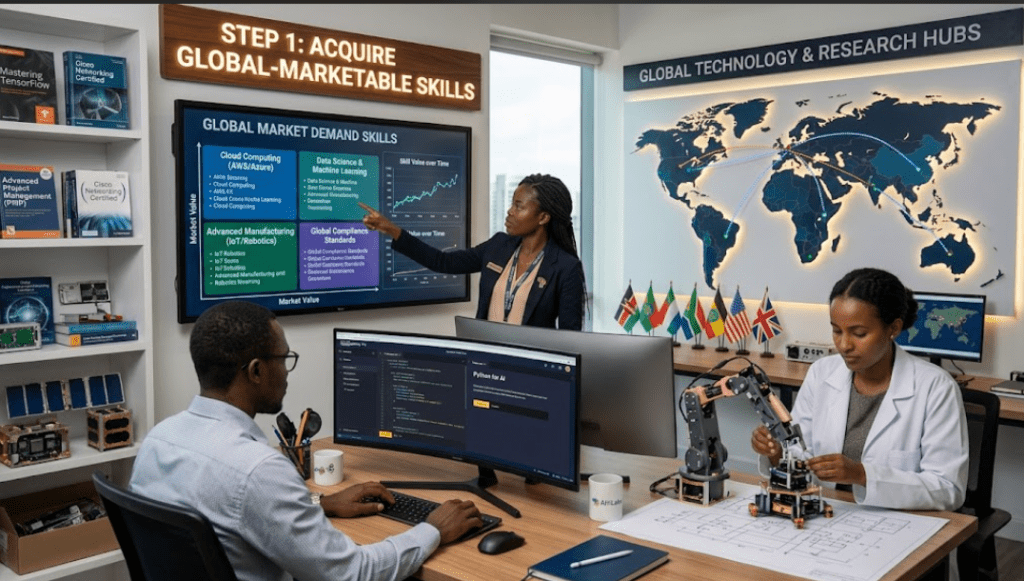
Step 1: Build Skills the Global Market Actually Pays For
Passion matters, but so does market demand. Before anything else, honestly assess whether your current skill set aligns with what international employers actively seek.
Right now, global companies hire aggressively in specific areas. These include:
- Software engineering and full-stack development
- Data science and machine learning
- Cybersecurity
- Cloud architecture and DevOps
- AI development and prompt engineering
- Product management
- UI/UX design
The demand for technology professionals continues to grow faster than the available talent pool. This transformation represents one of the greatest career opportunities Africa has ever experienced.
If your skills currently sit outside these areas, consider the adjacent skills you can build. A mechanical engineer can learn CAD software used globally. A biomedical professional can build data analysis skills. A civil engineer can layer on project management certifications that travel internationally. The baseline technical degree matters. Layering marketable skills on top of it is what creates global relevance.
Additionally, AI fluency is no longer optional. Employers across every sector now expect professionals to understand how to use AI tools productively. Start building that fluency today through consistent, practical use. If you need a starting point, check out our piece on Why Are Women Adopting AI at Lower Rates Than Men? for context on why this skill matters urgently for women in STEM specifically.
Step 2: Build a Professional Brand That Travels
Your skills might be exceptional, but if no one outside your city knows you exist, those skills will not open global doors. Building a visible professional brand is the work that makes everything else possible.
Professional visibility often leads to unexpected career opportunities. Career opportunities frequently emerge through relationships rather than traditional job applications.
Start with LinkedIn. Optimise your profile fully, write a headline that clearly states your expertise and what you offer, and post consistently about your work, your insights, and your projects. Global recruiters actively search LinkedIn for African talent, and your profile is often the first thing they see before they ever speak to you.
Beyond LinkedIn, consider building a portfolio. If you write code, put projects on GitHub. Also, if you work in data, publish case studies. If you do design, showcase your work on Behance or a personal website. Concrete proof of what you can do speaks far louder than a list of qualifications on a CV.
Also think about writing or speaking publicly about your area of expertise. Publishing articles, speaking at virtual conferences, or contributing to open-source projects builds credibility that crosses borders. A global employer who has read your work already trusts you before the first conversation.
Step 3: Understand That Positioning Decides Who Gets the Opportunity
Here is a truth that many talented African STEM professionals have not fully absorbed yet. The most skilled person does not always get the global opportunity. The most visible and strategically positioned person does.
This is not unfair. It is simply how opportunity works. Building an international remote career involves developing a combination of technical expertise, communication skills, professional branding, and continuous learning. Developers who understand how to position themselves effectively can compete confidently in the global marketplace.
Think carefully about the story your professional presence tells. Does your LinkedIn profile communicate clearly what problems you solve and for whom? Does your portfolio demonstrate real-world impact rather than just listing theoretical knowledge? Do the people in your professional network know what you are looking for and what you bring?
If the answers are no, then your positioning needs work. Positioning is not about exaggerating your experience. It is about making your actual value legible to people who have never met you and making it easy for them to advocate for you. This connects directly to the ideas explored in The Story They Tell: Transforming How Decision Makers See You, where Adaeze breaks down how the narrative decision-makers carry about you shapes every opportunity that reaches you or does not.
Step 4: Network Across Borders Deliberately
Networking feels uncomfortable for many people. Do it anyway. The professionals who build global careers almost always credit relationships as the factor that made the difference.
Networking does not mean collecting random connections. It involves meaningful participation within professional communities.
Join global professional communities in your field. Organisations like the Society of Women Engineers, IEEE, the International Society for Data Science, and field-specific Slack and Discord communities all connect African professionals with peers and employers across the world. Contribute meaningfully to those communities. Share your knowledge generously. Ask thoughtful questions. Show up consistently.
Attend virtual conferences. Many global industry events now offer free or subsidised access to participants in Africa. These events are not just for learning. They are opportunities to meet people who could become collaborators, mentors, sponsors, or hiring managers.
When you connect with someone internationally, focus on building a genuine relationship before making any ask. Comment on their work. Share resources they would find useful. Engage with their ideas. Then, when you eventually have a specific ask, the relationship already exists to support it.
Step 5: Know Where to Find the Opportunities
Knowing that global opportunities exist is one thing. Knowing where to find them specifically is another. Here are the most productive places to look.
LinkedIn Jobs remains the single most effective platform for finding international roles that are open to remote candidates. Use the location filter to search for “remote” and combine it with your target job title and skills.
Toptal, Turing, and Andela specifically connect African and global tech talent with international clients. These platforms pre-vet candidates and match them to projects, which removes much of the friction from the international job search process.
Scouthappy is a curated job board that specifically focuses on opportunities that are genuinely open to African talent, filtering out roles with geographic restrictions that exclude African applicants.
Remote Career Africa specialises in connecting African professionals with vetted global remote jobs, ensuring access to high-quality career opportunities.
GitHub Jobs and We Work Remotely list technical roles from companies across the world that hire remotely. Many of these companies genuinely do not care where you are located as long as you can deliver excellent work.
Apply strategically rather than randomly. Research each company before applying. Understand their product, their culture, and the specific problem you would solve in the role. A targeted, well-researched application consistently outperforms a scattered approach.
Step 6: Communicate With Clarity and Confidence
International employers often name communication as the deciding factor when they choose between similarly skilled candidates. International employers increasingly emphasise interpersonal abilities alongside technical expertise. Remote teams depend on trust, initiative, and clear collaboration.
Strong written communication matters enormously in remote-first environments. Every email, Slack message, pull request comment, and project update communicates something about how you think and how reliable you are. Invest time in developing your written English, particularly in professional and technical contexts.
Spoken communication matters just as much in interviews and video calls. Practice explaining your work clearly and concisely. Avoid jargon when speaking to non-technical stakeholders. Develop the habit of structuring your thinking before you speak, because clarity under pressure signals competence to international employers.
Additionally, learn to navigate time zones proactively. If a company you want to work with operates on a schedule that differs significantly from yours, think through how you would manage overlap hours and communicate your approach during the interview. Companies that hire remotely expect candidates to think about this. Showing them you have already thought it through removes a concern before they raise it.
Step 7: Protect Your Value and Price Yourself Correctly
Many African STEM professionals undercharge for international work out of habit or uncertainty. This is one of the most common and most costly mistakes you can make.
Research market rates for your role and skill level in the markets where you target employment. Sites like Glassdoor, Levels.fyi, LinkedIn Salary, and Payscale provide salary data by role, location, and experience level. Use these benchmarks to set your rates or negotiate your salary from a position of knowledge rather than guesswork.
When working as a contractor or consultant, price your services based on the value you deliver, not on what you think someone in your country typically earns. International clients pay for your expertise, not your location. If you undercharge significantly relative to the market rate, you raise questions about your confidence and your understanding of your own value.
Also think carefully about payment infrastructure. Platforms like Wise, Payoneer, and Grey make it significantly easier to receive international payments as an African professional. Set up these systems before you need them so that payment logistics never become a barrier to closing an opportunity.
Step 8: Keep Learning Consistently
The global STEM market moves fast. The skills that differentiate you today may become standard expectations in eighteen months. Staying current is not optional.
Consistent learning demonstrates adaptability, one of the most valuable qualities in modern technology careers. Dedicate regular time each week to learning, whether through online courses, technical documentation, industry publications, or practical experimentation with new tools.
Certifications from recognised global bodies add credibility to your profile, particularly in fields like cloud computing, cybersecurity, and data science where certifications signal a verified standard of knowledge to international employers. AWS, Google Cloud, Microsoft Azure, and Coursera all offer certifications that carry genuine weight with global hiring teams.
Build learning into your routine rather than treating it as something you do when you have spare time. Spare time almost never comes. Schedule it like any other professional commitment.
The Mindset That Makes All of This Work
Technical skills, positioning, networking, and communication all matter. Underneath all of them, however, sits something even more foundational: the belief that you genuinely belong in global professional spaces.
Many African STEM professionals carry an invisible tax. Years of navigating systems that undersell their worth, educational environments that underfunded their potential, and cultural messages that frame global success as something that happens to other people all leave residue. That residue shows up as hesitation, under-asking, and self-editing in moments when boldness would serve far better.
Reject that residue deliberately. Your training is world-class. Your problem-solving experience is often richer and more diverse than that of your international peers precisely because you have operated with fewer resources and overcome more obstacles. That experience is not a weakness to downplay. It is a strength to name clearly.
Africa is quickly becoming one of the world’s fastest-growing sources of remote talent. Your next employer may not be in your city or even on your continent. With the right preparation, it could be anywhere in the world.
Go claim your seat at that table. It was always yours.
Quick Reference: Tools and Platforms to Get Started
For job searching:
- LinkedIn Jobs (search remote + your role)
- Scouthappy
- Remote Career Africa
- Andela, Toptal, Turing
Building credibility:
- GitHub (for engineers)
- Kaggle (for data scientists)
- Behance (for designers)
- LinkedIn articles and posts
For receiving international payments:
- Wise
- Payoneer
- Grey
For learning and certification:
- Coursera
- edX
- AWS, Google Cloud, and Microsoft Azure certification programmes
- LinkedIn Learning
Conclusion
Building a global STEM career from Africa is not a distant aspiration anymore. It is a practical, achievable goal for professionals who approach it strategically. The demand exists. The tools exist. The communities exist. What determines whether you access this opportunity is whether you invest in building the skills, the brand, the network, and the mindset that make global employers choose you.
Start where you are. Build consistently. Position yourself with clarity. Communicate with confidence. Price your value correctly. And keep learning because everything will continue to shift and the professionals who grow with it are the ones who thrive.