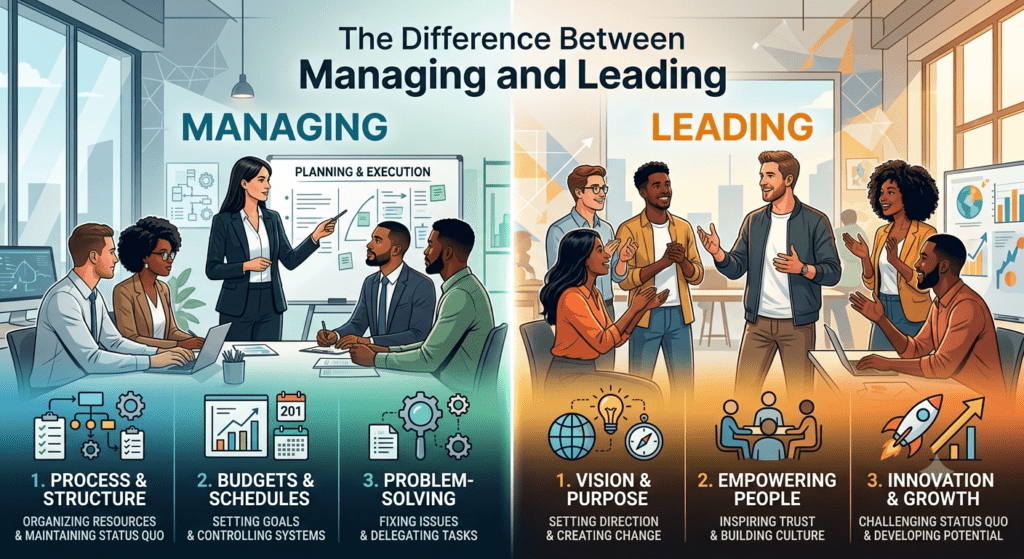
A title does not make a leader. It makes a manager. The distinction sounds simple, yet most organisations conflate the two so consistently that entire leadership development budgets get spent teaching management skills while calling it leadership training. The result is a workforce full of people with leadership titles and very few people who are actually being followed.
In Episode 056 of the Lunch with Leaders podcast, Adaeze Iloeje-Udeogalanya sits down with Bradley Hunt, executive coach and co-founder of The Why Group, to draw a clear, practical line between management and leadership.
Bradley brings decades of organisational development experience to the conversation, including a striking example from U.S. military succession planning that exposes just how superficial most corporate approaches really are. For women in STEM building careers in technical and organisational leadership, this episode offers a precise framework for understanding what actually earns influence, and what merely assigns authority.
Listen to Episode 056: Bradley Hunt: The Difference Between Managing and Leading
Management Is Assigned. Leadership Is Earned
Bradley opens the central distinction of this episode with a definition that reframes how most professionals think about their own roles. Management is a position assigned from above. Someone with organisational authority decides you will manage a team, and the title arrives with that decision regardless of whether the people on your team actually choose to follow you.
Leadership works in the opposite direction. It is defined and conferred by the people below you, not the people above you. You can hold a management title and have zero genuine leadership influence if your team complies with your instructions only because they must, not because they believe in your direction or trust your judgment. Conversely, you can have significant leadership influence with no formal title at all, simply because people choose to follow your example, your judgment, and your vision.
This distinction matters enormously for women in STEM navigating both technical and people-management tracks. A management title is a starting point, not a guarantee. The real work of leadership happens in the daily accumulation of trust, consistency, and demonstrated care that causes people to follow you because they want to, not because an org chart requires them to.
A simple audit: Ask yourself honestly whether your team follows your direction because they believe in it, or because your title requires their compliance. The answer reveals whether you are managing, leading, or both.
Why Most Succession Planning Fails
One of the most pointed critiques in this episode targets a practice that most organisations believe they are doing well: succession planning. Bradley describes the typical corporate approach as “circling the org chart,” a reactive, surface-level exercise where leadership identifies a name on paper shortly before or even after a transition becomes necessary.
This approach treats succession as an administrative task rather than a developmental commitment. It assumes that simply identifying a successor on a document constitutes preparation, when in reality, the people identified often have no idea they have been selected, no structured development plan, and no real opportunity to grow into the responsibilities they will eventually inherit.
Bradley offers a sharply contrasting model drawn from his experience studying U.S. military command structures. In that system, a commanding officer who takes a two-year post will name their successor just five months into that assignment. The successor then spends the remaining duration of the post being actively groomed, mentored, and tested before the transition occurs. Succession is not a last-minute decision. It is a sustained developmental process that begins almost immediately and continues deliberately over time.
This model exposes exactly what most organisations are missing. Real succession planning requires identifying potential early, communicating that potential to the person being developed, and investing structured time and mentorship into their growth long before the transition becomes urgent.
How to apply this
If you are in a leadership position, identify one person on your team right now who could eventually step into your role or a role at the next level. Begin actively developing them today, not when a vacancy forces the question. If you are early or mid-career, ask your own leadership directly whether you are being considered for growth, and if not, ask what would need to change for that to happen.
Hear Bradley break down the military succession model in full: Listen to Episode 056 of Lunch with Leaders

Level 5 Leadership: Where Talent Meets Humility
Bradley introduces a concept from Jim Collins’s leadership research that adds important nuance to the management-versus-leadership distinction: Level 5 Leadership. This framework describes the rarest and most effective form of leadership, one that combines exceptional professional talent with deep personal humility.
Most leadership development focuses heavily on the talent half of this equation: strategic thinking, decisive action, technical mastery, and the ability to drive results. Far less attention goes to humility, partly because humility is harder to measure and partly because organisational cultures often reward visible confidence over quiet capability.
Level 5 leaders demonstrate a specific and somewhat paradoxical combination. They are fiercely resolved to do what is necessary for the success of their organisation, while attributing success to factors beyond themselves, including their team, good fortune, and circumstance. They take full responsibility for failures while sharing credit generously for successes. This combination builds extraordinary trust, because people sense the absence of ego-driven decision-making and the presence of genuine commitment to collective outcomes over personal glory.
For women in STEM, this framework offers an important reframe. The pressure to perform confidence and project unwavering certainty, often amplified by the additional scrutiny women face in technical leadership roles, can push people away from the humility component of Level 5 Leadership. Bradley’s framework suggests that the most effective and most trusted leaders are not the ones who project the most certainty. They are the ones who pair genuine capability with authentic humility.
This connects to the conviction work explored in Episode 055 — The High Cost of Passive Hope, where Adaeze makes the case that active, deliberate leadership requires moving past both passive waiting and performative overconfidence toward a grounded, sustainable form of influence.
The Five Practices of Exemplary Leadership
The central framework Bradley champions throughout this episode comes from The Leadership Challenge, the book by James Kouzes and Barry Posner that he considers the definitive text on what leadership actually requires in practice. He argues that nearly every other leadership theory and framework fits somewhere within its five core practices.
Modelling the Way
Leadership begins with consistency between stated values and daily behaviour. Leaders who model the way codify their culture explicitly, articulate the values they expect from their team, and then demonstrate those values in their own visible actions, especially under pressure. Teams notice the gap between what leaders say and what they do far more quickly than leaders often realise, and that gap erodes trust faster than almost anything else.
Inspiring a Shared Vision
Effective leaders do not simply set direction. They articulate a vision compelling enough that others want to commit their own energy and creativity toward achieving it. This requires genuine clarity about where you are heading and the communication skill to make that destination feel meaningful to the people you need to bring with you.
Enabling Others to Act
This practice requires leaders to create the conditions, resources, and authority that allow their team members to act effectively, rather than hoarding decision-making and execution at the top. Bradley offers a pointed diagnostic for this practice: if you find yourself doing emails on the couch every night because your team cannot move forward without your constant input, you are not enabling others to act. You are creating a bottleneck.
Challenging the Process
Exemplary leaders actively seek out opportunities to innovate, improve, and challenge existing ways of doing things rather than defending the status quo simply because it is familiar. This requires comfort with calculated risk and a willingness to question assumptions that have gone unexamined for too long.
Encouraging the Heart
Leadership sustained over time requires genuine recognition, encouragement, and celebration of the people doing the work. This practice is often the most neglected, particularly in high-pressure technical environments where the focus tends to remain exclusively on output and metrics. Leaders who consistently encourage the heart build the kind of loyalty and sustained engagement that purely transactional leadership never achieves.
How to apply this framework: Choose one of the five practices where you suspect you are weakest. Identify one specific, concrete action you can take this week to strengthen it. Repeat with a new practice every few weeks rather than attempting to overhaul all five simultaneously.
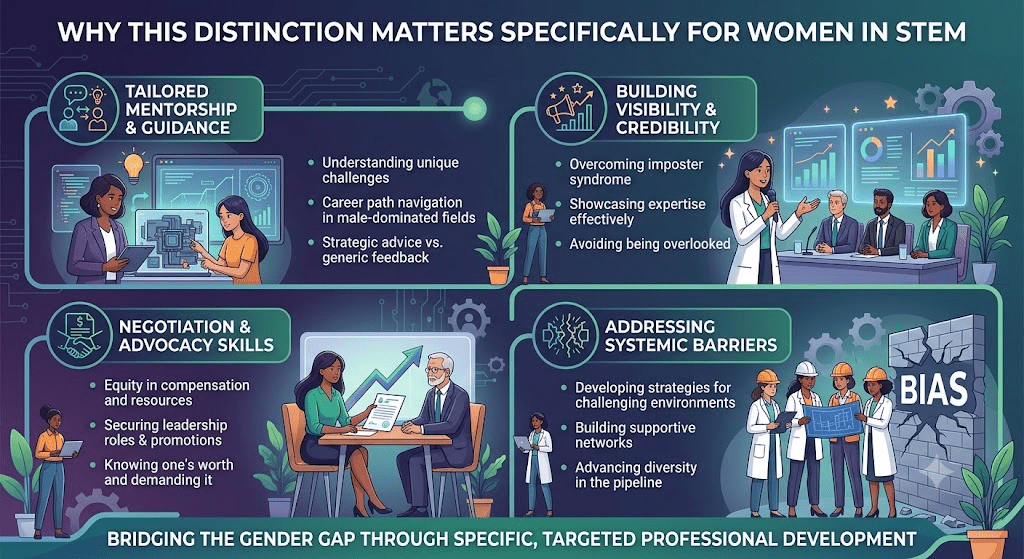
Why This Distinction Matters Specifically for Women in STEM
The management-versus-leadership distinction carries particular weight for women navigating STEM careers, where the path to formal management titles is often narrower and more contested than the path to genuine leadership influence.
Many women in STEM build substantial leadership influence long before they receive a corresponding title. They are the ones colleagues seek out for guidance, the ones whose judgment teams trust on difficult technical decisions, the ones who model the values that hold a team together even without formal authority to enforce them. Understanding that this influence constitutes real leadership, regardless of title, is an important reframe for women who have been told, implicitly or explicitly, that their contribution does not count until it comes with a corresponding promotion.
At the same time, this distinction is also a call to action. If you hold a management title without having genuinely earned the trust and followership of your team, the title alone will not sustain your effectiveness over time. The five practices of exemplary leadership offer a concrete, learnable path toward converting assigned authority into earned influence.
This builds directly on the integration and prioritization work explored in Episode 054 — Dr. Anokhi Kapasi: Building Your Whole Life Scoreboard as Moms in STEM, where Anokhi makes the case that sustainable, effective leadership requires systems-based thinking applied consistently over time, not heroic individual effort applied sporadically under pressure.
Practical Steps for Moving From Managing to Leading
Bradley closes the episode with concrete action steps that any professional, regardless of current title, can begin applying immediately:
- Audit your role honestly: Ask whether your team follows your direction because they believe in it or because your title requires compliance. This single question reveals more about your actual leadership effectiveness than any performance review.
- Read the foundational text: The Leadership Challenge by Kouzes and Posner offers the clearest articulation of what exemplary leadership requires. Understanding the five practices in depth gives you a concrete framework for self-assessment and development.
- Model the way deliberately: Codify the culture and values you want your team to embody, and then scrutinise your own daily actions for consistency with those values. Address any gaps before asking your team to close theirs.
- Enable others to act: Review your own workload honestly. If you are doing emails on the couch every night because your team cannot move without you, you are creating a bottleneck rather than building capacity. Identify what you can delegate this week.
- Rethink your approach to succession: Identify one person on your team who could grow into a future role, and begin actively mentoring them now, regardless of whether a vacancy currently exists. Real succession planning starts long before it becomes necessary.
Conclusion
Bradley Hunt’s conversation with Adaeze offers a precise corrective to one of the most common confusions in professional development: the assumption that a management title automatically confers leadership. It does not. Leadership is earned through consistency, humility, vision, and the daily practice of enabling and encouraging the people who choose to follow you.
For women in STEM, this distinction offers both validation and challenge. Validation, because much of the genuine leadership influence women build in technical and organisational environments happens without formal recognition, and that influence is real regardless of title. Challenge, because earning genuine leadership requires sustained, deliberate practice across all five exemplary practices, not a single defining moment or a title that arrives and does the work on its own.
Audit your role. Choose one practice to strengthen. Begin mentoring your successor today, not when the vacancy forces the question. The difference between managing and leading is not a matter of position. It is a matter of daily, accumulated choice.
Listen to the full conversation with Bradley Hunt: Episode 056 — Bradley Hunt: The Difference Between Managing and Leading