
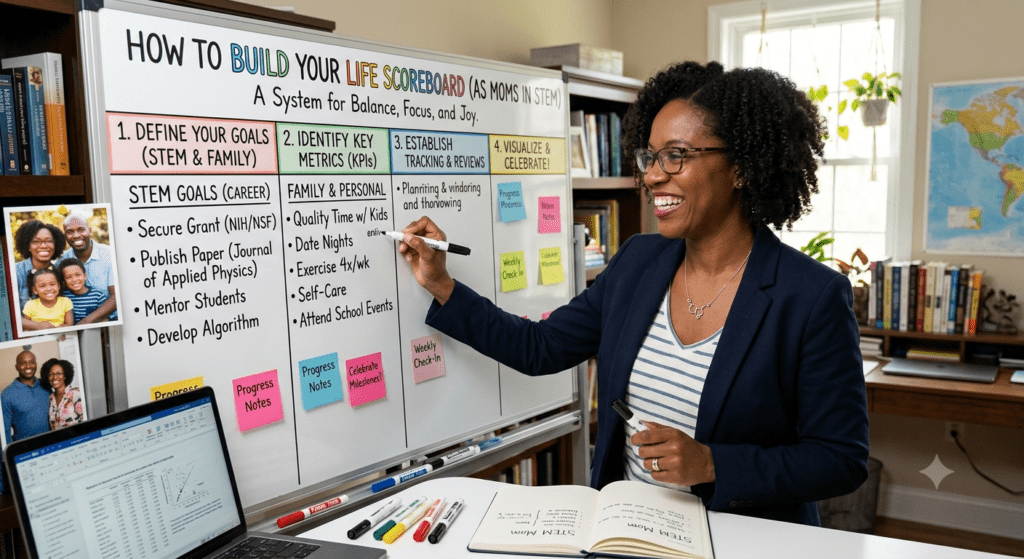
Somewhere along the way, women in STEM received a script. It told them that being serious about science meant being less present at home. That ambition and motherhood occupied opposite ends of a spectrum, and that choosing one meant compromising the other. That the demands of a rigorous STEM career were fundamentally incompatible with the demands of raising children, and that the women who tried to do both would eventually have to pick a side.
That script is not just outdated. It is driving one of the most damaging and preventable retention crises in STEM. And in Episode 054 of the Lunch with Leaders podcast, Adaeze Iloeje-Udeogalanya sits down with Dr. Anokhi Kapasi Sullivan, biomedical consultant and founder of Solve for Mom, to dismantle it completely.
Anokhi brings a rigorous, systems-thinking approach to what most people treat as a personal problem. Through her Career Life Integration Protocol, or CLIP, she offers women in STEM a framework for building careers and lives that do not require them to choose between the two. This is one of the most practically rich conversations of the season, and it arrives at exactly the right moment.
Listen to Episode 054: Dr. Anokhi Kapasi: Building Your Whole Life Scoreboard as Moms in STEM
The Forced Choice Trap: Why Women Are Leaving STEM
The forced choice trap is the name Anokhi gives to the false binary that causes so many talented women to leave STEM careers entirely. It operates through a script that most women in technical fields have encountered in some form:
- “You can be a serious scientist or a present mother, but not both.”
- “If you take the flexible arrangement, you are signalling that you are not committed.”
- “The people who advance are the ones who put the work first.”
- “Asking for accommodations marks you as someone who is not a team player.”
Each of these messages, whether spoken aloud or communicated through culture, policy, and the behaviour of institutions, presents a false choice. They position career advancement and family presence as mutually exclusive rather than as two dimensions of a single integrated life that requires thoughtful design.
The consequences of this trap are measurable and severe. Research shows that women leave STEM at significantly higher rates than men after having children, not because they lose ambition or capability, but because the environments they work in fail to support the integration of their full lives. The talent pipeline does not just develop a leak at the broken rung. It develops a second leak at the motherhood penalty, and together those two structural failures produce the dramatic underrepresentation of women in senior STEM roles.
Understanding the forced choice trap as a structural problem, not a personal failing, is the first and most important step toward escaping it.
Why Generic Work-Life Balance Advice Fails STEM Professionals
Most conversations about work-life balance offer advice that was designed for jobs that look nothing like a career in science or technology. Generic recommendations about setting work hours, creating morning routines, and switching off at 6pm do not account for the specific demands of deep technical work.
STEM careers require extended periods of uninterrupted focus. Experiments do not pause at convenient times. Clinical trials run on their own schedules. Research breakthroughs happen in the middle of deep work sessions that generic time management frameworks were not designed to protect. The cognitive cost of interruption in technical work is significantly higher than in jobs that involve more easily divisible tasks.
Anokhi designed CLIP specifically for this reality. Rather than adapting generic productivity advice to a STEM context, she built a framework that starts with the specific demands and constraints of technical careers and works outward from there. That specificity is what makes it work where other approaches have failed.
What makes STEM careers different when it comes to integration:
- Deep focus requirements that make interruption disproportionately costly
- Unpredictable timelines driven by research and experimental outcomes
- High stakes environments where mistakes carry significant professional and sometimes physical consequences
- Career structures that reward total availability and penalise boundary-setting
- Cultures that conflate hours worked with commitment and capability
Any framework for career-life integration in STEM must account for all of these factors. CLIP does.
The Whole Life Scoreboard: Changing the Metrics of Success
One of the most transformative concepts Anokhi introduces in this episode is the whole life scoreboard. It addresses a problem that affects almost every high-achieving woman in STEM who is also a mother: the tendency to measure an integrated life using career-only metrics.
When you measure your success using only professional metrics, the days you leave early for a school event register as losses. The week you reduced your hours to care for a sick child registers as underperformance. The project you declined because it required travel during a critical family period registers as a missed opportunity. By career-only metrics, every accommodation you make for your whole life looks like a setback.
However, those same decisions, measured against a whole life scoreboard, look entirely different. Leaving early for the school event is a win on the family dimension. Caring for your sick child is a win on the health and relationship dimensions. Declining the travel project to protect a critical family period is a win on the values alignment dimension.
The problem is not the decisions themselves. The problem is the scorecard being used to evaluate them. A career-only scorecard will always make an integrated life look like a series of compromises. A whole life scoreboard reveals it as a series of intentional choices made in alignment with what actually matters.
Building your whole life scoreboard:
- Identify the dimensions of your life that matter most to you: career, health, family, relationships, personal growth, community, spirituality, creativity
- Define what a win looks like in each dimension, not just in your career
- Assess your current decisions and priorities against all dimensions, not just the professional ones
- Notice where the scorecard reveals misalignment between your stated values and your actual time and energy investment
Hear Anokhi introduce the whole life scoreboard in full: Listen to Episode 054 of Lunch with Leaders

The Career Life Integration Protocol (CLIP): A Framework Built for STEM Moms
CLIP is the practical heart of Anokhi’s work, and it offers women in STEM a structured approach to making career decisions as part of an integrated system rather than in isolation from the rest of their lives.
The core insight behind CLIP is that most career decisions get made using only career-relevant information. You evaluate a promotion opportunity by asking what it will do for your career trajectory, your salary, and your professional development. You do not systematically evaluate it against your health, your family commitments, your energy levels, or your whole life vision. Then you accept it, and discover six months later that the cost to the non-career dimensions of your life was far higher than you anticipated.
CLIP changes that by building a cross-checking process into every significant career decision. Before committing to any major career move, you run it through a structured assessment against your whole life vision. You ask not just whether it advances your career, but whether it integrates with the life you are actually trying to build.
The CLIP process in practice:
- Define your whole life vision clearly across all the dimensions that matter to you
- Identify the non-negotiables in each dimension: the things that cannot be compromised regardless of career opportunity
- When evaluating a career decision, cross-check it explicitly against each dimension
- Identify the integration costs of the decision, not just the career benefits
- Make the decision with full information about its impact across your whole life
This approach does not guarantee that every decision will be easy or that every integration challenge will be solved. What it does is ensure that you make decisions with your eyes open to the full cost and benefit picture, rather than discovering the hidden costs after it is too late to change course.
Constraints Are Data: Using Systems Thinking in Your Life
One of the most powerful reframes in this episode comes from Adaeze’s observation that the engineering mindset offers a radical way of relating to the constraints of a life in STEM: treat them as data rather than as problems.
In systems thinking, a constraint is not an obstacle to be resented or overcome through sheer willpower. It is a piece of information about the system you are working within. It tells you something true and useful about what is possible, what needs to be designed around, and where the system requires creative problem-solving rather than brute force.
Applied to career-life integration, this reframe is genuinely liberating. The constraints of your life as a mother in STEM — the school pickup time, the unpredictable child illness, the partner’s work schedule, the hours your brain functions best for deep technical work — are not failures of your ability to manage your life. They are data points that your career design needs to account for.
Women who approach their constraints as data stop fighting against the shape of their actual lives and start designing intelligently within it. They find solutions that work within their real constraints rather than strategies that would work perfectly in a hypothetical life without any.
How to apply constraints-as-data thinking:
- List your current constraints honestly and specifically: time, energy, financial, family, health
- Treat each constraint as a design parameter rather than a personal failing
- Ask: given this constraint, what is the most effective design for how I work, when I work, and what I commit to?
- Look for structural solutions rather than willpower solutions: systems, delegation, automation, and negotiated arrangements that work within the actual shape of your life
Redefining Boundaries as a Professional Skill
Boundaries, in Anokhi’s framework, are a professional skill that increases your reliability and credibility. They are not a withdrawal from professional commitment. They are a clarification of how and when you show up, which makes it possible for colleagues and managers to depend on you accurately rather than unpredictably.
Consider the alternative. A professional without clear boundaries commits to everything, which means that everything gets done at whatever quality level exhaustion and overextension permit. Deadlines get met in name but not always in substance. Availability is technically unlimited but practically unreliable because the person’s capacity is stretched across too many commitments simultaneously.
A professional with clear boundaries commits to what they can actually deliver at the standard they are known for. Their yes means something because their no also means something. Their colleagues know when they are available, what to expect, and that the commitments they make will be honoured. That reliability is a professional asset, not a limitation.
This connects directly to the burnout conversation Adaeze opened in Episode 053 — When Your Body Forces You to Stop: A Burnout Story. Boundaries are not just a restoration strategy for people who have already burned out. They are a prevention strategy that protects the capacity for sustained high performance over the long term.
How to set boundaries that improve professional credibility:
- Define your working hours clearly and communicate them proactively rather than reactively
- Give advance notice when your capacity is limited rather than delivering reduced quality without explanation
- Frame boundaries around shared outcomes: protecting the quality and reliability of your work rather than personal preference
- Hold your boundaries consistently so that colleagues can build accurate expectations around them
The Focus Funnel: Eliminate, Delegate, Automate
Anokhi introduces a practical decision-making tool near the end of the episode that every overwhelmed professional can apply immediately: the Focus Funnel.
The Focus Funnel works by running every task and commitment through three sequential questions:
Can I eliminate this? Many tasks on a professional’s plate do not actually need to happen. They exist out of habit, historical precedent, or a failure to question whether the output is still valuable. Before delegating or automating anything, ask honestly whether it needs to exist at all.
Can I delegate this? Tasks that need to happen but do not require your specific expertise or judgment are candidates for delegation. This includes professional tasks that a team member could handle, personal tasks that could be outsourced, and household responsibilities that can be shared or redistributed.
Can I automate this? Tasks that need to happen and require consistent execution but do not require human judgment are candidates for automation. AI tools, scheduling systems, templates, and standard operating procedures all reduce the cognitive load of recurring tasks without reducing their quality.
What remains after this funnel is the work that only you can do, the deep technical work, the strategic thinking, the relationship building, the leadership contributions that require your specific expertise and judgment. That is where your focused energy belongs. Everything else is a candidate for elimination, delegation, or automation.
Conclusion
The forced choice trap has cost STEM too many exceptional women, too much accumulated expertise, and too many careers that did not need to end. The women who left were not less committed. They were less supported by systems that refused to account for the full shape of their lives.
Dr. Anokhi Kapasi’s work offers something that most career frameworks never do: a rigorous, systems-based approach to integration that respects the specific demands of technical work while refusing to accept that motherhood and STEM ambition are incompatible. The whole life scoreboard, the CLIP framework, the constraints-as-data mindset, and the Focus Funnel are not workarounds for a broken system. They are precision tools for building a life that works within the system as it currently exists while you advocate for the structural changes that will make it better.
Stop measuring your integrated life against a career-only scorecard. Start designing your career within the actual constraints of your whole life. Set boundaries that increase your credibility rather than diminishing it. And give your deepest focus to the work that only you can do.
Listen to the full conversation with Dr. Anokhi Kapasi: Episode 054 — Dr. Anokhi Kapasi: Building Your Whole Life Scoreboard as Moms in STEM
Learn more about Dr. Anokhi Kapasi’s work at solveformom.com and connect with her on LinkedIn.