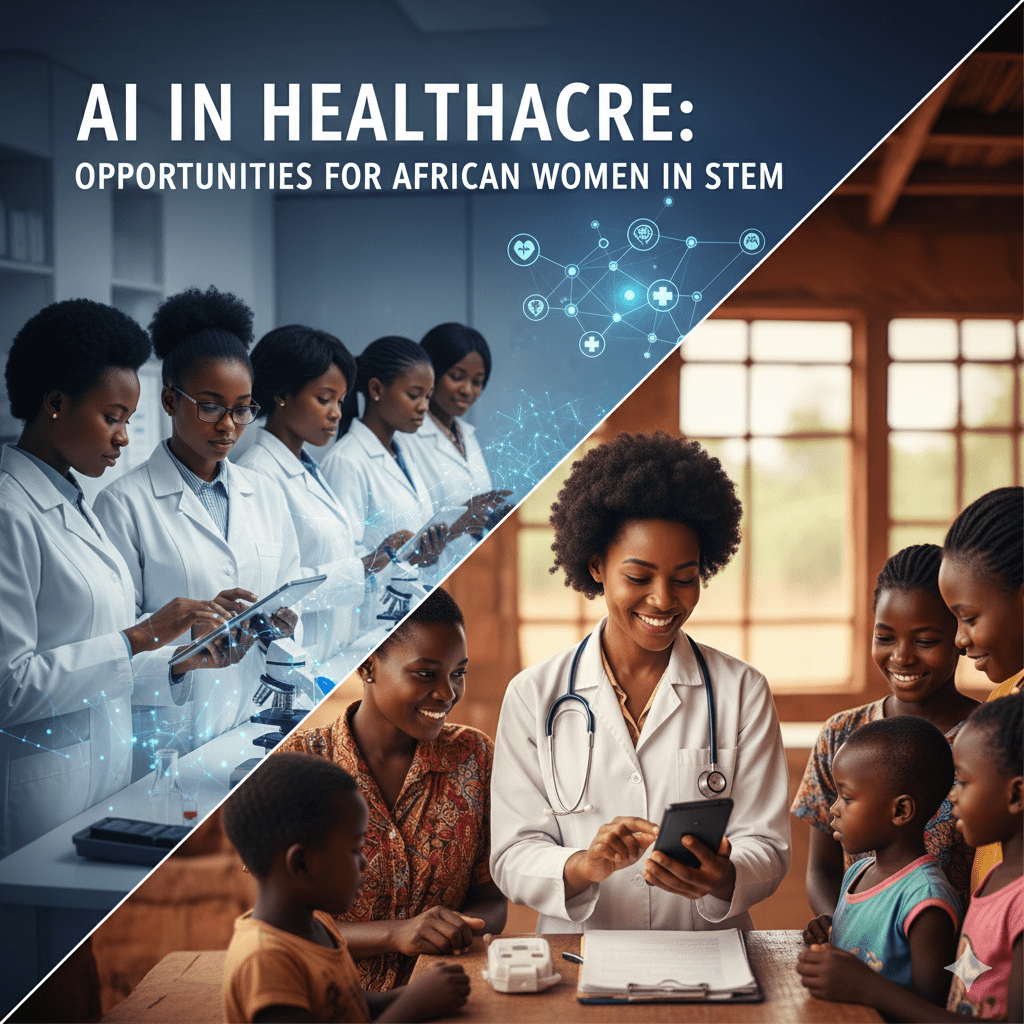
Artificial Intelligence, often called AI, is changing how the world approaches healthcare. Think about it, from apps that can detect diseases early, to smart systems that help doctors make faster and more accurate decisions, AI is making medical care more efficient and accessible. It is no longer just about robots or futuristic tools; it is about real solutions that save lives every day.
In Africa, this shift is even more exciting. Many hospitals and startups are beginning to use digital technology to improve patient care, track diseases, and make health services available in remote areas. As more countries invest in digital health systems, there is a growing need for people who understand both technology and healthcare and that is where opportunities for women in STEM come in.
This article takes a closer look at how AI is changing healthcare, the kinds of opportunities it is creating, and how women across the continent can take part in this transformation. It also highlights how the African Women in STEM community helps women gain the right skills, confidence, and networks to grow and lead in this space.
By the end, you will see that AI in healthcare is not just about technology, it is about people, innovation, and the power of women shaping the future of health in Africa.
The Rise of AI in Healthcare
AI is no longer just a buzzword in the tech world, it is quietly transforming how healthcare works every single day. Around the world, hospitals, doctors, and researchers are using AI to make better decisions, work faster, and reach more people.
So how exactly is AI being used in healthcare today? Think of disease detection tools that can spot cancer or malaria from a simple image. There are AI-powered systems that track patients’ vital signs in real time, alerting doctors when something is wrong. In research, AI is helping scientists discover new drugs much faster than before. Even in telemedicine, AI helps doctors diagnose patients remotely and manage large amounts of health data safely and efficiently.
The benefits are clear. With AI, diagnoses can happen faster and with fewer errors. Hospitals can manage patient records more efficiently. Healthcare costs go down because systems become smarter and more automated. Most importantly, patients receive more personalized care, treatment that fits their specific health needs, rather than a one-size-fits-all approach.
Across Africa, this transformation is gaining momentum. More startups are creating AI-based solutions for local challenges. Mobile health tools are connecting patients in rural areas to doctors in cities. Hospitals are beginning to use AI systems to automate administrative tasks, giving healthcare workers more time to focus on patients.
For example, some AI-powered mobile apps can help detect malaria just by analyzing a blood sample image. Others are being used to monitor maternal health, ensuring mothers and babies stay safe during pregnancy. There are even AI models predicting potential disease outbreaks before they happen, helping governments prepare early.
AI is not just changing how healthcare works, it is opening doors for innovation, collaboration, and leadership. And for women in STEM, this growing field offers a chance to use technology to improve lives and shape the future of healthcare in Africa.
Opportunities for Women in STEM
AI in healthcare is one of the fastest-growing and most exciting areas in the world right now. Hospitals, research centers, and tech companies are all looking for people who can bridge the gap between medicine and technology. This is where women in STEM have an incredible opportunity to shine.
Across Africa and beyond, healthcare organizations are hiring for roles in data science, bioinformatics, machine learning, health tech design, and medical research. These are the kinds of careers that use technology to make a real difference, improving diagnosis, designing smarter tools for doctors, and making healthcare more accessible for everyone.
Women bring unique strengths to these roles. Empathy and design thinking are key when creating patient-centered technologies. For example, when developing a health app or diagnostic tool, women often consider how it will be used by real people, mothers, patients in rural areas, or busy nurses. This human touch helps make technology not just powerful, but also practical and inclusive.
Globally, the demand for professionals who understand both AI and healthcare is booming. Experts predict that health-related AI jobs will continue to rise for years to come. This means there is growing space for African women to step in, lead, and make their mark, not just locally, but on an international scale.
That’s where the African Women in STEM community plays a powerful role. Through mentorship and peer learning, women in the community can connect with professionals already working in healthcare AI. They gain guidance on the right skills to learn, how to find internships or research collaborations, and how to build the confidence to pursue leadership roles.
For women who want to shape the future of healthcare, AI offers limitless opportunities and with the right support network, those opportunities are within reach.
Key Skills Needed to Thrive in AI and Healthcare
Working at the intersection of AI and healthcare requires both technical expertise and human-centered thinking. It is not just about coding or algorithms — it’s about understanding how technology can genuinely improve people’s lives.
Let’s start with the technical skills
To succeed in this field, it helps to be comfortable with tools like Python, which is one of the most widely used programming languages in AI and data science. Data analytics and machine learning are also essential since they help you analyze medical data, train AI models, and draw insights from large health datasets.
Another growing area is AI ethics, which ensures that algorithms are fair, unbiased, and transparent, especially important in healthcare, where decisions can affect human lives. Finally, health informatics ties everything together by helping you understand how data moves within hospitals and health systems.
But technical skills alone are not enough. The most successful AI professionals also have strong soft skills. In healthcare AI, collaboration is vital because you often work with doctors, nurses, engineers, and policymakers. You also need problem-solving skills to approach challenges creatively, communication skills to explain complex data in simple terms, and empathy to ensure that the technology you build truly serves patients and caregivers.
So, how can women begin developing these skills? There are many online courses and university programs focused on AI and healthcare, from introductory data science classes to specialized certifications in health analytics. Participating in mentorship programs is also a game-changer. Having a mentor can help you set learning goals, choose the right technical focus, and find opportunities to apply what you’ve learned.
That is exactly what the African Women in STEM community provides. Through mentorship and role modeling, the community connects women with professionals who have already built careers in AI and healthcare. These mentors guide them step by step, from learning the basics to building projects and finding career opportunities.
In short, thriving in AI and healthcare takes both brain and heart, mastering the tech while staying connected to the human purpose behind it. With the right skills and mentorship, African women can become leaders in shaping the future of health innovation.
Challenges Women Face in Entering AI Healthcare Fields
While the rise of Artificial Intelligence in healthcare opens exciting doors, many women still face real challenges when trying to step into this space. These barriers often start early, in education, and continue into the workplace, but with the right support systems, they can be broken down.
One of the biggest obstacles is the gender gap in STEM education and employment. Across Africa and many parts of the world, fewer girls are encouraged to pursue science, technology, engineering, and mathematics from a young age. This leads to fewer women entering AI-related programs at universities or technical institutes. Even when women do study in these fields, they often face bias in hiring and promotion, which makes it harder to climb the career ladder or get recognized for their work.
Another major challenge is limited access to funding, training, and mentorship. AI and healthcare are highly technical fields that require specialized knowledge and continuous learning. Unfortunately, not all women have access to affordable or high-quality training programs, especially in regions where digital resources are scarce. In addition, women-led startups in AI healthcare often struggle to get funding or investment due to a lack of visibility and persistent gender bias in the tech industry. Without mentorship, many talented women find it difficult to navigate these barriers alone.
There’s also the issue of representation in AI and data science sectors. When women look at leadership positions in tech or healthcare innovation, they rarely see people who look like them. This lack of representation can discourage young women from pursuing AI-related careers because they feel it’s not a space where they belong. Representation matters, not only for visibility but also because diverse voices bring new ideas, empathy, and creativity to problem-solving in healthcare.
This is where the African Women in STEM community makes a powerful difference. The community provides a safe and supportive space for women to connect, learn, and grow together. Through collaboration, mentorship, and visibility initiatives, African Women in STEM helps bridge the gender gap by connecting aspiring women with mentors who have already succeeded in the field. These mentors share their experiences, guide career development, and help women find training and funding opportunities that might otherwise be out of reach.
The community also celebrates women’s achievements, highlighting success stories that inspire others to take bold steps. When women see other African women thriving in AI healthcare, they begin to believe that they can too.
In short, the challenges are real, but they are not permanent. With education, mentorship, and community support, women across Africa can rise to meet the growing opportunities in AI and healthcare and lead the way in transforming the future of medicine.
The Future of AI in African Healthcare
The future of healthcare in Africa is being rewritten and Artificial Intelligence is at the heart of that transformation. AI is already changing the way doctors diagnose diseases, manage patient data, and even predict health outbreaks. But this is just the beginning. Over the next decade, AI is expected to revolutionize diagnosis, treatment, and disease prevention across the continent.
Imagine a future where an AI system can detect malaria or cancer in its earliest stages just by analyzing a photo or scan. Picture rural clinics using AI-powered chatbots to guide patients when doctors are miles away, or hospitals using predictive tools to prepare for outbreaks before they happen. These are not distant dreams, they are already being developed in parts of Africa today.
Emerging areas like wearable tech, predictive analytics, and AI ethics are becoming central to this evolution. Wearable health devices will help track heart rates, blood sugar, and other vital signs in real time, alerting doctors to potential problems before they become emergencies. Predictive analytics will allow health systems to make smarter decisions, such as identifying communities at risk of disease outbreaks or improving vaccine distribution. At the same time, AI ethics will become increasingly important, ensuring that algorithms are fair, transparent, and used responsibly to protect patient privacy.
For Africa, this growth represents not just a technological leap but also a chance to build inclusive, locally-driven healthcare solutions. And women will play a crucial role in shaping that future. Diversity in AI leadership is vital because healthcare is deeply human. Women bring empathy, insight, and a strong sense of ethics, all essential qualities for designing AI tools that truly serve people, not just systems. When women lead in AI healthcare, the solutions become more equitable and community-centered.
That’s where the African Women in STEM community steps in with its powerful vision, to empower women to take the lead in building Africa’s health tech future. By fostering mentorship, collaboration, and continuous learning, the community is preparing the next generation of African women to become innovators, researchers, and policy shapers in AI healthcare.
Conclusion
AI is transforming healthcare across Africa, opening up exciting new opportunities for women to make a real and lasting impact. From diagnosing diseases faster to improving patient care and building smarter health systems, technology is reshaping the way healthcare works and women have an important role to play in that transformation.
With the right skills, mentorship, and community support, African women can lead the next wave of healthcare innovation. They can design ethical AI systems, build health tech startups, and contribute to groundbreaking research that benefits millions. The future of healthcare is not just about technology, it’s about people, inclusion, and the power of women bringing new ideas to life.
If you’re passionate about using technology to solve real problems and make a difference, now is the perfect time to start. Join the African Women in STEM community to connect with mentors, gain valuable skills, and be part of a growing network of women shaping Africa’s future in AI and healthcare.