Artificial intelligence is everywhere. Open your favorite news site and you’ll see stories about how AI is revolutionizing everything from medicine to music. Conferences promise that if you just master machine learning, your career will soar. And for women in STEM, especially African women in tech, there is real excitement and real pressure to “get ahead” by learning the latest tools.
But let’s pause for a moment. If technology is the answer, why are the same old barriers still showing up? Why do women, and especially Black women, continue to be paid less, promoted less, and recognized less—even as they upskill, reskill, and lead innovation in STEM fields? Why, despite all the progress in tech, does the gender gap feel so stubborn?
The truth is, AI is powerful. But it can’t fix gender bias, broken systems, or workplace culture on its own. Tools are only as fair and forward-thinking as the people and structures that design and deploy them. If we want real equity in STEM, we need more than just the latest certificate. We need to reimagine what support, opportunity, and community look like for African women in tech today.
Learning AI Won’t Shield You from Bias
Let’s be clear: upskilling is important. Women across Africa and the diaspora are taking online courses, attending bootcamps, and earning new credentials in AI and data science at record rates. It’s a powerful way to stay relevant in a world where technology changes fast.
But here’s the hard truth: even with the best skills, women in STEM are still hitting walls that have nothing to do with their ability. The gender gap shows up in pay, promotions, and project leadership. According to the World Economic Forum, women made up about 28.2% of the STEM global workforce in 2024 and the numbers are even smaller for Black and African women.
Why? Because bias is not just about what you know. It’s about who gets seen and who gets heard. It’s about who is invited to key meetings, who is trusted with high-stakes work, and whose ideas are given credit. Learning AI is a smart move. But AI alone is not a shield against bias. Until the systems that decide “who rises” are fixed, technical skill will never be enough.
The Gender Gap Is Baked Into the Data
Here’s where things get tricky: AI learns from data. And much of that data is a reflection of the past, complete with all its blind spots, inequities, and assumptions. We like to think of technology as neutral, but the truth is that AI often makes invisible barriers even harder to see or challenge.
How AI Reproduces Inequality
- Biased hiring tools: Some companies have used AI to screen resumes, only to find that the algorithms prefer male candidates. Why? Because the data sets are full of historical hiring patterns that favored men.
- Visibility algorithms: Recommendation engines across platforms, from LinkedIn to Google, can reproduce the same biases, amplifying the profiles, work, and voices of people who already “fit” the mold.
- Performance tracking: AI tools that analyze productivity and performance can penalize women who take on invisible labor, like mentoring colleagues or supporting team morale, which is less quantifiable but essential to team success.
A 2019 study from MIT revealed that commercial AI facial recognition systems had error rates of up to 34% for darker-skinned women, compared to less than 1% for lighter-skinned men. The message: even in a high-tech world, women—especially Black women—remain underrepresented and under-supported.
Why Representation in Data Matters
If we are not careful, AI can quietly “lock in” old patterns. When AI is trained on biased data, it can amplify those inequalities at scale, making it even harder for women to break through.
The solution is not just to use AI, but to change who is building, training, and testing it. Inclusion at every stage of tech development is critical. If the data doesn’t see you, AI won’t either.
Tech Can’t Replace Real Mentorship or Advocacy
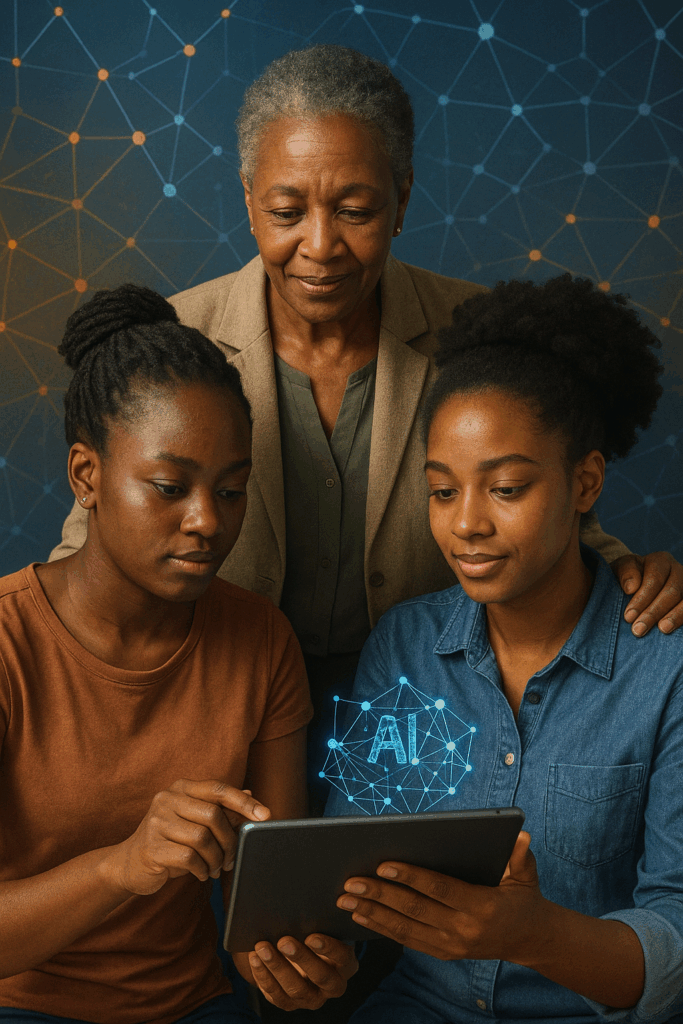
Let’s talk about something AI can’t do: build relationships. You can have the smartest algorithm in the world, but it can’t introduce you to the right person, vouch for your leadership in a crucial meeting, or help you navigate the politics of a challenging workplace.
Career growth, especially for African women in STEM, is about more than landing the next job. It’s about having people who believe in you, challenge you, and open doors that would otherwise stay closed. Mentors, sponsors, and advocates are the difference between feeling isolated and feeling seen.
Why Relationships Matter More Than Recommendations
- Mentorship provides perspective: A mentor helps you see the bigger picture—how to navigate bias, claim your achievements, and plan your next move.
- Sponsors open doors: A sponsor doesn’t just give advice—they put your name forward for opportunities, promotions, and leadership roles.
- Peer support matters: Sometimes, what you need most is a sounding board, a reality check, or a cheerleader. No algorithm can give you that.
African Women in STEM’s Mentorship Program
Many women feel let down by “mentors” who are unavailable or disconnected, mentors who meet once, offer generic advice, and then vanish. That’s not real support, and it’s not what you deserve.
At African Women in STEM, we do things differently. Our Mentorship Program is a 6-month journey built around small, tight-knit circles: one mentor and two to three mentees. This approach is designed to create lasting relationships and tangible progress.
What Makes Our Mentorship Different?
- Shared learning: Every member of the circle, mentor and mentees brings unique experiences. You’ll benefit from a diversity of perspectives, not just top-down advice.
- Trust and support: Meeting regularly in a small group builds real trust. You’ll feel safe to ask questions, share challenges, and celebrate wins.
- Access to voices that understand your journey: Our mentors are women who have walked the path you’re on. They know the realities of being an African woman in STEM and can offer insights that truly resonate.
- Forward momentum: This isn’t just talk. It’s about setting goals, tracking progress, and making sure you move forward—together.
A mentor can help you prepare for the interview, negotiate your offer, and navigate your first 90 days. More importantly, your circle becomes a source of encouragement, accountability, and lifelong friendship. AI can recommend a job posting. A real mentor will help you claim your worth and step into your next chapter with confidence.
Why AI Needs You But Also Leaves You Out
There’s a paradox at the heart of the AI revolution. On one hand, the world desperately needs more women—especially African women—at the table, shaping the future of technology. On the other hand, the very systems being built often leave these same women out.
The Diversity Deficit in AI
- Lack of representation: A World Economic Forum report found that women make up only 22% of AI professionals globally. The numbers are even lower for African women.
- Design bias: When tech teams lack diversity, the tools they create can reproduce the blind spots of their creators. For example, AI-powered healthcare apps may not recognize symptoms common in Black women, and language models may misunderstand African English or local dialects.
- Missed innovation: Research shows that diverse teams are more creative and better at solving complex problems. Without African women at the design table, we miss out on smarter, more inclusive solutions.
Inclusion Must Be Intentional
Access to tools is not enough. We need African women designing, testing, and leading new technologies. That means:
- Recruitment: Proactively hiring African women into tech roles.
- Leadership: Promoting women to decision-making positions where they can set the agenda.
- Listening: Valuing the lived experiences and insights of women who see what others miss.
AI will shape the future but only if we shape AI.
Real Growth Needs Community, Not Just Courses
There’s nothing wrong with learning a new programming language or earning a certificate in machine learning. But growth is about more than what you know. It’s about belonging. It’s about having a safe space to ask questions, share frustrations, and celebrate wins.
The Power of Community
- Belonging: When you’re the “only one” in your field, community reminds you that you’re not alone.
- Support: Friends and mentors can help you bounce back from setbacks and keep going when things get tough.
- Opportunity: Networks open doors to jobs, projects, and collaborations you might never find on your own.
IGNITE Membership: Turning Knowledge Into Power
That’s why we launched IGNITE Membership. IGNITE Membership is a 12-month, cohort-based program for mid-career African women in STEM who are ready to leap higher and show up stronger.
What does IGNITE offer?
- Masterclasses: Learn from industry leaders in AI, tech, and business.
- Mentorship: Ongoing guidance from women who have walked your path.
- Networking: Build relationships with peers, mentors, and potential sponsors.
- Real community: A space to be authentic, ambitious, and unapologetically you.
IGNITE is about more than learning. It’s about leaping, turning knowledge into confidence, and community into progress.
What’s the Bigger Fix?
Upskilling is valuable. But it is only one part of the solution. The real fix for the gender gap is collective, not just personal.
What Needs to Change Systemically
- Hiring practices: Recruit for diversity, not just technical skill.
- Recognition: Ensure women’s contributions are visible and valued.
- Funding: Invest in women-led startups and research.
- Leadership pipelines: Build clear pathways for women to lead teams, projects, and organizations.
- Workplace culture: Foster environments where all women, especially Black and African women, can thrive without having to “fit in” or shrink themselves.
The Role of Advocacy
- Speak up: Use your voice to call out bias, unfair policies, and exclusionary practices.
- Mentor and sponsor others: As you rise, lift others with you.
- Join collectives: Together, we have more power to push for change than we ever will alone.
The future of STEM depends on all of us, not just those who learn the latest code, but those who challenge, reshape, and democratize the systems that decide who gets to lead.
Conclusion
AI is a tool. It can help us solve problems, predict trends, and automate tedious work. But it cannot lead. It cannot see you, value you, or fight for you unless humans build systems that do.
We still need equity, visibility, and voice. We need relationships, advocacy, and community. African women in STEM are breaking barriers every day, but we cannot do it alone. The next chapter in tech will be written not just by those who upskill, but by those who uplift.
Take a moment to ask yourself: What systems are holding you back and who’s helping you push past them?