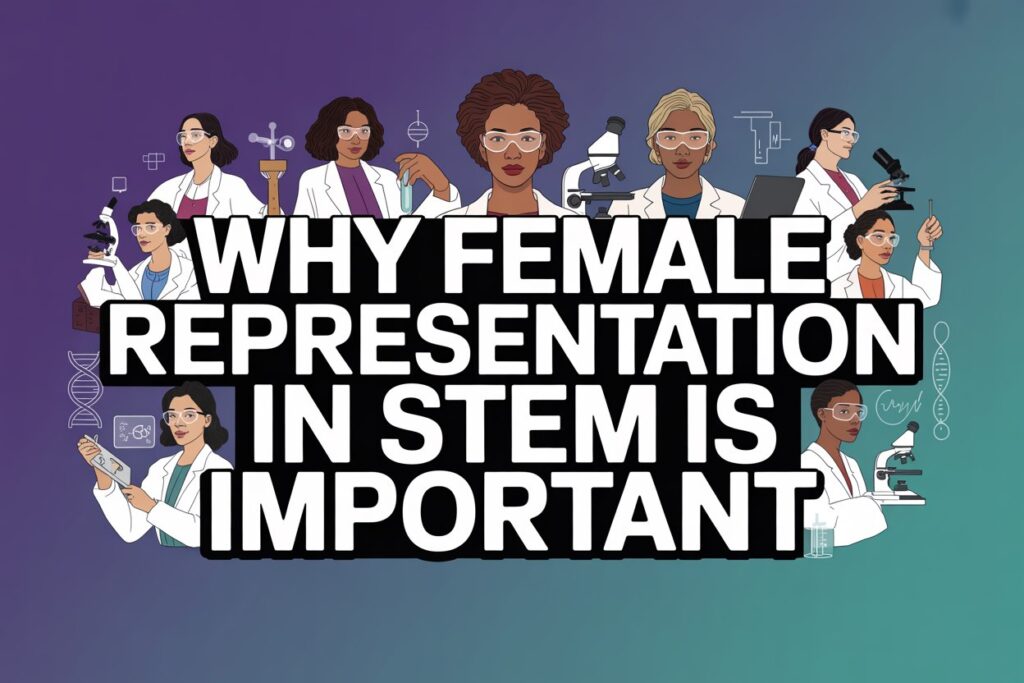
Science, technology, engineering, and mathematics shape how we live, work, and solve problems in the world. From healthcare and climate solutions to software, infrastructure, and innovation, STEM influences almost every part of modern life. Yet, even with all this progress, women remain underrepresented in many STEM fields.
Female representation in STEM is not just about increasing numbers or filling quotas. It is about visibility, access, voice, and opportunity. It is about who gets to contribute ideas, who gets to lead innovation, and whose experiences shape the solutions we build.
When women are missing from STEM spaces, the world loses valuable perspectives, creativity, and talent. This blog post explores why female representation in STEM is so important, how it impacts innovation and society, and what changes when women are supported to grow, lead, and thrive
Representation Shapes Belief and Possibility
Seeing is believing. When girls and young women see women working as engineers, data scientists, researchers, or tech leaders, it sends a powerful message that they belong there too. This is not just about inspiration, though that matters. It is about fundamentally changing what young women believe is possible for their own lives.
Representation turns dreams into something tangible. It helps girls imagine themselves in STEM careers because they can see real examples of women who have done it. They can observe how these women navigate their work, balance different priorities, and make meaningful contributions to their fields. Without this visibility, many girls quietly decide that STEM is not for them, even when they have the talent and interest.
The absence of role models creates a gap between ability and aspiration. A girl might excel in mathematics or show natural curiosity about how things work, but if she never sees women in STEM roles, she may not connect her skills to potential career paths. She may view her talents as hobbies rather than foundations for professional success.
The Impact of Visible Role Models
When young women lack examples of successful women in STEM, several things happen:
- They struggle to picture themselves in technical roles and may dismiss these careers as unrealistic
- They may believe STEM careers are not meant for people like them based on outdated stereotypes
- They miss out on understanding the diverse paths available in these fields and the many ways to contribute
- They lose motivation during challenging moments because they feel isolated and question whether they belong
- They lack concrete examples of how to navigate obstacles and setbacks in STEM environments
- They may internalize the message that their gender is a barrier rather than simply one aspect of their identity
On the other hand, strong female representation builds confidence, ambition, and a sense of possibility. It reminds women that their goals are valid and achievable. It shows them that success in STEM is not about fitting a stereotype but about bringing your unique strengths, perspectives, and problem-solving approaches to the table.
Diverse Teams Create Better Innovation
STEM is about solving problems, and the best solutions come from diverse perspectives. Women bring different lived experiences, ways of thinking, and approaches to problem-solving. When teams include women, the outcomes are often more creative, inclusive, and effective.
This is not about claiming that women think fundamentally differently from men in some biological sense. Rather, it is about recognizing that people with different experiences notice different problems, ask different questions, and propose different solutions. A woman’s experience navigating the world provides insights that might not occur to someone with a different background.
Research consistently shows that diverse teams outperform homogenous ones in problem-solving and innovation. They consider more perspectives, challenge assumptions more effectively, and arrive at more robust solutions. Diverse teams are less likely to fall into groupthink and more likely to identify potential problems before they become serious issues.
Representation Helps Break Stereotypes and Bias
For years, stereotypes have shaped who society believes belongs in STEM. Many people still associate technical skill, leadership, and innovation with men. These assumptions affect hiring decisions, promotions, classroom dynamics, and workplace culture in ways both obvious and subtle.
These stereotypes start early. Studies show that by age six, girls are less likely than boys to believe members of their gender are “really, really smart.” Teachers often unconsciously call on boys more frequently in math and science classes. Parents may encourage sons toward technical hobbies while steering daughters toward other interests, even when both show equal aptitude.
The stereotypes continue into higher education and professional life. Women in STEM classes often report being assumed to be less competent, having their contributions overlooked, or being mistaken for administrative staff rather than researchers or engineers.
How Visible Women Change the Narrative
When women are visible in STEM roles, these stereotypes begin to fade. Seeing women lead teams, publish research, build startups, or speak at conferences challenges outdated beliefs. It normalizes women as experts, innovators, and leaders. It makes it harder for people to maintain unconscious assumptions about who belongs in these fields.
This visibility matters at every level:
- In education: Girls see that math and science are not “boys’ subjects” and that excelling in these areas is normal and expected for students of all genders. They have examples of women who pursued these paths successfully.
- In hiring: Recruiters begin to recognize qualified women more readily when they can easily recall examples of successful women in similar roles. The “pattern matching” that often happens in hiring starts to include women.
- In leadership: Companies understand that technical expertise and management skills are not gendered traits. They see proof that women can lead technical teams, make strategic decisions, and drive innovation effectively.
- In media: The public image of who belongs in STEM starts to shift. Popular culture gradually updates its portrayal of scientists, engineers, and technologists to include women, which influences the next generation’s perceptions.
- In investment: Venture capitalists and funders become more comfortable backing women-led technical startups when they see track records of success and can envision women as technical founders.
Representation also changes how women see themselves. It reduces the pressure to constantly prove worth and helps create environments where women are evaluated based on skill and contribution rather than gender. Women spend less energy managing perceptions and more energy doing excellent work.
Over time, representation reshapes culture and opens doors for future generations. The more women are seen succeeding in STEM, the less unusual it becomes. And the less unusual it becomes, the easier it is for the next generation to enter these fields without facing the same barriers and doubts.
Breaking stereotypes is not just about changing minds. It is about changing systems, expectations, and the default assumptions that shape opportunities and outcomes.
Economic and Social Impact of Women in STEM
Increasing female representation in STEM benefits not only individuals but also economies and societies. STEM careers are often high-impact and high-growth roles. When women are excluded, countries miss out on a large portion of their talent pool, limiting economic potential and innovation capacity.
The underrepresentation of women in STEM represents a massive waste of human capital. When talented women avoid STEM fields or leave them due to hostile environments or lack of support, society loses their potential contributions. This is not just unfortunate for those individuals. It is a collective loss that affects everyone.
The Economic Case for Inclusion
The numbers tell a compelling story:
- Workforce growth: Including more women in STEM could significantly increase the skilled workforce and drive economic growth. Many countries face shortages of STEM professionals, yet they underutilize half their potential talent pool.
- Innovation capacity: Diverse teams produce more patents and create more innovative solutions, as research has repeatedly demonstrated. More women in STEM means more innovation and more economic value creation.
- Business performance: Companies with diverse technical teams often show better financial performance, higher employee satisfaction, and stronger retention rates. Diversity correlates with better decision-making and problem-solving.
- Economic participation: STEM careers typically offer higher salaries, giving women greater economic independence and stability. This has ripple effects on families and communities as women invest in education, healthcare, and local economies.
- GDP impact: Studies suggest that achieving gender parity in STEM fields could add trillions of dollars to global GDP over time. This represents opportunity cost when women are excluded.
Solving Critical Social Challenges
Beyond economics, women in STEM play key roles in addressing social challenges:
- Healthcare solutions: Women researchers and doctors bring attention to health issues that have been historically understudied, from maternal health to autoimmune conditions that disproportionately affect women.
- Environmental sustainability: Women often bring perspectives on community impact, long-term thinking, and resource management that are crucial for sustainable solutions.
- Educational technology: Women educators and technologists create learning tools that are accessible and inclusive, considering different learning styles and needs.
- Urban infrastructure: Women planners and engineers design cities that work for diverse populations, including families, elderly people, and those with disabilities.
- Agricultural innovation: Women scientists advance farming techniques that support family and community wellbeing, considering factors like nutrition, sustainability, and local knowledge.
- Clean energy: Women in renewable energy fields often focus on solutions that serve underserved communities and address energy poverty.
Their work often reflects a deep understanding of human needs and long-term impact. This perspective is essential for creating technology and solutions that truly serve society rather than creating new problems while solving old ones.
When women participate fully in STEM, we get solutions that consider a broader range of human experiences and needs. We get technologies that work for more people. We get research priorities that address a fuller spectrum of challenges.
The Role of Mentorship in Building Representation
Representation does not happen by accident. It is built through support, guidance, and opportunity. Mentorship plays a critical role in helping women enter, stay, and grow in STEM fields. Without mentorship, many talented women struggle to navigate the unwritten rules, hidden obstacles, and cultural challenges that exist in STEM environments.
Mentorship bridges the gap between potential and achievement. It provides women with the knowledge, confidence, and connections they need to succeed. It offers a safe space to ask questions, admit uncertainty, and work through challenges without fear of judgment.
Why Mentorship Matters
A mentor provides clarity, encouragement, and real-world insight. They help women navigate challenges, build confidence, and make informed career decisions. Mentorship also increases visibility by opening doors to opportunities, networks, and leadership roles that women might not otherwise access.
Here is what effective mentorship offers:
- Practical guidance on navigating workplace dynamics, understanding organizational culture, and making strategic career decisions. Mentors share what they learned through experience, helping mentees avoid common pitfalls.
- Emotional support during challenging moments and setbacks. Having someone who believes in you and reminds you of your capabilities can make the difference between persisting and giving up when things get hard.
- Network access to opportunities, collaborations, and professional connections. Mentors can introduce mentees to people in their network, recommend them for projects, and vouch for their abilities.
- Skill development through feedback, advice, and shared experiences. Mentors help identify areas for growth and suggest resources or approaches for building new capabilities.
- Confidence building by affirming abilities and encouraging growth. Mentors help women recognize their own strengths and value, countering imposter syndrome and self-doubt.
- Advocacy by speaking up for mentees in rooms where decisions are made. Mentors can champion their mentees for promotions, projects, and recognition.
- Role modeling by demonstrating what success looks like and showing that it is achievable. Seeing a mentor navigate challenges successfully provides a template for one’s own journey.
If you are looking for guidance, support, and clarity in your STEM journey, consider applying for our mentorship program. It is designed to help women grow their skills, confidence, and leadership while navigating real challenges in STEM spaces. Our mentors are women who have walked similar paths and are committed to helping you succeed.
Conclusion
Female representation in STEM matters because it shapes belief, drives innovation, challenges bias, and strengthens society. When women are visible, supported, and empowered, STEM becomes more creative, ethical, and impactful. The benefits extend far beyond the women themselves to touch everyone who is affected by the technologies, research, and solutions that emerge from these fields.
Every woman’s journey in STEM matters. Every voice adds value. And every step toward inclusion brings us closer to a future where talent and curiosity matter more than gender.
If you want to grow in a supportive environment, connect with like-minded women, and build visibility in STEM, join African Women in STEM. You will find community, collaboration, and encouragement from women who understand your journey and are committed to mutual success.