

Internships are a crucial step for any aspiring STEM professional. They provide hands-on experience that allows students and recent graduates to apply the knowledge they gained in the classroom to real-world projects. In STEM fields like engineering, computer science, biotechnology, and data science, practical experience is often what sets candidates apart when recruiters evaluate job applications. This is because early exposure to professional work helps you build essential skills such as problem-solving, communication, teamwork, and technical proficiency.
It also boosts confidence as you navigate unfamiliar environments and take on responsibilities that prepare you for future challenges. Beyond skill-building, internships offer opportunities to expand your professional network by connecting with supervisors, colleagues, and industry peers. These connections can lead to job offers, mentorship opportunities, and collaborative projects, giving you a significant advantage in a competitive job market. This early experience not only enhances your resume but also equips you with insights and practical knowledge that can accelerate your professional growth.
Let’s get into why it matters.
Why Internships Matter in STEM
Internships are more than just a temporary work placement. They are one of the most effective ways to bridge the gap between theory and practice in STEM careers. Many graduates leave school with strong academic knowledge but limited exposure to how those concepts apply in the real world. An internship gives you the opportunity to test what you have learned in class by working on real problems, using actual tools, and collaborating with professionals in the field. This practical experience is something that recruiters value highly, often even more than grades.
Another benefit of internships is skill development. While technical expertise is important, recruiters also look for soft skills such as communication, teamwork, and problem-solving. An internship environment exposes you to both. You may be asked to work on coding projects, conduct experiments, or analyze data, but you will also need to present your results, collaborate with colleagues, and adapt to new challenges. By practicing these skills early, you become more confident and more prepared for the job market.
Internships also give you the chance to explore different STEM areas and discover what excites you most. For example, a computer science student might test whether they prefer working in data science, artificial intelligence, or software engineering. Similarly, an engineering graduate might try roles in renewable energy or civil infrastructure before deciding on a long-term path. This exposure helps you narrow down your interests and make career choices that align with your passions and strengths.
Networking is another powerful outcome of internships. By working in a professional setting, you meet supervisors, colleagues, and industry leaders who can become part of your career network. These connections often lead to mentorship, job recommendations, or even direct job offers. Recruiters pay attention when a candidate has strong references and professional endorsements, and internships are one of the best ways to build those relationships.
Mentorship plays a vital role in making internships more successful. A mentor can help you find the right opportunities, prepare your application, and guide you in navigating workplace challenges. At African Women in STEM, our mentorship program supports women in securing internships that match their career goals. Mentors also provide advice on how to stand out during your internship so that it can lead to long-term opportunities.
Types of STEM Internships
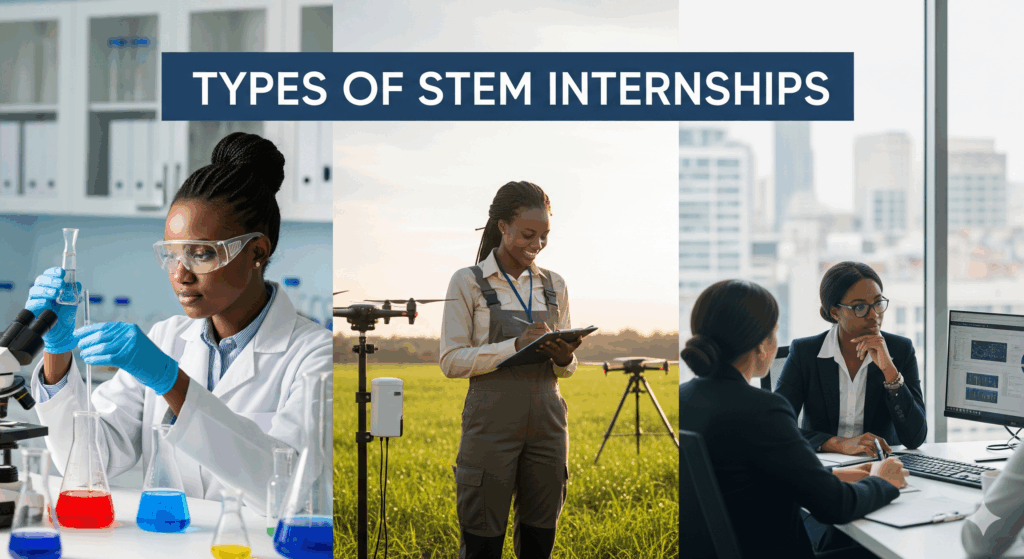
STEM internships come in many forms, and understanding the options available can help you choose the path that best aligns with your career goals. Each type of internship provides unique experiences, skills, and networks that shape your professional journey.
1. University-affiliated programs
Many universities across Africa and globally provide structured internship opportunities through labs, research assistantships, and cooperative education programs. These experiences allow you to work directly with professors, researchers, or academic teams. You gain exposure to advanced research methods, lab techniques, and project management. For students considering graduate school or a career in research, university-affiliated internships are a great way to strengthen academic credentials and build a strong foundation in scientific inquiry.
2. Industry internships
Internships with private companies, tech firms, engineering consultancies, or biotechnology labs immerse you in the professional environment of STEM industries. These roles are especially valuable because they expose you to the daily operations of businesses, including product development, problem-solving for clients, and teamwork within diverse departments. Industry internships often lead to full-time job offers after graduation, as employers like to hire interns they have already trained and evaluated.
3. Online or remote internships
With the rise of digital collaboration tools, online internships have become a powerful way to gain experience even if physical opportunities are limited. Remote internships allow you to work with international teams, contribute to projects across borders, and build skills in communication and self-management. They are particularly useful for students in regions where local opportunities may be scarce. These internships also prepare you for the increasingly global and virtual nature of STEM careers.
4. Cross-border internships through networks
One of the most exciting opportunities for African women in STEM comes from cross-border internships facilitated by professional communities. Through the African Women in STEM network, women can access internships across different countries and industries, giving them exposure to diverse perspectives and practices. These cross-border opportunities not only strengthen technical expertise but also foster cultural awareness and global collaboration skills.
By exploring these different types of internships, you can match your goals with the right opportunities. Whether you want to build a strong academic profile, gain industry-ready skills, or connect with global teams, there is an internship pathway designed for you.
How to Find the Right Internship
Finding the right internship can shape the direction of your STEM career, so it is important to be intentional about your choices. Instead of applying everywhere, focus on opportunities that align with your career goals and personal interests.
1. Research organizations and roles
Start by identifying the industries or fields within STEM that excite you the most. For example, if you are passionate about renewable energy, look for companies or labs working on solar or wind technology. If data science sparks your interest, explore internships with tech firms, startups, or research teams. Visit company websites, job boards, and university career centers to discover opportunities that align with your goals.
2. Use your network
Your network can be one of the most valuable tools in finding internships. Mentors, professors, peers, and community members often know about opportunities that may not be widely advertised. Reach out to people who are already in the field you want to enter, and do not hesitate to ask for guidance or referrals. Within professional communities, like African Women in STEM, members regularly share openings and provide recommendations that help you land the right fit.
3. Leverage programs like the Thrive Hub Accelerator
Structured programs can give you an edge by connecting you directly with organizations looking for talent. The Thrive Hub Accelerator not only provides training and career preparation but also links participants to exclusive internship opportunities. This connection can save you time and give you access to roles that are curated specifically for ambitious women in STEM.
4. Tips for standing out
Competition for internships is often tough, which means you need to present yourself strongly. Tailor your CV to highlight relevant skills, projects, and coursework. Include practical examples such as research assistantships, coding projects, or lab experiments. Prepare thoroughly for interviews by practicing common questions and being ready to explain how you can add value to the team. Showcasing projects through portfolios, GitHub profiles, or even presentations helps recruiters see your initiative and creativity.
Finding the right internship is not just about applying; it is about positioning yourself for success. With the right preparation, the support of a strong community, and access to exclusive programs, you can secure internships that put you on the path to a thriving STEM career.
Maximizing the Internship Experience
Securing an internship is only the first step. What truly matters is how you use the opportunity to grow your skills, confidence, and professional network. Internships can be life-changing when approached with the right mindset and strategy.
1. Take initiative and ask for challenging projects
Do not limit yourself to only the basic tasks assigned to you. Show curiosity and a willingness to learn by asking for opportunities to contribute to larger or more complex projects. For instance, if you are interning in a lab, offer to assist in advanced experiments. If you are in a tech role, volunteer to help debug code or support product development. Recruiters and supervisors notice when interns demonstrate initiative and enthusiasm for growth.
2. Learn beyond your assigned tasks
Internships are an excellent chance to immerse yourself in a professional environment. Attend workshops, training sessions, and meetings, even if they are not directly related to your role. These experiences provide insights into how the organization functions as a whole and expose you to skills you may not gain otherwise. Observing how professionals present ideas, manage teams, and solve problems gives you valuable lessons you can carry into your future career.
3. Seek feedback and reflect on your performance
Feedback is one of the most powerful tools for growth. Ask your supervisors and colleagues for constructive feedback on your work, and use it as a guide for improvement. Take time to reflect on your strengths, areas that need development, and lessons learned during your internship. Keeping a journal of your experiences can help you track progress and articulate your growth when applying for future roles.
4. Mentorship and community support
Having a mentor during your internship can help you set clear goals and stay focused. Mentors guide you on how to navigate workplace culture, tackle challenges, and position yourself for future opportunities. In addition, being part of a supportive community allows you to share experiences with peers who are also navigating internships. Platforms like African Women in STEM provide both mentorship and peer support, ensuring you are never alone in your journey. The Thrive Hub Accelerator, for example, connects interns to mentors and industry leaders who help translate internship experiences into career breakthroughs.
By taking initiative, broadening your learning, seeking feedback, and leaning on mentorship and community, you transform your internship into more than just a temporary role. It becomes a stepping stone that accelerates your career in STEM.
Common Challenges and How to Overcome Them
While internships provide valuable experience, they are not without challenges. Many students and graduates, especially women in STEM, encounter barriers that can make internships difficult to access or complete. The good news is that with the right strategies and support systems, these challenges can be overcome.
1. Limited access to local opportunities or funding
In many parts of Africa, internship opportunities in STEM fields may be scarce. Even when they exist, they may not be paid, creating financial barriers for women who cannot afford to work without compensation. To overcome this, students should explore remote internships, cross-border opportunities, and programs offered through global platforms. Applying for small grants or scholarships can also help cover expenses. Communities such as African Women in STEM open doors by connecting women to internships beyond their immediate location, ensuring that lack of local options does not limit career growth.
2. Navigating workplace dynamics as a woman in STEM
Internships are often a woman’s first experience in a professional STEM setting, and workplace dynamics can sometimes feel intimidating. Gender bias, being underestimated, or not being taken seriously are common challenges. Overcoming this requires confidence, preparation, and support. Mentors can guide interns on how to assert themselves respectfully, highlight their contributions, and navigate difficult interactions. Being part of a supportive community also gives interns a safe space to share their experiences and receive encouragement.
3. Balancing internship with academic or personal responsibilities
Many students take internships while still completing coursework or managing personal commitments. This balancing act can create stress and affect performance. To manage this effectively, interns need to prioritize time management, set clear schedules, and communicate openly with both supervisors and family members. Having a mentor helps interns set realistic goals and stay accountable, while peer networks offer encouragement and tips on managing workload.
4. How mentorship and community support make the difference
One of the best ways to overcome these challenges is by leaning on mentorship and community support. A mentor provides guidance on professional growth and practical solutions to specific problems, while a community of peers ensures that interns do not feel isolated. Programs like the Thrive Hub Accelerator combine both elements, giving interns access to training, mentorship, and a network of women who understand their challenges and share strategies for success.
Internship challenges may be real, but they do not have to hold women back. With resilience, the right resources, and the backing of a strong community, every challenge becomes an opportunity for growth.
Turning Internships Into Long-Term Career Opportunities
An internship is more than a short-term experience. When approached strategically, it can become the foundation for a thriving STEM career. Many organizations use internships as a pipeline for hiring, which means performing well can directly open the door to full-time roles.
1. Converting internships into full-time roles
One of the best outcomes of an internship is being offered a permanent position. To achieve this, interns should consistently demonstrate professionalism, curiosity, and commitment. Going above expectations, volunteering for extra tasks, and showing genuine interest in the company’s mission help you stand out. Supervisors are more likely to hire interns who have already proven their value and integrated into the workplace culture.
2. Using internship experience to strengthen your CV and interviews
Even if an internship does not immediately lead to a job with that employer, the experience remains a powerful asset for future applications. Highlighting your contributions, skills, and accomplishments in your CV shows recruiters that you have practical knowledge beyond academics. During interviews, be ready to share specific examples of challenges you faced, how you solved problems, and what you learned. This storytelling makes your application memorable and shows employers your ability to apply theory to practice.
3. Staying connected with supervisors and colleagues
Internships are also about building relationships. Your supervisors and colleagues can become valuable references, mentors, or even future employers. Stay connected by keeping in touch after the internship ends, sharing updates on your career journey, and expressing gratitude for the opportunities you had. Building these professional ties helps you maintain a supportive network that can open doors long after the internship.
4. Thrive Hub Accelerator and mentorship
Career growth does not stop when the internship ends. Continued mentorship and access to networks can help you take the next step confidently. The Thrive Hub Accelerator supports women in turning internship experiences into long-term success by offering tailored career coaching, recruiter connections, and project-based opportunities. Mentors within the African Women in STEM community provide ongoing guidance to help you transition from being an intern to a professional ready for leadership roles.
Conclusion
Internships are more than temporary roles. They are powerful stepping stones that help bridge the gap between classroom learning and real-world STEM careers. By gaining hands-on experience, building networks, and applying skills in professional settings, internships give women in STEM the confidence and foundation they need to thrive in competitive job markets.
With the right support, the impact of an internship can last far beyond its duration. Mentors guide you in choosing the right opportunities, communities provide encouragement and shared knowledge, and programs like the Thrive Hub Accelerator open doors to exclusive internships, recruiters, and career growth resources. Together, these supports ensure you are not just participating in an internship but truly maximizing its value.