
You have heard the word “STEM” everywhere. It is in the news, woven into school curriculums, highlighted in scholarship brochures, and tossed around by politicians and business leaders. But what does STEM really mean, and why should it matter to you as an African woman?
STEM is the heartbeat of our changing world. From the phones in our pockets to the bridges we cross, from the medical breakthroughs that save lives to the climate solutions that shape our future, STEM shapes nearly every part of daily life. For African women, understanding STEM is not just about getting a good job. It is about having a seat at the table where the biggest decisions about Africa’s future are made.
But, too often, STEM feels distant, a world reserved for “geniuses,” “techies,” or people from privileged backgrounds. The truth is, STEM is for everyone, and the future of Africa depends on more women, especially African women, stepping confidently into this space. In this article, we will break down what STEM stands for, why it is crucial for African women, the barriers that stand in the way, and how you can be part of building a new future.
What Does STEM Stand For?
Let’s start at the beginning. STEM is an acronym for Science, Technology, Engineering, and Mathematics. Each part is important, but together they form a powerful toolkit for solving problems and shaping the world.
S – Science
Science is about understanding the world around us. It is the study of everything from the smallest molecules to the largest galaxies. Science includes subjects like:
- Biology: The study of living things, from plants and animals to humans and microorganisms. Biology helps us understand health, disease, and the environment.
- Chemistry: The makeup of substances and how they interact, combine, and change. Chemistry is behind everything from cooking to medicine.
- Physics: The laws of motion, energy, and matter. Physics helps us build bridges, launch satellites, and make sense of the universe.
- Environmental Science: Understanding ecosystems, climate change, and ways to protect our planet.
When you think of science, think of curiosity, the drive to ask “why?” and “how?” about the world.
T – Technology
Technology is about using tools, systems, and software to solve real-world problems or improve how we live and work. Technology includes:
- Coding and Programming: Writing software and building apps, websites, and systems.
- Artificial Intelligence (AI): Creating machines that can “learn” and make decisions.
- Information Technology (IT): Managing data, networks, and computer systems.
- Digital Design: Creating digital content, from graphics to user interfaces.
Also, technology turns scientific discovery into practical solutions. Every time you use your phone, send an email, or pay with mobile money, you are using technology created by people in STEM fields.
E – Engineering
Engineering is about building and designing. Engineers create the structures, machines, and systems that keep our world moving. Some types of engineering include:
- Civil Engineering: Designing and building roads, bridges, and buildings.
- Mechanical Engineering: Machines, engines, and manufacturing systems.
- Electrical Engineering: Electronics, power systems, and telecommunications.
- Chemical Engineering: Turning raw materials into useful products, from fuel to soap.
Engineering is creative. It is about taking an idea and turning it into something real, something you can touch, use, or see.
M – Mathematics
Mathematics is the foundation of all STEM fields. It is about patterns, logic, numbers, and data. Mathematics is used to:
- Analyze data in health and business
- Model climate change and predict weather
- Design computer algorithms
- Solve everyday problems, from finances to logistics
Mathematics is not just about memorizing formulas. It is about thinking critically, solving puzzles, and making sense of complex information.
Connecting the Dots
STEM is behind everything from mobile apps to clean water systems. It is the reason we have vaccines, solar energy, online banking, and so much more. If you have ever used a smartphone, traveled on a bus, or benefited from a medical breakthrough, you have experienced the power of STEM.
Why STEM Is a Big Deal (Especially in Africa)
Why does STEM matter so much, and why is it especially important for African women to get involved?
1. STEM Drives Innovation and Solves Real Problems
Africa faces unique challenges: climate change, health crises, food insecurity, and gaps in infrastructure. STEM careers are at the center of finding solutions. For example:
- Healthcare: African doctors and researchers are using technology to diagnose diseases faster and more accurately.
- Agriculture: Engineers are developing irrigation systems and drought-resistant crops to help farmers thrive.
- Infrastructure: Civil engineers are building safer roads, bridges, and water systems for growing cities.
- Technology: African women are building apps that help women entrepreneurs, connect rural communities, and spread education.
When African women step into STEM, they are not just building careers. They are designing Africa’s future.
2. STEM Jobs Are Well-Paying, Flexible, and Future-Proof
The world is changing fast, and so is the job market. Many traditional jobs are disappearing, but STEM jobs are growing. These careers often offer:
- Good salaries: STEM jobs tend to pay more than non-STEM jobs at similar education levels.
- Flexibility: Many tech and engineering roles offer remote work or flexible hours.
- Global opportunities: STEM skills are in demand around the world, opening doors locally and internationally.
3. Underrepresentation Hurts Everyone
Despite the benefits, African women are still dramatically underrepresented in STEM. This is not just a problem for women, it is a problem for all of Africa.
- Diversity drives innovation: Teams with women and people from different backgrounds are more creative and solve problems better.
- Representation matters: When girls see African women in STEM, they believe it is possible for them too.
- Economic growth: More women in STEM means stronger economies and healthier communities.
When African women are missing from STEM, everyone loses out on talent, ideas, and solutions.
Common Barriers African Women Face in STEM

So, if STEM is so important, what keeps African women on the sidelines? The barriers are real, but they are not inevitable.
1. Lack of Exposure or Encouragement in School
Many girls do not get the chance to experiment with science kits, join tech clubs, or take advanced math classes. Teachers may unintentionally steer girls away from STEM, focusing more encouragement on boys.
2. Gender Stereotypes
There is a stubborn myth that “tech isn’t for girls” or that boys are naturally better at math and science. These messages show up in classrooms, in the media, and even at home. They chip away at confidence and curiosity.
3. Few Role Models or Mentors
It is hard to imagine yourself as a computer scientist or engineer if you have never seen an African woman in that role. The lack of visible role models makes STEM feel out of reach.
4. Limited Access to Resources, Networks, and Opportunities
STEM can feel expensive and exclusive. From buying lab materials to accessing coding bootcamps, resources are not always available. Competitions, internships, and scholarships are often harder for African women to find.
5. Cultural and Societal Expectations
In many families, girls are still expected to prioritize caregiving, marriage, or “safe” careers over pursuing STEM. Even when women enter the field, they may be pressured to step back when life gets complicated.
6. Isolation and Imposter Syndrome
Being the only woman or only African woman, on a team can be isolating. This can lead to self-doubt, anxiety, and burnout, causing talented women to leave STEM before reaching their full potential.
How We’re Helping You Thrive in STEM
At African Women in STEM, we know the barriers are real. But we also know they can be overcome. Our programs are designed by African women, for African women—because we understand what it takes to thrive.
1. Mentorship Program
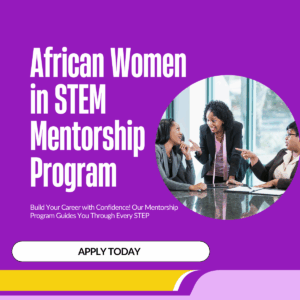
Our 6-month Mentorship Program places you in a small circle with one mentor and two or three other mentees. This is not a one-off conversation, it is a journey of real support, guidance, and growth.
- No gatekeeping: Mentors share both the wins and the struggles, giving honest advice.
- Confidence and clarity: You will learn how to navigate your career, set goals, and advocate for yourself.
- Professional navigation: Get help on everything from technical interviews to work-life balance.
Our mentorship is about building lasting relationships, not just checking a box.
2. Free Community
We believe you should never have to do this alone. Our free community is a safe and welcoming space for African women in STEM, no matter your background or experience level.
- Events: Regular webinars, workshops, and panels on topics from coding to career planning.
- Networking: Meet peers and professionals across Africa and the diaspora.
- Shared experiences: Learn from others who have faced similar challenges and found ways to succeed.
You will find advice, encouragement, and a space to celebrate your wins—big and small.
3. IGNITE Membership

For mid-career women ready to take the next step, our IGNITE Membership is designed to help you grow, get visible, and reach your goals.
- Visibility training: Learn how to build your professional brand and get noticed for promotions and leadership roles.
- Career strategy: Get tailored advice for transitioning into new fields, taking on management roles, or moving abroad.
- Masterclasses and resources: Access to leading experts and up-to-date content on what it takes to thrive in STEM today.
- Supportive network: You will join a cohort of ambitious African women who will push you to dream bigger.
IGNITE is about more than skill-building. It is about empowerment, strategy, and community.
4. Thrive Hub Accelerator
Ready to lead, not just participate? The Thrive Hub Accelerator is for African women in STEM ready to land their ideal job or promotion and earn what they deserve.
- Career Coaching: One-on-one and group sessions focused on positioning you for leadership, visibility, and higher pay.
- Strategic Career Mapping:Learn how to identify your next best move, craft a standout professional presence, and get noticed for the roles you truly want.
- Network Building: Gain access to a high-impact network that opens doors, champions your growth, and helps you rise faster.
The Thrive Hub is where African women in STEM grow into confident leaders, not just employees.
Want to secure your career and future? Apply to the Thrive Hub Accelerator Now.
STEM Isn’t Just for Scientists, It’s for Problem Solvers
One of the biggest myths about STEM is that it is only for people who love numbers or want to wear lab coats. The truth is, STEM needs all kinds of minds.
- If you love design, you might thrive in engineering, architecture, or digital product development.
- If you enjoy people and communication, consider STEM education, health communication, or project management.
- If you are passionate about helping communities, there are roles in environmental science, public health, and sustainable agriculture.
- If you are a creative thinker, you can help design new apps, invent products, or build businesses that solve real problems.
STEM is not about being the smartest in the room. It is about being curious, creative, and willing to learn. The best STEM professionals are problem solvers who see opportunity where others see obstacles.
Diverse Paths in STEM
- Technical roles: Software developer, engineer, scientist, data analyst
- Creative roles: UX designer, science communicator, innovation lead
- Leadership roles: Project manager, chief technology officer, policy advisor
- Entrepreneurial roles: Founder, start-up leader, inventor
Whatever your passion, there is a place for you in STEM and the field is richer for your perspective.
Conclusion
Understanding STEM is the first step. But the most important step is believing that you belong in this space. Africa needs more women, more African women solving problems, designing solutions, and leading the way. Do not let stereotypes, barriers, or self-doubt hold you back. Whether you are just exploring STEM or already deep in your career, there is a community here for you.
Explore our programs and resources at africanwomeninstem.