Across Africa, science, technology, engineering, and mathematics are expanding at an exciting pace. Breakthroughs in health research, renewable energy, digital technology, and agriculture are transforming communities and opening doors for future generations. Yet, despite this progress, many women continue to face barriers that limit their participation in the most dynamic part of this growth: the digital skills that fuel modern STEM careers.
Digital skills are no longer a luxury or an optional advantage. They are the foundation for success in research, collaboration, innovation, and leadership. Without them, women risk being left behind in industries that increasingly depend on coding, data analysis, artificial intelligence, and digital collaboration tools.
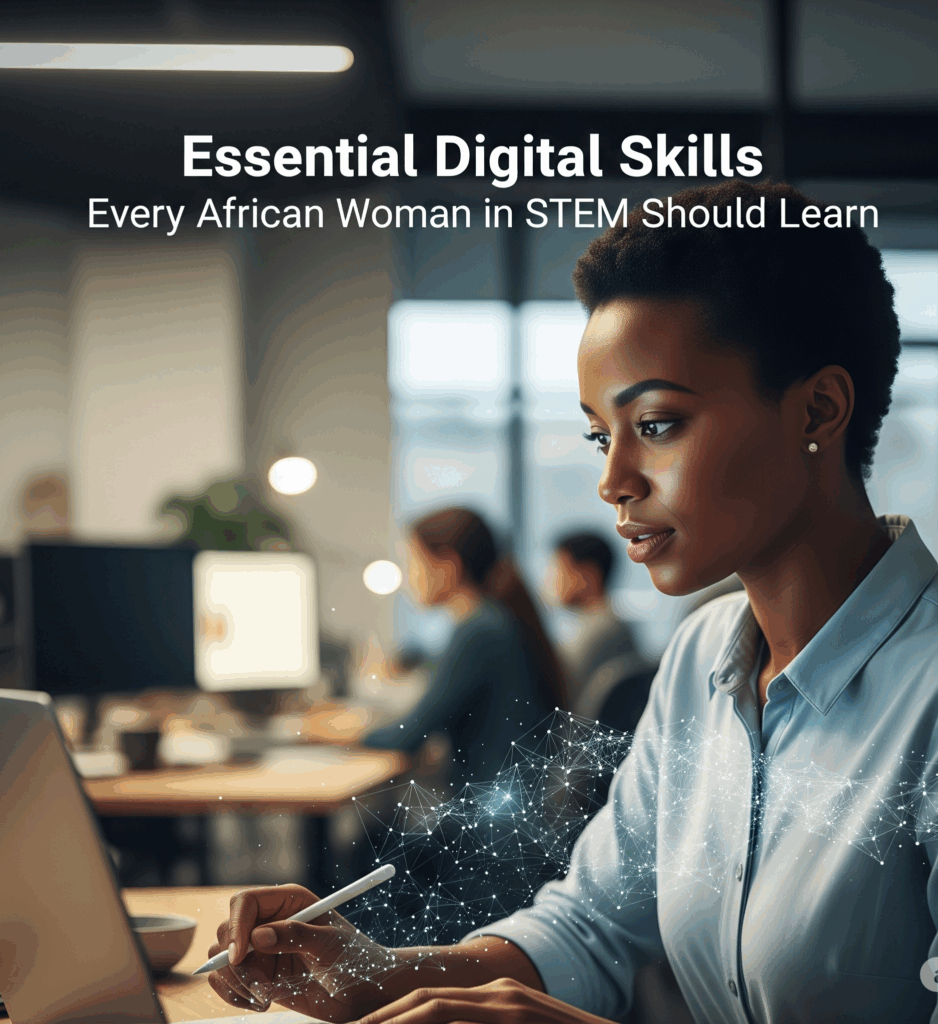
The purpose of this article is to highlight the essential digital skills that African women in STEM should focus on to thrive in their careers. It will also show how mentorship and community programs play a critical role in bridging the gap, providing women with the tools, confidence, and support they need to apply these skills in real-world contexts. By combining individual learning with collective empowerment, African women can take their place at the forefront of STEM innovation.
Understanding the Importance of Digital Skills in STEM
The world of STEM is being transformed by digital technology. Artificial intelligence, big data, coding, and other digital tools are now at the heart of how science, engineering, and technology are practiced. In medicine, researchers use data analytics and AI to detect diseases earlier and improve patient care. In agriculture, digital sensors and big data help farmers predict yields and manage resources more effectively. Engineers rely on advanced software to design, test, and optimize projects before they are built in the real world. Across every field, digital skills are not just useful, they are necessary for staying relevant and competitive.
For African women in STEM, adapting to this digital transformation is critical. Without strong digital literacy, women risk being excluded from major opportunities such as international collaborations, research funding, or leadership roles in technology-driven projects. Many of the fastest-growing careers, from data science to software engineering, require skills that go beyond traditional STEM knowledge. Digital literacy opens doors to these careers and helps women demonstrate that they can contribute at the highest levels.
Digital skills also have the power to bridge long-standing gender and regional gaps. With the right training and tools, African women can compete on a global stage, regardless of their location. A woman in Lagos who masters machine learning has the same ability to contribute to cutting-edge innovation as a woman in Silicon Valley. When women in Africa are digitally equipped, they do not only strengthen their personal career path but also elevate the continent’s contribution to global science and technology.
In short, digital skills are the great equalizer. They allow women to overcome traditional barriers, compete with confidence, and bring African innovation into global conversations. This is why focusing on digital literacy is not just important, it is urgent for the future of African women in STEM.
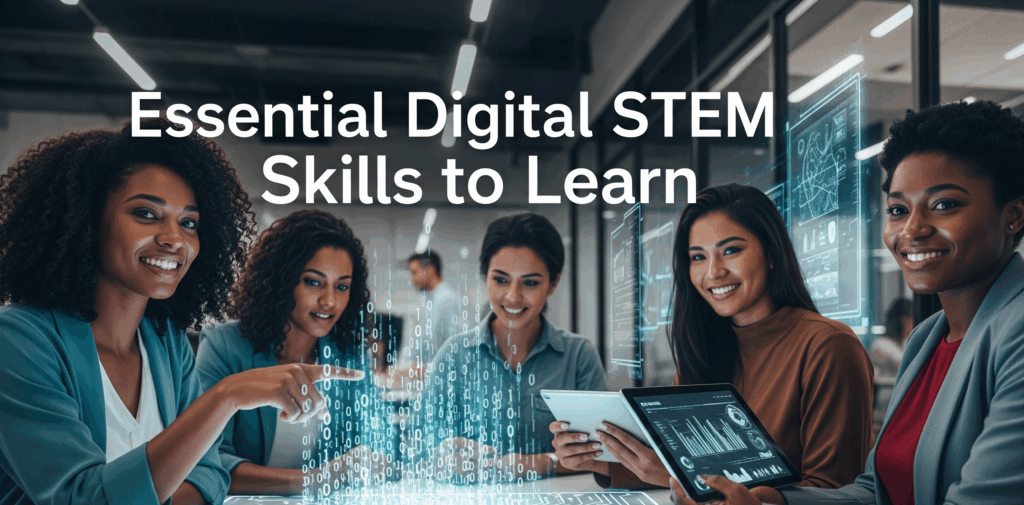
Essential Digital STEM Skills to Learn
Data Literacy and Data Analysis
Why it matters: Data is the language of modern STEM. Whether you run experiments, design products, or evaluate programs, decisions should be backed by clean, well-structured data and sound analysis. Strong data literacy helps you frame the right questions, choose the correct methods, and communicate trustworthy insights to technical and non-technical audiences.
Core abilities to build:
- Understand data types, measurement scales, sampling, bias, and basic statistics such as mean, median, variance, correlation, and confidence intervals.
- Clean and prepare data: handle missing values, outliers, inconsistent formats, and duplicates.
- Analyze and visualize: create tables and charts that reveal patterns and support decisions.
- Interpret results responsibly: distinguish correlation from causation and communicate limitations.
Tools to learn: Excel for quick analysis and dashboards, Python or R for scalable analytics and automation, SPSS for point-and-click statistical workflows used in health and social sciences.
Practical starting path:
- Use Excel to import a CSV, clean it, create pivot tables, and build a simple dashboard.
- Re-create the same workflow in Python with pandas or in R with tidyverse to automate repetitive steps.
- Add basic data visualization with matplotlib or ggplot2.
Coding and Programming Skills
Why it matters: Code is the engine behind automation, simulation, modeling, and product development. Even basic programming lets you test ideas faster, reduce manual work, and collaborate effectively with engineers and data scientists.
Languages to focus on:
- Python for data science, scripting, and machine learning.
- Java for large-scale systems and Android development.
- MATLAB for numerical computing and control systems.
- C++ for performance-critical tasks in robotics, embedded systems, and simulations.
Benefits:
- Automation: eliminate repetitive tasks like weekly data cleaning or report generation.
- Problem-solving: translate complex problems into logical steps that computers can execute.
- Innovation: prototype tools, models, or apps that solve local challenges.
Practical starting path:
- Learn variables, loops, conditionals, functions, and version control basics.
- Build a small script that ingests sensor readings and alerts when thresholds are crossed.
- Document and publish your code in a GitHub repository.
Digital Collaboration Tools
Why it matters: STEM work is increasingly distributed. Teams span cities and continents, and successful contributors know how to coordinate work, track versions, and communicate clearly online.
Key platforms:
- GitHub for version control, code reviews, and open collaboration.
- Slack for structured team communication.
- Trello or similar boards for project tracking and sprint planning.
- Google Workspace for shared documents, spreadsheets, and presentations.
How this helps international collaboration: Shared repositories and issue boards make your work transparent and reviewable. Time-zone friendly threads reduce meeting overload. Clear documentation means a teammate in Nairobi can pick up where a colleague in Accra left off.
Practical starting path:
- Create a GitHub repo, push your code, write a concise README, open and close issues, and review a pull request.
- Run a short project in Trello with tasks, owners, due dates, and a simple weekly check-in.
- Maintain a living project doc with decisions, links, and next steps.
Proof you are progressing: You can onboard a new collaborator using your README and issue board alone.
Cybersecurity Awareness
Why it matters: Research data, health records, financial models, and intellectual property must be protected. A single lapse can compromise an entire project or violate ethics protocols.
Basic skills:
- Strong, unique passwords and a password manager.
- Multi-factor authentication on all key accounts.
- Safe data handling: encrypt sensitive files, control access, and log who can see what.
- Phishing recognition and secure browsing habits.
- Ethical practices around handling personal or confidential data.
Relevance to STEM: Scientific integrity depends on trustworthy data. Secure pipelines prevent tampering and ensure reproducibility.
Practical starting path:
- Enable multi-factor authentication on email, cloud, and code hosting.
- Use a password manager and rotate passwords for critical systems.
- Create a simple data classification policy for your team: what is public, internal, confidential, or restricted, and how each category is stored and shared.
Cloud Computing and Storage
Why it matters: The cloud makes advanced computing accessible without large up-front costs. You can store data, run analyses, and deploy applications from anywhere with an internet connection.
Platforms to understand: AWS, Google Cloud, Azure. You do not need to master all three. Focus on core services: object storage, virtual machines, managed databases, and basic serverless functions.
Benefits:
- Scalability: scale up for heavy processing and scale down to save costs.
- Accessibility: collaborate across borders without shipping hard drives.
- Cost-efficiency: pay for what you use.
Impact in Africa: Cloud tools lower barriers for startups, research groups, and NGOs that cannot maintain large on-premise servers. They support remote labs, data collection in the field, and continent-wide collaborations.
Practical starting path:
- Store a dataset in cloud object storage and access it from a notebook environment.
- Spin up a small virtual machine to run a model or host a simple app.
- Track costs and set budget alerts so spending stays predictable.
Proof you are progressing: You can deploy a small data app that teammates can use from different locations.
AI and Machine Learning Basics
Why it matters: AI techniques power predictions, classifications, and recommendations across many STEM fields. A practical understanding lets you choose when AI is appropriate and how to evaluate results.
Core concepts to learn:
- Supervised and unsupervised learning, model training and validation, evaluation metrics, overfitting versus underfitting.
- Responsible AI: bias detection, fairness, transparency, and data privacy.
Applications with African context:
- Agriculture: yield prediction and pest detection from images or sensor data.
- Medicine: triage support, image analysis, and supply forecasting.
- Climate and energy: demand forecasting, anomaly detection on grids, and early warning systems.
Beginner-friendly resources: Introductory courses that cover Python-based machine learning, hands-on notebooks, and challenge platforms with public datasets.
Practical starting path:
- Train a simple model to classify crop leaf images as healthy or diseased.
- Evaluate performance with precision, recall, and confusion matrices.
- Document risks and limitations, especially around bias and data quality.
Digital Communication and Personal Branding
Why it matters: Visibility creates opportunities. A clear online presence helps employers, collaborators, and funders understand your expertise and find your work.
Key platforms:
- LinkedIn for career storytelling, achievements, and thought pieces.
- ResearchGate or Google Scholar for publications and citations.
- GitHub for code and technical portfolios.
Digital storytelling tips:
- Write a concise headline that states your role and focus area.
- Share short posts about lessons learned from projects, conference takeaways, or community insights.
- Use a consistent voice and keep your profiles updated with speaking engagements, certifications, and awards.
Practical starting path:
- Refresh your LinkedIn headline and About section with your domain, impact, and interests.
- Publish a short post about a project, linking to a GitHub repo or slide deck.
- Ask a mentor to review your profile and suggest improvements.
Technical Writing and Digital Documentation
Why it matters: Clear writing turns complex work into usable knowledge. Good documentation reduces errors, saves time, and helps others reproduce your results.
Tools to know:
- LaTeX for academic manuscripts and math-heavy documents.
- Microsoft Word advanced features and Google Docs for collaborative drafts, styles, references, and change tracking.
- Markdown for README files and lightweight technical docs.
What to practice:
- Write concise abstracts and problem statements.
- Describe methods with enough detail for replication.
- Include assumptions, limitations, and data sources.
- Add visuals and tables with clear captions and references.
Practical starting path:
- Create a project README that explains goals, setup, data sources, and how to run the code.
- Draft a one-page methods note for a recent experiment with inputs, steps, outputs, and quality checks.
- Use reference managers to handle citations cleanly.
Putting it all together
A strong foundation across these skills makes you versatile and resilient. Start with one or two areas that align with your current role, set small weekly goals, and build a public record of your progress through repos, dashboards, and short write-ups. As you grow, surround yourself with mentors and peers who can review your work, suggest learning paths, and open doors to real projects.
Challenges Women Face in Acquiring Digital Skills
Limited Access to Resources
Many African women in STEM struggle with unequal access to the very tools required for digital learning. Reliable internet connectivity is often expensive or unavailable in rural and semi-urban areas. Even when access exists, data costs can be a significant burden, limiting how much women can practice coding, attend online classes, or use cloud-based platforms.
In addition, many women do not have personal laptops or up-to-date devices that can handle advanced software and digital tools. Training programs, certifications, and software licenses also come with costs that can discourage women who already face financial constraints. This digital divide makes it harder for women to keep pace with technological advances, leaving them at a disadvantage compared to peers with better resources.
Gender Stereotypes
Cultural and workplace stereotypes reinforce the belief that women are not naturally suited for technical or digital tasks. From a young age, girls may hear that coding or engineering is for men, while women should focus on less technical roles. These messages undermine confidence and discourage women from pursuing advanced digital training.
Even when women enter STEM fields, they often encounter skepticism from colleagues or supervisors who assume that they cannot handle data analysis, programming, or cybersecurity. Such stereotypes create a self-fulfilling cycle: fewer women enroll in digital skills programs, and their underrepresentation further reinforces the bias. Overcoming these stereotypes requires deliberate encouragement, mentorship, and visible role models who prove that women can excel in technology-driven careers.
Time Pressures
Another barrier is the demand on women’s time. Many African women juggle multiple responsibilities: professional duties, academic studies, household management, and caregiving for children or extended family. Learning digital skills often requires long hours of practice, trial and error, and continuous updating because technology evolves quickly.
Women may find it difficult to carve out uninterrupted study time, especially when societal expectations place domestic responsibilities primarily on them. As a result, they fall behind in gaining critical skills that could advance their careers. Without supportive policies such as flexible learning schedules, childcare options, or mentorship that respects these challenges, many women cannot fully participate in digital training opportunities.
How Mentorship Helps Women Gain Digital Skills
Breaking Isolation
One of the greatest challenges for African women entering the digital side of STEM is the sense of being alone. Many find themselves as the only woman in a coding class, in a lab learning new data tools, or in an office setting dominated by men. This isolation can quickly lead to self-doubt and discourage women from pushing forward.
Mentorship solves this by pairing women with role models who have already walked the same path. Seeing another African woman who has mastered Python, built a career in data science, or contributed to an AI project makes the journey less intimidating. It reminds women that they are not the first to face these struggles and that success is possible with persistence and guidance.
Guided Learning Paths
The digital world can feel overwhelming because there are endless tools, languages, and platforms to learn. Without guidance, it is easy to waste time on skills that may not align with specific career goals. Mentors help women cut through the noise. They can recommend which courses to take, whether to prioritize learning Python for data science, MATLAB for engineering, or AWS for cloud computing.
Mentors also advise on affordable or free resources, industry-recognized certifications, and practical ways to apply digital skills in real projects. This guided path saves time and ensures that women focus on what will have the greatest impact on their careers.
Confidence Boost
For many women, the greatest barrier to entering digital fields is not ability but fear. Coding, data science, or machine learning can appear intimidating, especially when there are stereotypes suggesting that women are less capable in technical work. Mentorship provides a steady stream of encouragement and feedback.
A mentor can help a mentee celebrate small wins such as writing her first successful program, analyzing her first dataset, or presenting her findings in a digital format. This encouragement builds the confidence needed to tackle larger and more complex digital challenges. When women believe in their skills, they are more likely to apply for leadership roles, pursue advanced training, or lead digital projects.
Community Learning
Beyond one-on-one mentoring, being part of a larger community is powerful. The African Women in STEM mentorship program is not just about individual guidance. It also connects women to group workshops, peer learning circles, and shared resources that accelerate skill development. In these spaces, women can ask questions without fear of judgment, share opportunities, and even collaborate on real-world projects.
Community learning transforms digital skill-building into a collective journey where everyone grows together. Instead of competing, women support and uplift one another, creating an ecosystem of shared success.
Why Join the African Women in STEM Mentorship Program?
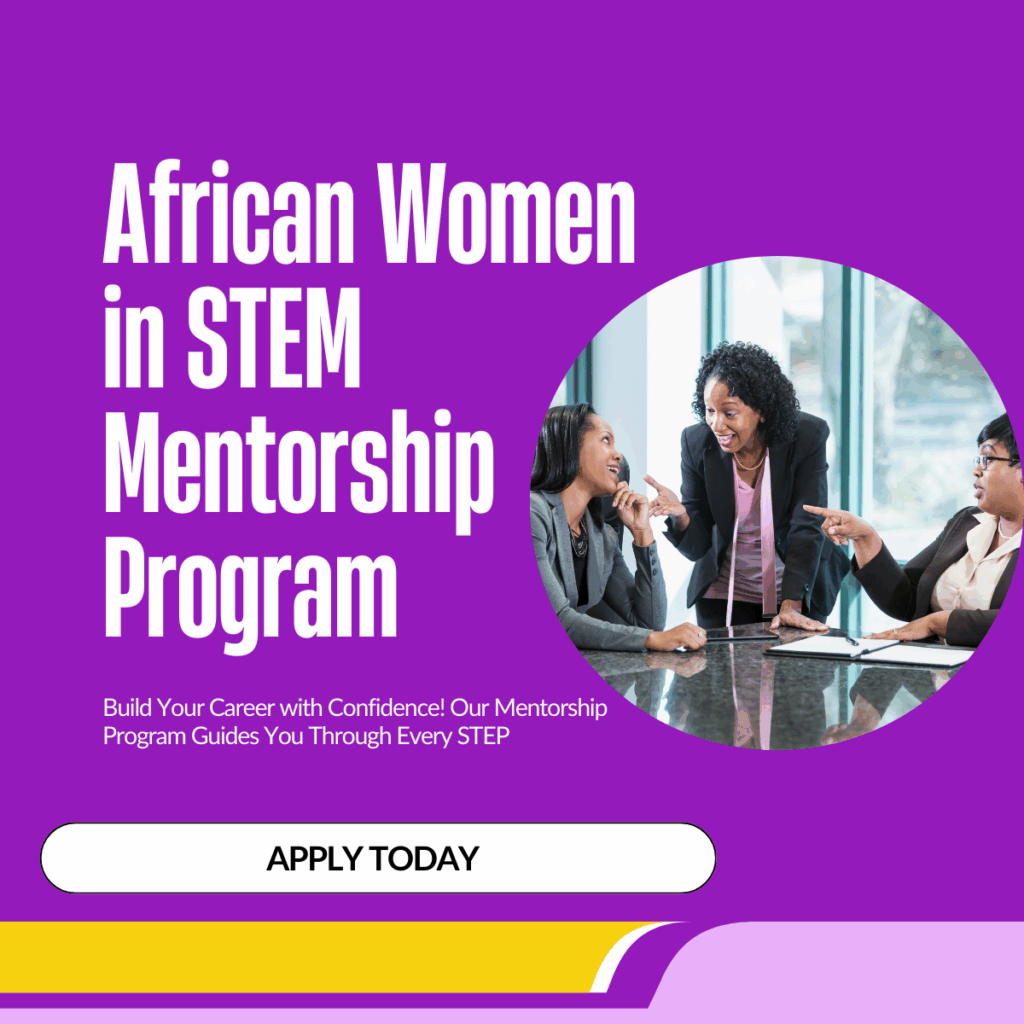
The journey to mastering digital skills can feel overwhelming without proper support, but the African Women in STEM mentorship program provides structure and direction. Participants gain step-by-step guidance from experienced mentors who understand the challenges unique to women in STEM across Africa. Instead of trying to navigate countless online resources alone, women receive clear learning paths that match their career goals.
Another key benefit is direct access to mentors who share real-life experiences. These mentors are not just teachers, they are professionals who have already faced barriers such as gender bias, limited resources, and societal expectations. By learning from their successes and mistakes, mentees gain insights that go far beyond what textbooks or online tutorials can provide. This real-world perspective helps women avoid common pitfalls and move forward with greater confidence.
In addition, joining the program connects women to a growing network of peers across Africa. This network becomes a source of encouragement, collaboration, and opportunity sharing. Women in Kenya can connect with peers in Ghana, Nigeria, or South Africa, learning from one another’s perspectives and experiences. These relationships often lead to joint projects, research collaborations, and even job opportunities.
Community Impact
The mentorship program is not only about individual growth but also about building collective strength. Every woman who joins contributes to the creation of a continent-wide community of African women in STEM. As women grow in confidence and skills, they are encouraged to give back by supporting others who are just starting out. This creates a powerful cycle of mentorship, where today’s mentees become tomorrow’s mentors.
The impact of this community goes beyond individual careers. By equipping more women with digital skills, the program strengthens Africa’s overall innovation potential. Skilled women bring fresh perspectives to research, technology, and engineering challenges. They inspire younger generations, reshape workplace cultures, and contribute to building an inclusive STEM ecosystem.
If you are ready to accelerate your digital skills journey and be part of a supportive, continent-wide community, join the African Women in STEM mentorship program today. Together, we grow, we innovate, and we transform the future of STEM in Africa.
Conclusion
Digital skills are no longer optional, they are the backbone of success in modern STEM fields. Whether it is data analysis, coding, cybersecurity, or digital collaboration, these skills are what enable innovation, problem-solving, and leadership in today’s fast-changing world.
For African women, acquiring these skills is not just about staying competitive, it is about unlocking opportunities to lead groundbreaking research, develop new technologies, and shape industries across the continent. By gaining confidence in digital tools, women can break barriers, challenge stereotypes, and inspire the next generation of scientists and innovators.