STEM stands for Science, Technology, Engineering, and Mathematics, a group of fields shaping our world more than ever before. From the technology powering your phone to the systems that keep cities running, STEM is the backbone of our modern society. Every day, breakthroughs in medicine, agriculture, renewable energy, and data science are changing lives, solving critical challenges, and opening new opportunities for growth and prosperity.
Now, more than ever, there’s a growing demand for African women in STEM. As industries become more global and as Africa’s influence rises, diverse voices and perspectives are crucial for innovation. African women bring unique ideas, cultural insights, and problem-solving skills that can transform how science and technology serve our communities.
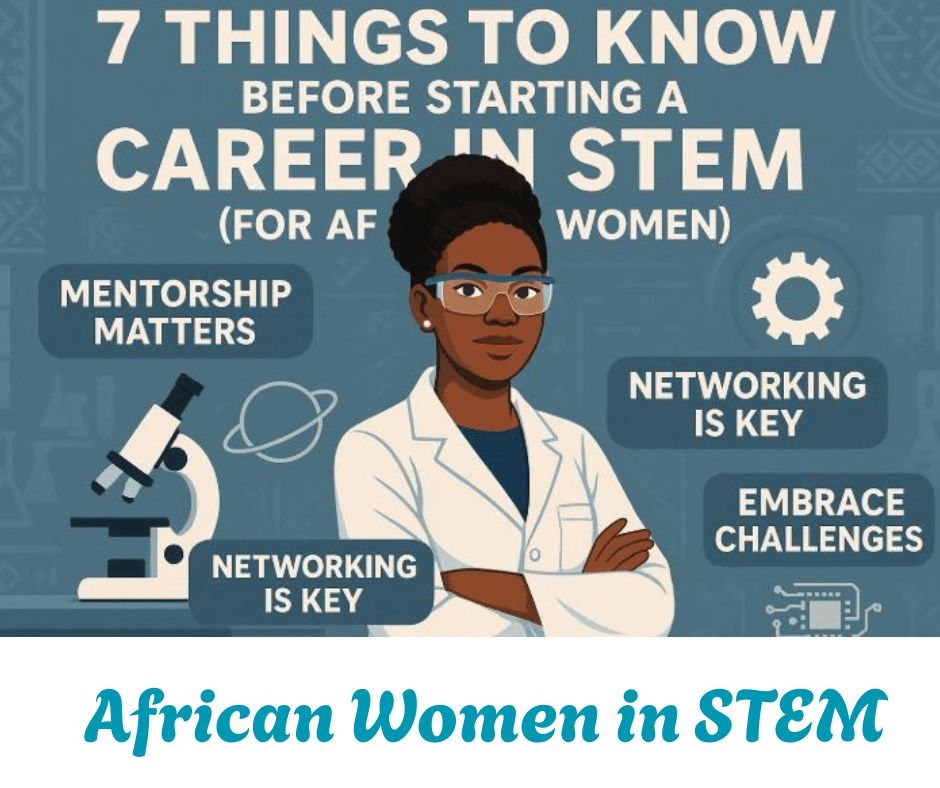
But let’s be real: STEM is exciting, but it isn’t just about degrees and jobs. It’s about preparation, mindset, and support. Success in STEM is not only a matter of passing exams; it’s about building confidence, finding mentors, expanding your network, and learning to advocate for yourself. If you’re considering a STEM career or if you’re already on the journey, here are the 7 things every African woman should know before diving in.
1. STEM Requires More Than Just Good Grades
Many people assume that excelling in STEM means getting straight A’s in math and science. While strong academics matter, they are only the starting point. In the real world, practical skills, critical thinking, creativity, and problem-solving matter just as much, if not more than your academic record.
Why Practical Skills Matter
Employers and research institutions are looking for people who can apply knowledge, not just memorize facts. Can you use data to solve a real-world problem? Can you troubleshoot a malfunctioning device or write code that streamlines a business process? These are the skills that set you apart.
Critical thinking helps you analyze data, interpret results, and make decisions based on evidence. Creativity and curiosity fuel innovation, helping you approach challenges in new ways. Problem-solving isn’t just for engineers, it’s for everyone in STEM.
Building Real-World Experience Early
Look for opportunities to gain hands-on experience while you are still in school or early in your career. Internships, volunteering, research assistantships, hackathons, coding camps, and science fairs all count. These experiences not only build your skills but also help you discover what you’re passionate about. They also make your resume more attractive to employers.
How We Help: IGNITE Membership
At African Women in STEM, our IGNITE Membership gives you access to skill-building resources, real-world projects, and workshops led by industry experts. We help you go beyond the classroom by connecting you with opportunities to practice and apply STEM skills in the real world.
2. Confidence Gaps Are Real But You Can Close Them
It’s no secret that STEM fields are still male-dominated. Many African women in STEM have experienced moments of self-doubt, even after earning degrees or landing great jobs. This feeling is often called imposter syndrome, the belief that you do not belong or that your success is just luck.
The Impact of Self-Doubt
Self-doubt can hold you back from applying for jobs, speaking up in meetings, or going after leadership roles. It can stop you from asking questions or seeking help when you need it. In a field that already has so many challenges, confidence gaps can make the journey even harder. However, you are not alone. Many African women in STEM have faced these same feelings.
Building Confidence
Confidence grows when you surround yourself with people who believe in you, who have faced similar doubts and overcome them. It comes from celebrating your wins—big and small—and from learning that mistakes are part of the process.
How We Help: Mentorship Program
Our Mentorship Program connects you with African women in STEM who have walked the same path and are now thriving. Mentors offer encouragement, share strategies for overcoming self-doubt, and help you develop the confidence to pursue your goals. You don’t have to do it alone, there’s a sisterhood here for you.
3. Your Network Will Open More Doors Than Your Resume
Academic achievements and technical skills are important, but your network often has more influence over your career than your resume. In STEM, where opportunities can be hidden and advancement depends on who knows your work, building authentic professional relationships is essential.
The Power of Networking
- 70 percent of jobs are filled through networking rather than open applications, according to CNBC.
- Professionals with strong networks are more likely to be promoted, recommended, and invited to collaborate on exciting projects.
- Networking exposes you to new ideas, industries, and opportunities you might never find on your own.
Building Authentic STEM Relationships
Networking is not about collecting business cards or making small talk, it’s about building genuine connections. Therefore, attend conferences, participate in online forums, join STEM organizations, and engage in social media discussions about your interests.
Don’t be afraid to reach out to people whose work you admire. Ask for advice, collaborate on projects, and share your own insights. Remember, networking is a two-way street—support others and they will support you.
How We Help: Thrive Hub Accelerator
Our Thrive Hub Accelerator is designed to help African women in STEM grow high-impact professional networks. Through curated networking events, mastermind groups, and introductions to leaders in your field, you’ll build relationships that open doors and help you reach your next level.
4. You May Encounter Bias But You’re Not Alone
Sexism, racial bias, and underrepresentation are realities in STEM worldwide, and African women often face a double barrier because of both gender and race. You may find yourself as the only woman, the only African, or both on your team. Bias can show up in subtle ways: being interrupted in meetings, having your ideas dismissed, or being passed over for promotions.
Facing and Overcoming Bias
It’s important to know that bias is not your fault and it’s not a reflection of your abilities. Staying resilient means seeking support, documenting your achievements, and finding allies. Learn to advocate for yourself and for others. Sometimes, just knowing you’re not alone can make a huge difference.
The Strength of Community
Connecting with others who share your experiences helps you process challenges and find practical solutions. Community is also a place to celebrate your successes and boost each other up.
How We Help: Community
Our Community is a safe space for African women in STEM to come together, share stories, and support each other through the ups and downs. We offer encouragement, visibility, collaboration, and a network of people who get what you’re going through—because they’ve been there too.
5. STEM Careers Are Broad, You Don’t Have to Have It All Figured Out
STEM is not a single path. It is a vast, ever-changing universe of possibilities from biotechnology, civil engineering, and computer science to renewable energy, robotics, and data analysis. You do not need to know exactly what you want to do at the start. Many successful women in STEM have taken winding paths, trying different roles before finding their passion.
Explore and Experiment
- Shadow different professionals: Ask to spend a day with an engineer, a data analyst, or a lab scientist.
- Take online courses: Platforms like Coursera or edX offer free and paid courses in hundreds of STEM fields.
- Volunteer or intern: Even short-term experiences can help you discover what you like and what you don’t.
Remember, career paths are rarely straight lines. Curiosity and willingness to learn are your best assets.
How We Help: Resources and Mentors
At African Women in STEM, our mentors and resources guide you in exploring various pathways within STEM. We help you identify your strengths, expose you to new possibilities, and connect you with women who can share what it’s really like in different roles and industries. You don’t have to make decisions in the dark.
6. You’ll Need Both Hard and Soft Skills
It’s not just about technical expertise. Communication, leadership, and teamwork are as vital as coding or lab work. Employers value people who can explain complex ideas clearly, lead teams, and collaborate across disciplines.
The Importance of Soft Skills
- Communication: Presenting research findings, writing reports, and explaining technical concepts to non-experts.
- Leadership: Managing projects, guiding teams, and taking initiative.
- Teamwork: Collaborating with others, respecting different perspectives, and resolving conflicts.
African women in STEM who master both hard and soft skills become leaders who inspire trust, unite teams, and drive innovation.
Examples of Success
Dr. Francisca Nneka Okeke, a renowned Nigerian physicist, has credited her rise in academia not just to her research but to her ability to lead and communicate. Similarly, software developers who can bridge the gap between tech teams and business leaders become invaluable assets in tech companies.
How We Help: Workshops and Coaching
Through IGNITE and Thrive Hub, we offer workshops and coaching on both technical and soft skills. You’ll learn public speaking, negotiation, leadership, and more all in a supportive, culturally informed environment.
7. Support Makes All the Difference
The single most important predictor of success in STEM is not grades, school prestige, or even technical ability—it’s support. Mentors, a strong community, and a clear career strategy can turn barriers into stepping stones. No one succeeds in STEM alone.
Why Support Networks Matter
- Mentors share wisdom and open doors.
- Communities offer encouragement and accountability.
- Career coaches help you craft strategies and stay on track.
Having a support system means you have someone to turn to for advice, someone to cheer you on, and someone to celebrate your wins.
How We Help: Comprehensive Programs
Every one of our programs from Mentorship, to IGNITE and Thrive Hub is designed to ensure no African woman in STEM has to walk her journey alone. From one-on-one mentorship to group coaching to a vibrant online community, we make sure you have the support you need at every stage.
Conclusion
A career in STEM is challenging, rewarding, and transformative. It’s not just about getting a job,it’s about making an impact, solving problems, and shaping the future of Africa and the world. But no one should have to do it alone.
If you remember one thing, let it be this: You belong here. You are needed. The world needs your voice, your ideas, your leadership. With the right preparation and support, you can go farther than you ever imagined.
At African Women in STEM, we’re here to walk this journey with you. Through mentorship, skill-building, networking, and community, we help you overcome barriers and seize opportunities. Whether you’re just starting out or ready to take your career to the next level, we have a place for you.
So, visit africanwomeninstem.com to learn more, join our programs, and connect with a network of African women who are building the future together.