
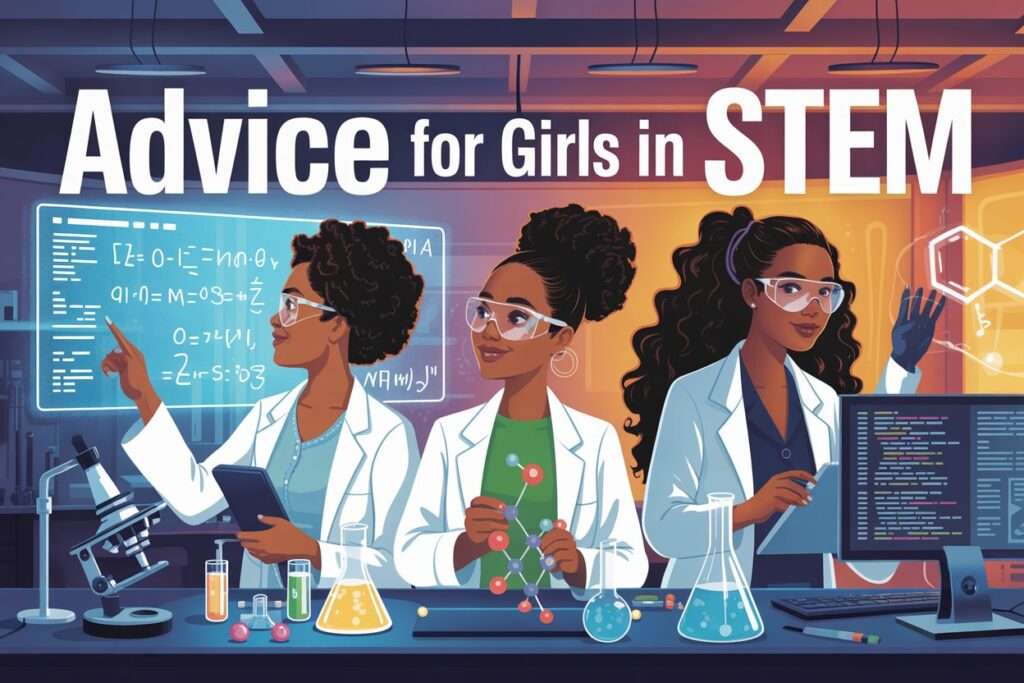
Let me tell you something important: the world needs your brilliant mind in science, technology, engineering, and mathematics. Right now, girls and women make up only a small percentage of people working in STEM fields across Africa and around the world. This isn’t because girls aren’t capable. It’s because too many girls face obstacles that boys don’t encounter in the same way.
In addition, you might hear people say that math is “too hard for girls” or that engineering is “a man’s job.” You might look around your classroom and notice you’re one of only a few girls interested in physics or computer science. Also, you might not see many women scientists or engineers in your textbooks or on TV. These challenges are real, but they don’t define what you can achieve.
The truth is that diversity makes STEM better. When people from different backgrounds bring their unique perspectives to solve problems, they create solutions that work for everyone. Your voice, your ideas, and your way of thinking are exactly what the STEM world needs more of.
This article is here to give you practical advice that will help you not just survive in STEM, but truly thrive. Whether you’re just getting curious about science or you’re already working on your next big project, these tips will support you on your journey.
Believe in Your Curiosity
Do you remember being a little girl who wanted to know how everything worked? Maybe you took apart toys to see what was inside. Maybe you asked “why” and “how” about everything around you. That curiosity is still inside you, and it’s your greatest strength in STEM.
Science, technology, engineering, and math are all built on curiosity. Every invention, every discovery, every breakthrough started with someone asking a question. Also, when you wonder why the sky changes colors at sunset, you’re thinking like a scientist. When you figure out a shortcut to solve a math problem, you’re thinking like an engineer. When you imagine a better way to do something, you’re thinking like an innovator.
Don’t let anyone make you feel like your questions are silly or your ideas are too ambitious. Some of the most important discoveries in history came from people who asked questions others thought were impossible to answer. Marie Curie was curious about invisible rays and discovered radioactivity. Katherine Johnson was curious about the math behind space travel and helped put astronauts on the moon. African scientists like Wangari Maathai were curious about the connection between environmental conservation and social justice, changing how we think about sustainability.
Your curiosity is not a distraction from learning. It IS learning. Feed it. Explore ideas that fascinate you. Try experiments, even small ones. Read about topics that excite you. Watch documentaries. Visit science museums or exhibitions when you can. The more you follow your curiosity, the more you’ll discover what you’re passionate about in STEM.
Build Confidence Step by Step
Here’s something many girls struggle with: confidence. Studies show that even when girls perform just as well as boys in STEM subjects, they often feel less confident about their abilities. You might know the answer in class but hesitate to raise your hand. You might understand the concept but doubt yourself when it’s time to take the test.
This confidence gap is real, but it’s not permanent. Confidence isn’t something you’re born with. It’s something you build, one small action at a time.
Start by celebrating your small wins. Did you finally understand that difficult chemistry equation? That’s a win. Did you complete your coding project, even if it wasn’t perfect? That’s a win. Did you speak up once in your math class? That’s a win. Each small victory builds the foundation for bigger confidence.
Try new skills, even when they feel uncomfortable. Sign up for that robotics workshop even if you’ve never built anything before. Attempt the advanced math problem even if you’re not sure you’ll get it right. Every time you try something new, you prove to yourself that you’re capable of growth.
Practice speaking up. Share your ideas in group projects. Ask questions when you don’t understand. Answer questions when you do. At first, your voice might shake. That’s okay. Every woman in STEM who speaks confidently at conferences today once felt nervous speaking up in a classroom.
Remember this: confidence doesn’t come from being perfect. It comes from taking action. Also, you don’t need to have all the answers before you start or need to be the best before you participate. You just need to begin, and confidence will grow as you go.
Find Mentors and Role Models
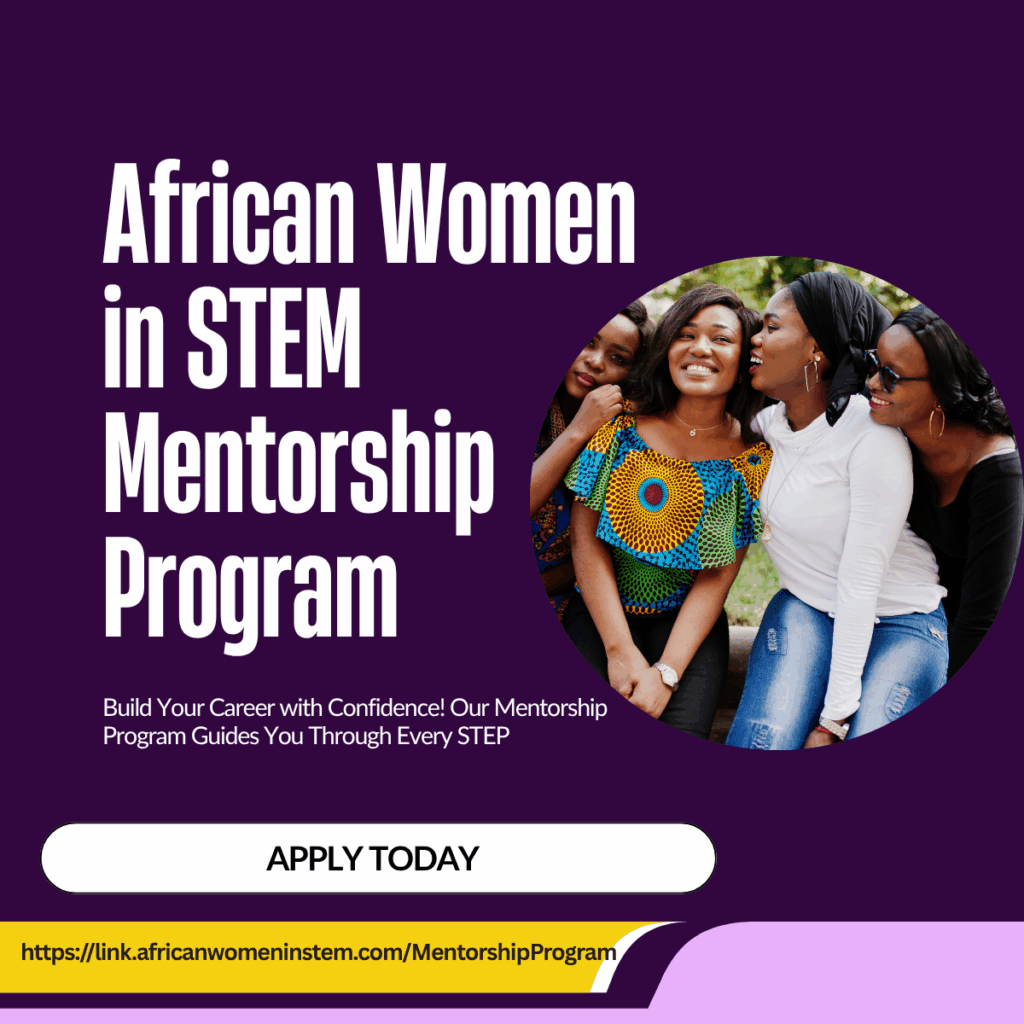
One of the hardest parts of being a girl in STEM is not seeing enough women who look like you in these fields. When all your textbooks show male scientists, when all your teachers are men, when you can’t name a single female engineer, it’s easy to wonder if you belong.
This is why mentors and role models are so important. A mentor is someone who has walked the path you want to walk and can show you the way. A role model is someone whose success shows you what’s possible. Both can change your entire STEM journey.
A good mentor can help you in many ways. They can answer your questions about coursework and career paths, share their own struggles and how they overcame them and can introduce you to opportunities you didn’t know existed. They can remind you that you belong when you start to doubt yourself. Most importantly, they can show you that if they made it, you can too.
Where do you find these mentors? Start by looking around your school. Is there a teacher who seems excited about supporting girls in STEM? Ask if they’d be willing to meet with you occasionally to talk about your interests. Look for STEM programs in your community that pair students with mentors. Search online for virtual mentorship programs that connect girls with women working in STEM fields.
Join communities where women in STEM gather. This is where you’ll find both mentors and peers who understand your journey. Speaking of which, if you’re looking for a community that gets it, African Women in STEM is here for you. This is a space where you can meet mentors who understand the specific challenges you face, ask questions without judgment, and feel supported by women who have been where you are. Join us, and let’s grow together.
Embrace Challenges Instead of Fearing Them
Let’s be honest: STEM can be hard. But here will be subjects that confuse you. Also, there will be problems you can’t solve on the first try. There will be moments when you feel completely lost. But here’s what you need to understand: difficulty doesn’t mean you’re not smart enough. It means you’re learning.
Many girls interpret struggle as a sign that they don’t belong in STEM. When a math problem is hard, they think “I’m not good at math.” When a coding project doesn’t work, they think “Maybe programming isn’t for me.” But boys often interpret the same struggle differently. They think “This is hard, but I’ll figure it out.”
This difference in mindset makes a huge difference in success. It’s called a growth mindset, and it’s the belief that your abilities can improve with effort and practice. Instead of thinking “I can’t do this,” try thinking “I can’t do this YET.”
Look at the stories of successful women in STEM, including African women making waves in science and technology. Dr. Mosidi Motshegwa from Botswana, a computer scientist working on artificial intelligence, didn’t become an expert overnight. Dr. Francisca Nneka Okeke from Nigeria, who studies human-computer interaction, faced challenges learning new technologies. Every successful woman in STEM has a story of struggling with something before mastering it.
When you face a difficult subject or project, don’t run away from it. Break it down into smaller pieces. Find additional resources to help you understand. Ask for help from teachers or peers. Try different approaches. The struggle itself is making you stronger and smarter.
Learn Through Hands-On Experiences
Reading about science is good. Doing science is better. One of the best ways to fall in love with STEM and build your skills is through practical, hands-on experiences.
Join STEM clubs at your school. If there isn’t one, consider starting one with friends and a supportive teacher. These clubs give you space to explore your interests in a low-pressure environment.
Look for robotics teams in your area. Building and programming robots teaches you engineering, problem-solving, and teamwork all at once. Don’t worry if you’ve never touched a robot before. Everyone starts somewhere.
Attend coding camps or workshops, whether in person or online. Coding might seem intimidating, but many programs are designed specifically for beginners. You could learn to build websites, create apps, or even make games.
Participate in science fairs. These events let you design your own experiment, test your hypothesis, and present your findings. It’s real science, and you get to choose what to study.
Take on online challenges. Many websites offer STEM challenges, competitions, and projects you can do from home. These are great if you don’t have many opportunities nearby.
Hands-on learning does something that lectures and textbooks can’t: it shows you that you can create, build, and solve real problems. When you write your first line of code that actually works, or when your science experiment produces results, or when your engineering design successfully solves a problem, you feel something powerful. You feel capable.
Build a Supportive Community
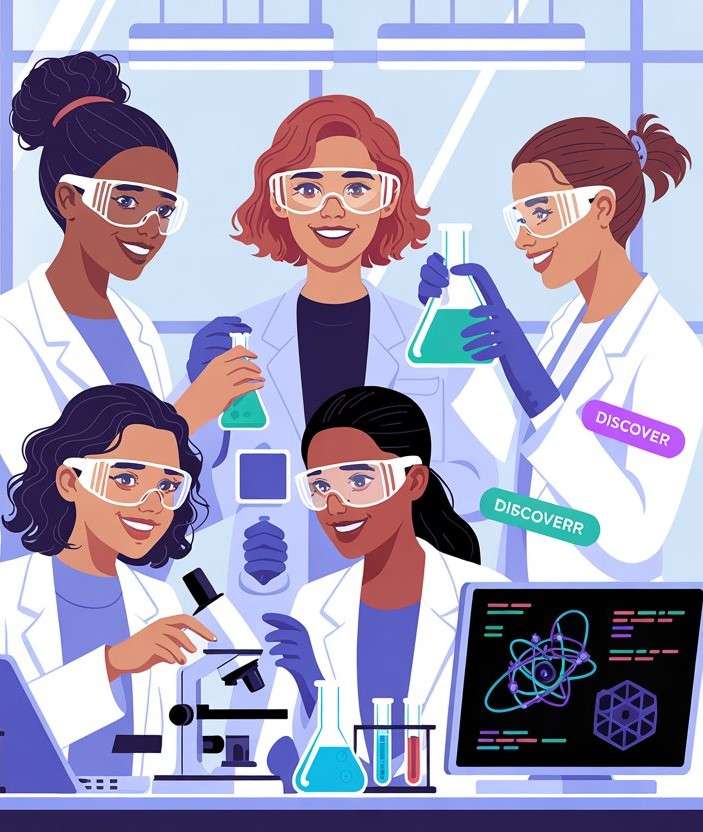
STEM can feel lonely, especially if you’re one of few girls in your classes or programs. Having people who understand what you’re going through makes everything easier.
Find your people. Look for other girls who are interested in STEM. Form study groups where you can work through difficult problems together. When you’re struggling with a concept, explaining it to someone else or hearing their explanation can help it finally click.
Collaboration isn’t cheating. It’s how real scientists, engineers, and technologists work. They share ideas, challenge each other’s thinking, and solve problems as teams. Learning to work with others now prepares you for the collaborative nature of STEM careers.
A supportive community also reduces the pressure you feel. When you see others making mistakes and learning from them, you realize that perfection isn’t the goal. When you celebrate each other’s successes, you create an environment where everyone can thrive.
Attend workshops and events where you can meet other young women interested in STEM. These gatherings remind you that you’re not alone on this journey.
If you’re looking for this kind of supportive community, African Women in STEM is the place for you. We offer workshops where you can learn new skills, mentorship programs where you can connect with experienced women in STEM, and a network of peers who understand your journey. We create spaces where you can ask questions, share your struggles, and celebrate your wins with people who truly get it. Join us, and find your STEM family.
Explore Different STEM Paths
When people say “STEM,” you might immediately think of being a doctor or an engineer. But STEM is so much bigger than just a few careers. There are hundreds of paths you can take, and exploring them helps you find what excites you most.
Software development is booming across Africa. You could create apps that solve problems in your community, build websites for businesses, or develop systems that make life easier for millions of people.
Engineering has many branches. Civil engineers design buildings and infrastructure. Mechanical engineers create machines and devices. Electrical engineers work with power systems and electronics. Chemical engineers develop new materials and processes. Which type interests you?
Data science is one of the fastest-growing fields. Data scientists analyze information to help organizations make better decisions. In a world generating more data every day, these skills are incredibly valuable.
Biotechnology combines biology and technology to solve problems in health, agriculture, and the environment. You could work on developing new medicines, creating drought-resistant crops, or finding sustainable solutions to environmental challenges.
Medicine remains one of the most respected STEM careers. But it’s not just about being a doctor. You could be a medical researcher discovering new treatments, a public health expert designing programs to keep communities healthy, or a biomedical engineer creating medical devices.
Environmental science is crucial for Africa’s future. You could study climate change, work on conservation projects, develop sustainable farming methods, or create solutions for water scarcity.
Research and academia allow you to focus on discovery itself. As a researcher, you could spend your career answering questions that fascinate you and expanding human knowledge.
Don’t feel pressured to choose your path right now. Explore different fields. Take classes in various subjects. Try internships or volunteer opportunities in different areas. The more you explore, the better you’ll understand what makes you excited to learn and work.
Ignore Stereotypes and Own Your Identity
Let’s talk about something frustrating: stereotypes. You might hear that girls are naturally better at some subjects than others. In addition, you might hear that you need to act a certain way to be taken seriously in STEM or might feel pressure to choose between being feminine and being a scientist.
Here’s the truth: these stereotypes are lies. There’s no such thing as a “STEM personality” or a “STEM look.” Successful women in STEM come in all personalities, styles, and interests. Some are quiet and introverted. Others are loud and outgoing. Some love fashion and makeup. Others don’t. What they have in common isn’t how they look or act. It’s their curiosity, persistence, and passion for their work.
Likewise, you don’t need to change who you are to succeed in STEM and don’t need to be more like boys or less like girls. You need to be yourself, because your unique perspective is valuable.
Diversity of thought and background makes innovation possible. When everyone in a room has the same experiences and perspectives, they come up with similar ideas. But when people from different backgrounds collaborate, they see problems from different angles and create better solutions. Your experiences as an African woman give you insights that others might miss.
Show up as yourself. Be proud of your identity. Your background, your culture, your way of thinking—these aren’t obstacles to success in STEM. They’re advantages.
Celebrate Progress, Not Perfection
In STEM, there’s often a focus on getting the right answer. While accuracy matters, this focus on perfection can make you afraid to try. You might not attempt a difficult problem because you’re scared of being wrong. You might not share your idea because it’s not fully developed.
But STEM isn’t really about perfection. It’s about progress. It’s about experimenting, making mistakes, learning from them, and trying again. Also, every scientist has experiments that fail. Likewise, every engineer has designs that don’t work on the first try. Every programmer writes code with bugs. This isn’t failure. This is how STEM works.
Track your progress instead of judging yourself against perfection. Keep a journal where you write about what you’re learning. Look back at where you were three months ago, six months ago, a year ago. You’ll be surprised at how much you’ve grown.
Take pride in improvement, not just achievement. Did you finally understand a concept that confused you last month? Celebrate that. Did you complete a project even though it wasn’t as polished as you wanted? Celebrate that too. Did you try something new, even though it didn’t go perfectly? That’s worth celebrating.
Mistakes are normal. They’re not signs that you don’t belong in STEM. They’re proof that you’re pushing yourself to learn. Every mistake teaches you something. Every failure brings you closer to success.
When things don’t go as planned, ask yourself: What did I learn? How can I use this experience to improve next time? This mindset transforms mistakes from sources of shame into opportunities for growth.
Conclusion
As we come to the end of this article, I want you to remember something important: you belong in STEM. Not despite being a girl, but because of everything you bring to the field. Also, your perspective matters, ideas matter and your contributions will matter.
The path won’t always be easy. There will be moments of doubt. Also, there will be challenges that feel overwhelming. There will be people who underestimate you. But there will also be moments of pure joy when you finally understand a difficult concept, when you solve a problem that seemed impossible, when you create something that makes a difference.
Stay bold. Stay curious. Keep learning. Every question you ask, every problem you solve, every project you complete is preparing you for an incredible future.
And remember, you don’t have to do this alone. Support is available. Community is waiting for you. Join African Women in STEM today. Connect with mentors who have walked this path and want to help you succeed.