
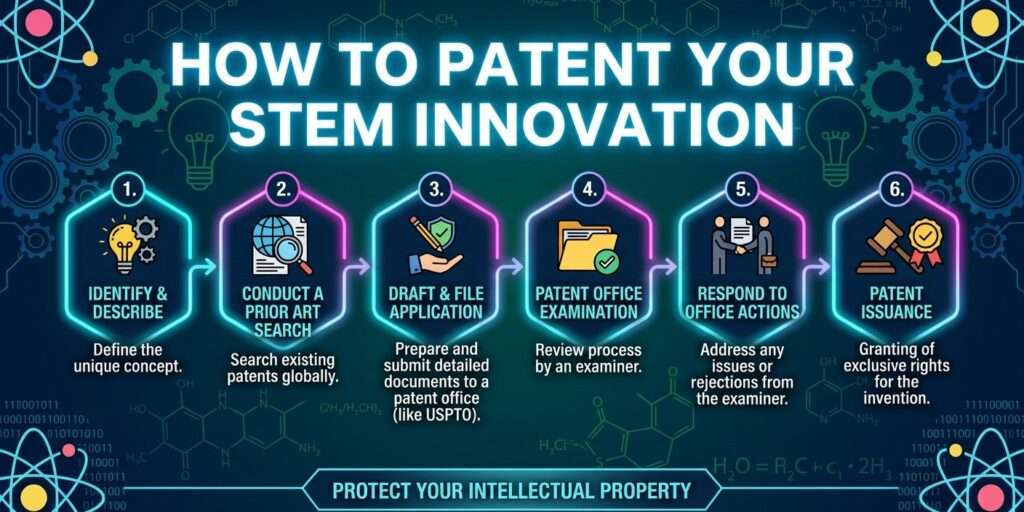
You built something worth protecting. Maybe it is a new process that solves a problem your industry has been ignoring for years. Perhaps it is a device, a method, a software system, or a material compound that genuinely works better than anything currently available. Whatever the innovation, the next question matters enormously: how do you make sure nobody else can profit from your idea before you do?
Patents exist precisely for this reason. A granted patent gives you exclusive rights to prevent others from making, using, selling, or importing your invention for up to 20 years from the date you file. For women in STEM who are building, founding, and inventing at an increasing rate, understanding the patent process is not a legal technicality. It is a career and financial asset that compounds over time.
This guide walks you through the full process clearly and practically, so you can move forward with confidence rather than guesswork.
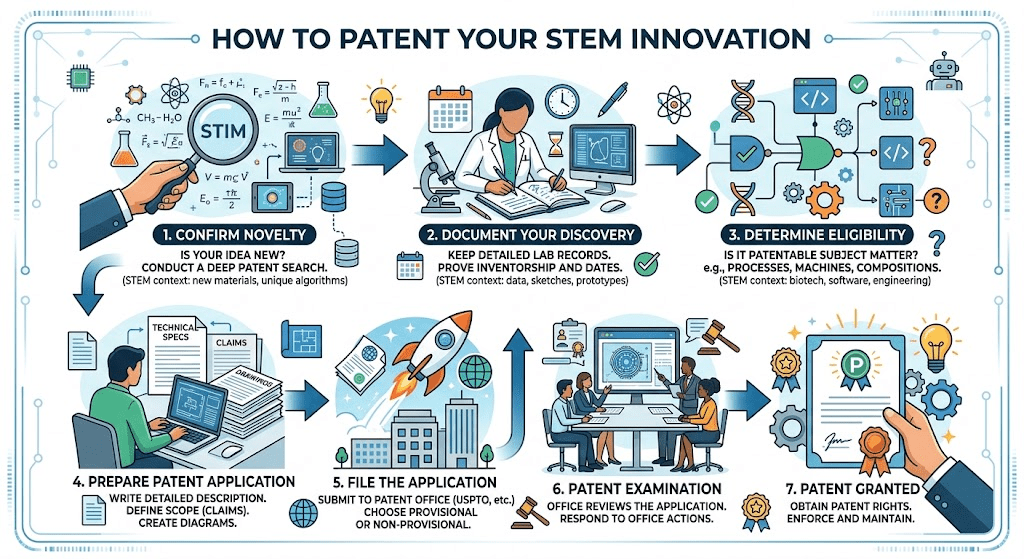
Understand What a Patent Actually Protects
Before filing anything, you need to understand what patents cover and what they do not. The United States Patent and Trademark Office, known as the USPTO, grants three main types of patents.
Utility patents protect how something works. This is the most common type and the one most STEM professionals will need. Utility patents cover processes, machines, manufactured items, and compositions of matter. If you developed a new engineering method, a biomedical device, an AI algorithm with a specific industrial application, or a chemical compound, a utility patent is almost certainly the right category.
Design patents protect how something looks. They cover the ornamental or aesthetic features of a functional item, not the function itself. A unique visual design for a piece of laboratory equipment, for example, could qualify.
Plant patents cover new varieties of asexually reproduced plants. Unless you work in agricultural biotechnology, this type is unlikely to apply to your work.
Most STEM innovations fall under utility patents, so the rest of this guide focuses there.
Check Whether Your Innovation Qualifies
Not every invention qualifies for a patent. The USPTO requires your innovation to meet three specific criteria before granting protection.
Novel:Your invention must be new. If the same idea already exists anywhere in the world, whether in a published paper, an existing patent, a product on the market, or even a public presentation, it fails the novelty test. This is why timing matters. Publicly disclosing your invention before filing can disqualify you from patent protection in many countries.
Non-obvious: Your invention must represent a meaningful leap beyond what already exists. Something that any trained professional in your field would consider a minor or obvious modification of existing technology does not qualify. The standard is not that the idea is surprising, but that it would not be immediately apparent to a skilled practitioner.
Useful: Your invention must have a clear, practical application. Theoretical ideas, abstract concepts, natural phenomena, and laws of nature do not qualify. The usefulness requirement is generally the easiest to satisfy for STEM innovations with real-world applications.
Document Everything From the Start
Documentation is the foundation of a strong patent claim. Start recording your invention process immediately and maintain that record consistently throughout development.
Your documentation should capture the initial concept and the date you conceived it. Include every design iteration, every test result, every modification, and every discovery made along the way. Note the specific problems your invention solves and how your solution differs from existing approaches. Date every entry. Sign and date your records, and where possible, have a trusted witness do the same.
Maintain dated records in bound notebooks or secure digital systems, and include witness signatures when possible, especially for breakthrough moments or critical discoveries. While the United States now operates under a first-to-file system, meaning the priority goes to whoever files first rather than whoever invented first, comprehensive documentation remains critical for legal challenges to patent validity.
Conduct a Thorough Patent Search
Before investing significant time and money into a patent application, search the existing patent landscape to understand what is already out there. This step saves you from filing an application that will almost certainly be rejected and from building a strategy around protection that cannot be obtained.
The USPTO Patent Database provides free access to millions of patents, while Google Patents offers user-friendly search capabilities. Start your search there. Look for patents that cover similar inventions, similar methods, or similar applications to yours. Read the claims sections carefully, because that is where the actual legal protection is defined, not the abstract or the description.
A professional patent search gives you a significant advantage. A thorough professional patent search costs around $399, and that investment kills bad ideas early and gives you a written report you can hand an attorney before drafting begins. The math is simple: a search that disqualifies your concept saves you $7,000 to $15,000 in patent attorney fees and government filing costs.
Search thoroughly and honestly. If you find existing patents that cover your idea, that information is valuable even when it is disappointing. It tells you whether to pivot your approach, narrow your claims, or focus on a genuinely differentiated aspect of your work.
Choose Between a Provisional and Non-Provisional Application
Once you confirm that your innovation is patentable and novel, decide which type of application to file first. This decision affects your costs, your timeline, and your strategy.
A provisional patent application establishes your priority date without triggering the full examination process. Filing one gives you 12 months to continue developing your invention, seek funding, or test the market before committing to the full application process. Provisional applications are less expensive and less formally structured, but they must be strong enough to actually support the claims you eventually make in your non-provisional application. A weak provisional buys you weak protection.
A non-provisional patent application triggers the official examination process. This is the full application that, if approved, results in a granted patent. It requires a specification that describes your invention in sufficient detail, a set of claims that define exactly what you are protecting, drawings where applicable, and an abstract. The USPTO then examines your application, which can take anywhere from one to three years depending on the technology area.
For most STEM innovators who are still developing or testing their invention, filing a provisional application first makes strategic sense. It secures your priority date while buying time to refine the invention and gather resources for the more expensive non-provisional process.
Write Strong Claims
The claims section of your patent application is where your actual legal protection lives. Claims define the specific boundaries of what you own. Broad, well-drafted claims make it significantly harder for competitors to design around your patent. Narrow or poorly drafted claims protect very little of practical value.
Independent claims should be as broad as the prior art allows. Dependent claims should narrow toward your preferred embodiment. In practice, this means your independent claims describe your invention at its most general useful level, while dependent claims add specific details that give you additional layers of protection.
Writing claims is the most technically demanding part of the patent process and the area where most inventors without legal training make costly mistakes. Working with a qualified patent attorney or patent agent at this stage pays for itself many times over. The specification and claims together must enable any skilled practitioner in your field to replicate your invention based on what you have written. Gaps in this enablement get claims narrowed or rejected.
Understand the Costs Involved
Patents require real financial investment. Going in with a clear picture of the costs prevents surprises and allows you to plan strategically.
Filing costs include: a professional patent search at roughly $1,500 to $4,000; drafting and filing a non-provisional application with USPTO fees around $800, plus attorney fees that average roughly $5,000 to $8,000; responding to a rejection at $0 to $660 in USPTO fees and roughly $3,000 to $5,000 in attorney fees per office action; and an issue fee at grant of about $500 in USPTO fees.
Small entities and micro-entities, including many independent inventors and small businesses, qualify for significantly reduced USPTO fees. Confirm whether you qualify before filing, because the savings are substantial.
Additionally, if you want protection in other countries, you will need to file internationally. The Patent Cooperation Treaty, known as the PCT, allows you to file a single international application that preserves your rights in over 150 countries for up to 30 months, giving you time to decide where to pursue protection before incurring the full cost of individual national filings.
Navigate the Examination Process
After you file a non-provisional application, the USPTO assigns a patent examiner in your technology area. That examiner searches existing patents and prior art, then either approves your application or issues an office action, which is a formal document outlining the reasons for rejection or the changes required.
Roughly half of all patent applications filed face at least one rejection, and strategic navigation is what makes the difference between securing exclusive rights worth millions and watching competitors replicate your innovation without consequence. Receiving an office action is not a failure. It is a normal part of the process that your patent attorney responds to with arguments and amendments.
The examination process takes time. Average pendency for utility patents currently runs between 18 and 30 months from the date of filing. Complex technology areas, including AI and biotechnology, can take longer. Plan your business and commercialisation strategy with this timeline in mind.
Protect Your Patent After It Is Granted
Receiving a granted patent is a significant achievement. It is also the beginning of a new responsibility. The USPTO does not monitor or enforce your patent. That responsibility falls entirely on you.
Stay alert to the market. If a competitor appears to be using your patented invention without a licence, consult a patent attorney about your enforcement options. Maintain your patent by paying the required maintenance fees at 3.5, 7.5, and 11.5 years after grant. Missing these fees causes your patent to lapse.
Consider whether licensing your patent to others might generate revenue without requiring you to manufacture or distribute the invention yourself. A well-drafted patent with strong claims can become a genuine revenue stream through licensing agreements, particularly in technology-intensive industries.
Frequently Asked Questions
Do I need a patent attorney?
You can file a patent application yourself, and the USPTO website provides resources to help. However, the complexity of writing claims that provide genuine protection makes working with a registered patent attorney or patent agent worth the investment for most STEM innovations. The money you spend on strong drafting is far less than the cost of weak claims that competitors can easily design around.
What happens if I publicly disclose my invention before filing?
In the United States, you have a one-year grace period from public disclosure to file a patent application. However, many other countries offer no grace period at all. Any public disclosure before filing destroys your right to patent protection internationally. File before you present, publish, or pitch publicly whenever possible.
Can I patent software or AI inventions?
Software and AI inventions occupy complex legal territory. Abstract ideas alone are not patentable, but software that produces a specific technical result or improves a technical process can qualify. The USPTO has been actively examining AI-related patent applications, and AI alone is fuelling over 30% of new patent filings in 2026. Work with a patent attorney experienced in software and AI to navigate the specific eligibility requirements for your invention.
How long does patent protection last?
Utility patents protect your invention for 20 years from the filing date of your non-provisional application, provided you pay the required maintenance fees. Design patents provide 15 years of protection from the date of grant with no maintenance fees required.
Conclusion
Patenting your STEM innovation is not just a legal formality. It is a strategic investment in the value of your work and your ability to benefit from it over the long term. The process requires attention, resources, and patience. Done well, however, it creates a defensible asset that can generate revenue, attract investors, and protect everything you have built from competitors who would otherwise profit from your ingenuity without contributing to it.
Start documenting your invention today. Search the existing landscape honestly. File before you disclose publicly. Work with qualified professionals on your claims. And treat your intellectual property with the same seriousness and strategy that you bring to the innovation itself.
References
- United States Patent and Trademark Office. Nonprovisional (Utility) Patent Application Filing Guide [Internet]. Last modified 2026 Mar 26. Available from: https://www.uspto.gov/patents/basics/apply/utility-patent
- United States Patent and Trademark Office. Applying for Patents [Internet]. Last modified 2026 Apr 29. Available from: https://www.uspto.gov/patents/basics/apply
- United States Patent and Trademark Office. How to Apply for a Patent [Internet]. Available from: https://www.uspto.gov/patents/basics/patent-process-overview