

Cities are changing faster than most people realise. Across the world, urban centres are embedding sensors into roads, deploying AI to manage energy grids, using real-time data to redirect traffic, and building digital platforms that connect millions of residents to public services they once had to queue for in person. This is not a distant vision of the future. The global smart cities market reached $2.25 trillion in 2025 and is projected to grow to approximately $15.92 trillion by 2035, growing at a compound annual rate of over 21%.
Behind every sensor, every data pipeline, every algorithm optimising a city’s water usage or public transport network, there is a STEM professional. Probably several. The smart city revolution is not just changing how cities work. It is generating an entirely new category of careers, and many of them do not yet have widely recognised job titles.
For women in STEM, this represents something significant. Not just new job openings in familiar fields, but a genuine opportunity to build careers in spaces that are still being defined, where the rules have not been set yet and where showing up early carries real advantage.
What a Smart City Actually Is
Before exploring the careers, it helps to understand what a smart city actually involves. At its core, a smart city uses technology and data to improve how urban infrastructure functions and how residents experience daily life. Professionals in this field work on projects related to transportation, energy efficiency, data analytics, IoT, and governance, in roles including urban planners, data analysts, engineers, and policy advisors, all collaborating to create more efficient and livable cities.
Think of it as applying an engineering mindset to the entire city as a system. Traffic lights communicate with each other to reduce congestion. Buildings adjust their energy consumption based on occupancy patterns. Waste collection routes update in real time based on sensor data from bins. Emergency services receive predictive alerts before problems escalate. Every one of these systems requires people to design it, build it, test it, manage it, and improve it over time.
The range of disciplines involved is broader than most people expect. Data science, electrical engineering, cybersecurity, urban planning, environmental science, public health, communications technology, and policy all converge in smart city work. That convergence creates space for professionals with diverse STEM backgrounds, not just software engineers.
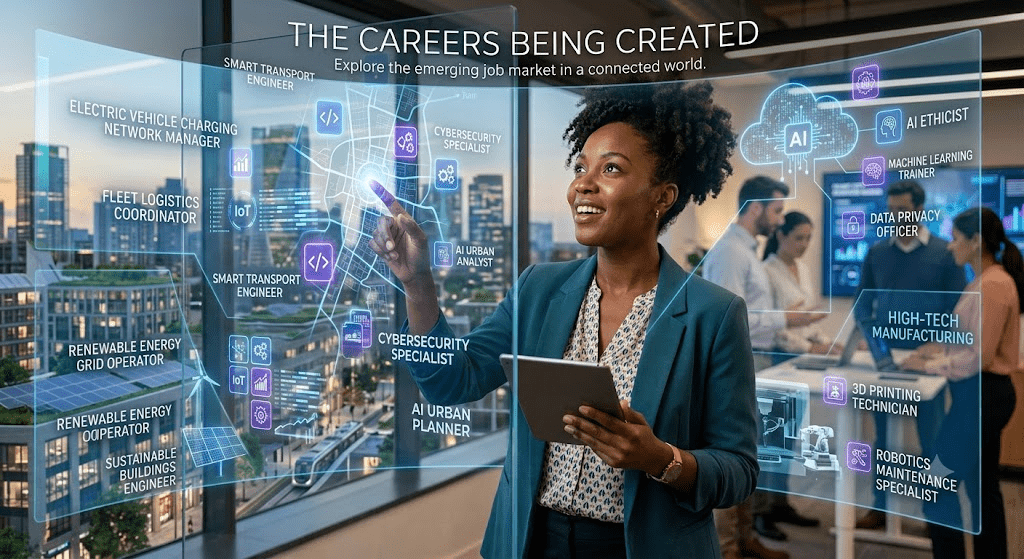
The Careers Being Created Right Now
IoT Engineers and Systems Architects
Smart cities run on the Internet of Things, the vast network of connected sensors and devices that collect and transmit data across urban infrastructure. Someone has to design that network, maintain it, secure it, and troubleshoot it when any part of it fails. IoT engineers and systems architects do exactly that.
As smart cities leverage IoT infrastructure to collect traffic, weather, human, and other data and analyse it with third-party applications to create more value, technical roles in this space are becoming central to improving the quality of life of city residents. These roles require expertise in embedded systems, networking, and data transmission protocols. They are well-suited to electrical engineers, computer engineers, and systems specialists who enjoy working at the intersection of hardware and software.
Urban Data Scientists and Analysts
Every smart city generates enormous volumes of data every day. Traffic patterns, energy consumption, air quality readings, public transport usage, emergency response times: all of this data has value, but only when someone with the skills to analyse it can turn it into insights that city planners and policy makers can actually act on.
Urban data scientists occupy a space that barely existed a decade ago. They combine traditional data science skills with an understanding of urban systems, public policy, and community impact. The job outlook for data scientists is exceptionally strong, with employment projected to grow by 31% from 2019 to 2029, and smart city development is one of the sectors driving that demand. The African Women in STEM community has been exploring AI fluency as a career accelerator throughout this season, and urban data science is one of the clearest examples of where that fluency translates directly into high-demand, well-compensated roles.
Smart Infrastructure and Civil Engineers
Physical infrastructure does not disappear in a smart city. Roads, bridges, buildings, water systems, and energy grids all still need to be designed, built, and maintained. What changes is that smart cities require those physical systems to integrate with digital technology. A road is not just a road anymore. It carries sensors, communication equipment, and data infrastructure alongside vehicles.
Emphasis on smart cities and green construction expands opportunities as municipalities modernise infrastructure across the United States, creating demand for civil and structural engineers who understand both physical systems and digital integration. Civil engineers who build competency in IoT integration, digital twins, and smart materials are positioning themselves for a generation of infrastructure work that combines traditional engineering with emerging technology.
Cybersecurity Specialists for Urban Systems
A city that runs on connected technology is a city with a vastly expanded attack surface. Every sensor, every network node, every data pipeline represents a potential vulnerability. When the system being attacked is a city’s water supply, power grid, or emergency communications network, the stakes are not theoretical.
Cybersecurity for smart urban infrastructure is one of the fastest-growing specialisations within the broader field. Professionals in this space combine knowledge of traditional cybersecurity with understanding of industrial control systems, IoT security, and the specific regulatory and governance frameworks that apply to public infrastructure. The demand is significant, and the talent pool remains genuinely insufficient to meet it.
AI and Machine Learning Engineers
AI and machine learning scientists are central to smart city development, improving the quality of life of city residents and creating new revenue streams as cities analyse data from IoT infrastructure to create more value. These professionals build the systems that make smart city data genuinely useful: predictive models that anticipate infrastructure failures before they happen, optimisation algorithms that route emergency vehicles through traffic in real time, and natural language systems that allow residents to interact with city services through digital platforms.
AI engineering in the smart city context requires not just technical skill but the ability to design systems that account for equity and bias. As Christelle Mombo-Zigah discussed in an earlier episode on AI governance, the systems we build reflect the values and blind spots of the people who build them. Smart city AI will have profound effects on how resources are distributed, how public safety is managed, and who benefits from urban innovation. The women who build these systems have an opportunity and a responsibility to build them differently.
Urban Planners With Technology Expertise
Traditional urban planning focused on land use, zoning, transportation networks, and community development. Smart city planning adds a technological layer that requires planners to understand data systems, digital infrastructure, and the ways technology reshapes how people use and experience urban space.
The demand for urban planners is projected to grow by 11% over the next decade as cities evolve and face new challenges related to population growth and environmental sustainability. Planners who combine traditional urban planning training with expertise in data-driven decision-making and smart technology integration are particularly valuable, because they bridge the gap between technical systems and community outcomes that purely technical professionals often struggle to navigate.
Sustainability and Environmental Systems Engineers
Smart cities are also green cities, at least in aspiration. Energy management, waste reduction, water conservation, and carbon emissions monitoring are all active areas of smart city investment. Environmental systems engineers and sustainability specialists who understand how technology can optimize resource use across an entire urban area are finding a new generation of career opportunities.
Cities worldwide are investing in smart power technologies to enhance public services, optimise energy usage, and improve urban mobility, driving demand for professionals who can design and manage integrated sustainability systems at scale.
Why This Matters Specifically for Women in STEM
The smart city sector is still young enough that its culture, norms, and talent pipelines have not fully solidified. That matters. In more established STEM fields, the structures that systematically exclude or undervalue women are deeply entrenched. Smart city development offers a window of opportunity to build differently, to establish representation, set norms, and occupy leadership positions before the field calcifies around a narrower definition of who belongs.
Building visibility strategically is what makes that possible. As explored in the 3 Pillars of Career Advancement: Visibility, Sponsorship, Positioning, the professionals who secure early influence in emerging fields are not always the most technically advanced. They are the ones who make their expertise visible in the right rooms, build strategic relationships early, and position themselves clearly in spaces that decision-makers are actively watching.
Smart city work is also inherently interdisciplinary. The best outcomes require people who can move between technical and community-facing roles, translate complex data into policy recommendations, and design systems that account for the needs of diverse populations. These are exactly the capabilities that women in STEM consistently demonstrate, often without being adequately credited for them.
What Skills Position You for Smart City Careers
The specific technical requirements vary by role, but several capabilities appear across smart city career paths consistently:
- Strong data literacy, including the ability to work with large, complex datasets and communicate findings clearly to non-technical audiences
- Understanding of IoT systems and how physical and digital infrastructure integrate
- Cybersecurity awareness, even for roles that are not primarily security-focused
- Familiarity with AI and machine learning principles, and increasingly with the governance and ethics questions surrounding their application
- Systems thinking, the ability to see how components interact and diagnose problems at the level of root causes rather than symptoms
- Communication skills strong enough to bridge technical and policy conversations
None of these requires starting from zero. Many women in STEM already hold the technical foundations and need to layer on specific smart city context through targeted learning, professional communities, and deliberate exposure to the sector.
The narrative work also matters. As explored in The Story They Tell: Transforming How Decision Makers See You, the story that decision-makers carry about your capabilities shapes the opportunities they consider you for. Actively positioning yourself as someone who is building smart city expertise, through the language you use in professional conversations, the communities you join, and the projects you seek out, creates the narrative that opens the doors.
Conclusion
Smart cities are not arriving at some point in the future. They are under construction right now, in cities across every continent, and the careers they create are already being filled. The professionals who position themselves in this space today are building expertise in a sector that will only grow in scope, complexity, and economic significance over the next decade.
For women in STEM, the timing is important. The field is young enough that early presence translates into real influence. The skills required are broad enough to draw on diverse STEM backgrounds. And the problems being solved, from energy equity to public health infrastructure to climate resilience, are ones that deeply benefit from the perspectives and lived experiences that women bring.