When a young girl in Accra solves complex quantum algebra equations, when a teenager in Lagos beats mathematics champions from around the world, when a woman in Ouagadougou becomes the first female PhD mathematician in her country, they are doing more than excelling at numbers. They are dismantling stereotypes about who belongs in mathematics and proving that African women can compete at the highest levels of mathematical achievement.
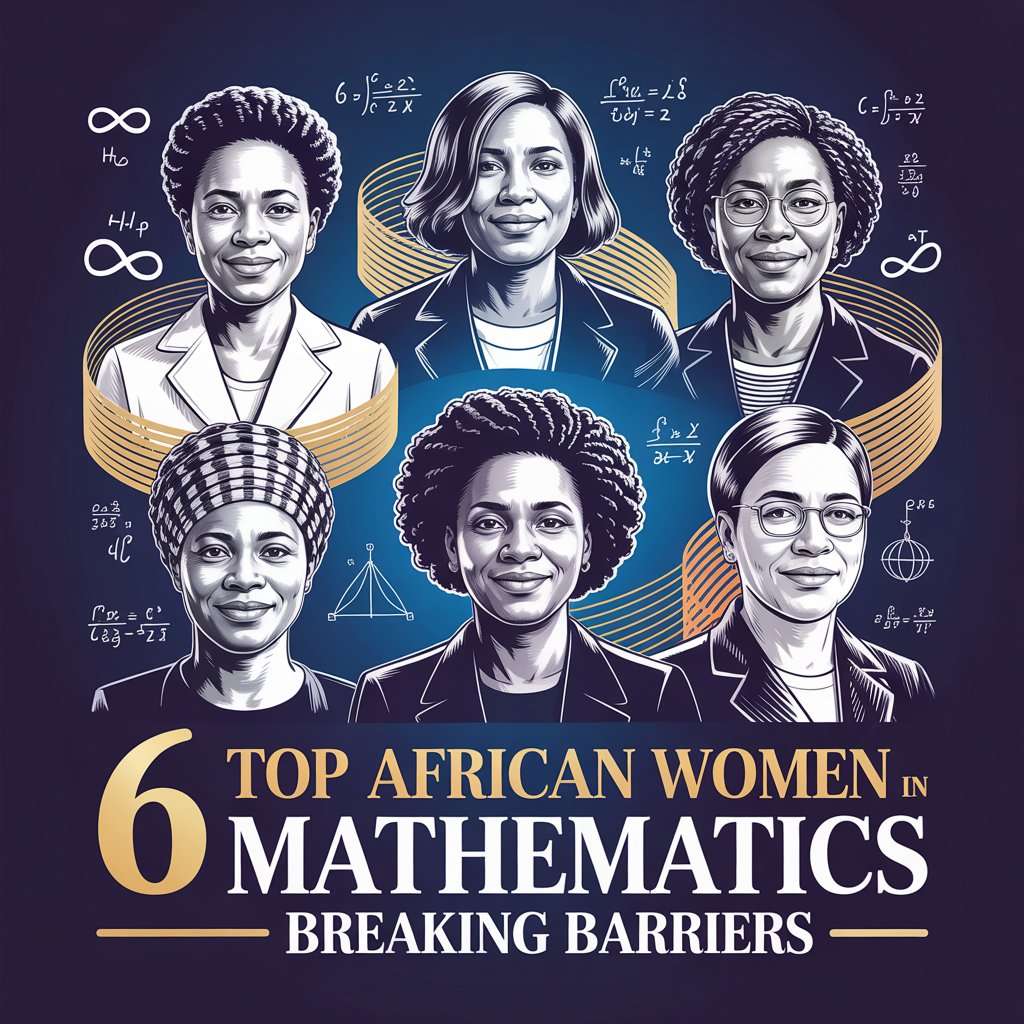
This International Women’s Day 2026, we celebrate six extraordinary African women who are transforming the field of mathematics. These are mathematicians who are not just solving equations but solving real problems. Women who are not just advancing their careers but advancing the next generation through mentorship and advocacy.
Let’s honor these brilliant mathematicians who are proving that African women belong at every level of mathematical excellence.
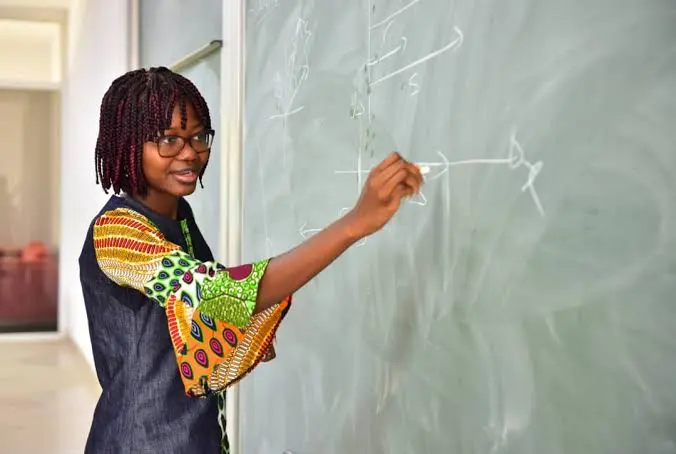
Dr. Angela Tabiri – Image: BlackPast
1. Dr. Angela Tabiri: Ghana’s Maths Queen with a Quantum Mission
Dr. Angela Tabiri, known in Ghana as the “Maths Queen,” made history in 2024 as the first African to win The Big Internet Math Off competition. This achievement is remarkable not just for the win itself but because Angela never initially planned to study mathematics.
Growing up in Ashaiman, a densely populated, low-income area near Accra, Angela lived in a lively household with five sisters. She often sought quiet at the local youth community center to focus on her studies. Originally aspiring to study business administration like two of her sisters, Angela was instead accepted into mathematics and economics when her grades fell just short of the business program.
She now calls this “a blessing in disguise.” Today, the 35-year-old researcher specializes in quantum algebra, also known as non-commutative algebra, at the Ghana branch of the African Institute for Mathematical Sciences (AIMS).
As academic manager for the Girls in Mathematical Sciences Programme at AIMS Ghana, Angela works to ensure a pipeline of young girls leading in mathematical sciences research and innovation. Also, through her non-profit organization FemAfricMaths, Angela supports African girls and women from less privileged backgrounds to pursue their mathematical dreams.
According to BBC reporting on her achievements, Dr. Tabiri represents a new generation of African mathematicians who are not just participating in global mathematics but leading conversations about the future of quantum technology.
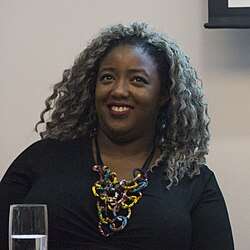
Dr. Anne-Marie Imafidon – Image: Wikipedia
2. Dr. Anne-Marie Imafidon: Child Prodigy Turned STEM Advocate
Dr. Anne-Marie Imafidon’s mathematical journey reads like something from a movie. Born in the UK to Nigerian parents, she became one of the youngest people ever to earn a Master’s degree in Mathematics and Computer Science from Oxford University at age 20.
Anne-Marie’s mathematical genius emerged early. At age 10, she passed two GCSEs (high school diploma exams) in Mathematics and Information Technology. Also, at 11, she became the youngest girl ever to pass A-level Computing in Britain. 12, she received an Oxford scholarship. At 13, she was granted a British scholarship to study Mathematics at Johns Hopkins University in Baltimore, Maryland.
By 17, she began her Master’s level studies at Oxford, completing what typically takes other students two years in just four months of work, studying two hours weekly.
After earning her Master’s degree, Anne-Marie worked at prestigious companies including Goldman Sachs, Hewlett-Packard, and Deutsche Bank, applying her mathematical and computer science expertise in financial technology.
In 2017, she was awarded an MBE (Member of the Order of the British Empire) for her services to young women and STEM sectors. She was voted the Most Influential Woman in Tech in the UK in 2020 by Computer Weekly and served as the 2022-2023 President of the British Science Association.
In 2013, Anne-Marie co-founded Stemettes, an award-winning social enterprise dedicated to inspiring and promoting the next generation of young women in Science, Technology, Engineering, and Mathematics.
Anne-Marie serves as Chancellor of Glasgow Caledonian University, a trustee at the Institute for the Future of Work, and sits on multiple advisory boards including the Girl Guides and the Council of Digital Economy. Her 2022 book “She’s in CTRL” provides guidance for women navigating STEM careers, sharing lessons from her own journey and the thousands of young women she’s mentored through Stemettes.
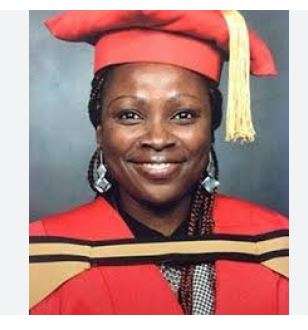
Professor Oghenetega Ighedo
3. Professor Oghenetega Ighedo: Breaking Barriers in Pure Mathematics
Professor Oghenetega Ighedo made history as the first Black woman to obtain a PhD in Pure Mathematics from the University of South Africa (UNISA). She now serves as an Associate Professor at UNISA, where she continues her research and mentors the next generation of African mathematicians.
Professor Ighedo’s achievement is particularly significant in the context of African mathematics education. Pure mathematics, which focuses on abstract mathematical theory rather than applied problems, has historically had very few Black women practitioners globally.
By earning her doctorate in this field, Professor Ighedo opened doors for other African women interested in pursuing pure mathematical research. Her presence at UNISA as a professor creates crucial representation for students who might not otherwise see themselves in academic mathematics.
As an Associate Professor, Professor Ighedo conducts research while teaching undergraduate and graduate mathematics students. Her dual role allows her to advance mathematical knowledge while simultaneously building the capacity of African institutions to produce world-class mathematicians.
Her position at one of Africa’s largest universities means her influence extends across the continent, as UNISA serves students from multiple African countries through its distance learning programs.
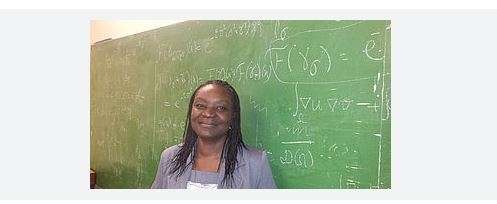
Marie Françoise Ouedraogo – Image: Wikipedia
4. Marie Françoise Ouedraogo: Burkina Faso’s First Female Mathematics PhD
Marie Françoise Ouedraogo holds the distinction of being the first woman in Burkina Faso to earn a PhD in mathematics. This pioneering achievement positioned her as a trailblazer not just for women in her country but for women across francophone West Africa.
After earning her doctorate, Dr. Ouedraogo dedicated herself to creating pathways for other women to follow. She founded and leads initiatives specifically designed to support women pursuing mathematics in Africa, recognizing that representation alone isn’t sufficient without active support systems.
Her work focuses on identifying talented girls interested in mathematics, providing them with mentorship, connecting them to educational opportunities, and creating networks where women mathematicians can support each other’s advancement.
Dr. Ouedraogo’s legacy extends beyond her personal achievement. By being first, she proved it was possible for women from Burkina Faso to earn advanced mathematics degrees. By creating support initiatives, she ensured that she wouldn’t remain the only one.
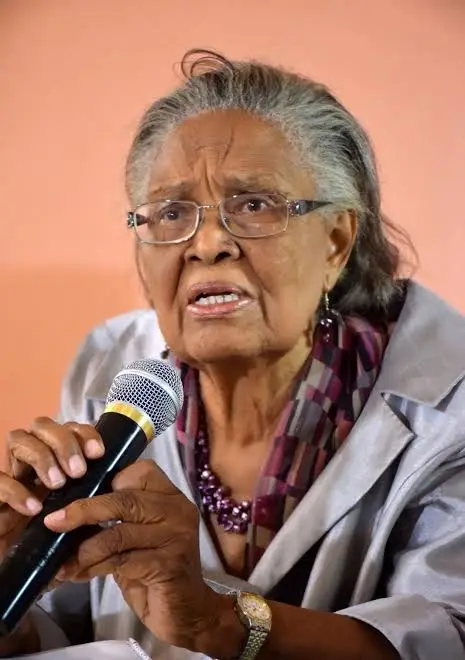
Grace Lele Williams – Image: Fatherland Gazette
5. Grace Lele Williams: Pioneering Mathematics Education in Nigeria
Grace Lele Williams is recognized as one of the first Nigerian women to earn a doctorate in Mathematics Education. Her focus on mathematics education rather than pure or applied mathematics represents an important contribution to African mathematics development.
While pure mathematicians advance theoretical knowledge and applied mathematicians solve practical problems, mathematics educators study how people learn mathematics and how to teach it effectively. This research is crucial for improving mathematics education at all levels.
Dr. Williams’s work in mathematics education helps ensure that Nigerian students receive quality mathematics instruction that builds strong foundational skills. Her research likely addresses culturally relevant teaching methods, curriculum development, and strategies for making mathematics accessible to diverse learners.
By earning her doctorate in Mathematics Education, Dr. Williams positioned herself to train the teachers who would educate thousands of Nigerian students. This multiplier effect means her impact extends far beyond her direct teaching or research.
Every mathematics teacher she trained went on to teach hundreds or thousands of students over their careers. Every curriculum improvement she contributed to affected entire generations of learners. This kind of systemic impact is what transforms educational outcomes at a national level.
6. Professor Marié Grobbelaar: Excellence in Mathematical Physics
South African mathematician Professor Marié Grobbelaar is a distinguished professor specializing in partial differential equations, functional analysis, and mathematical physics. Her work represents the highest levels of mathematical research achievement.
Partial differential equations (PDEs) are fundamental to understanding everything from heat flow and wave propagation to quantum mechanics and general relativity. Professor Grobbelaar’s expertise in PDEs positions her at the intersection of pure mathematics and physics, where mathematical theory meets physical reality.
Functional analysis, another of her specializations, provides the theoretical framework for much of modern physics and engineering. Mathematical physics applies rigorous mathematical methods to solve physical problems, creating the mathematical foundations that other scientists and engineers build upon.
As a professor, Dr. Grobbelaar supervises graduate students conducting their own research in mathematics and mathematical physics. These mentoring relationships create the next generation of mathematical researchers, ensuring that her expertise and approach to mathematical problem-solving get passed on.
According to research published in Nature, diverse teams produce better mathematics research outcomes, making the presence of women like Professor Grobbelaar essential to advancing mathematical knowledge effectively.
Why These Mathematical Stories Matter This International Women’s Day
These six women represent different paths to mathematical excellence, from competition championships and pure mathematics research to mathematics education and applied mathematical physics. Together, they demonstrate the breadth of opportunities available in mathematical fields.
Mathematics Needs Diverse Perspectives
Mathematics is often presented as objective and universal, divorced from human concerns. But the questions mathematicians choose to study, the problems they prioritize, and the applications they pursue are deeply human choices.
When women mathematicians work on quantum computing applications, they consider questions and applications that might not occur to male researchers. Also, when they teach mathematics, they understand barriers that female students face. Likewise, when they mentor, they provide guidance rooted in experience navigating mathematics as women.
The field benefits from including diverse perspectives because it leads to asking better questions and developing more comprehensive solutions.
Representation Creates Possibility
Every girl who sees Dr. Angela Tabiri winning international mathematics competitions, Faith Odunsi defeating global champions, or Dr. Anne-Marie Imafidon founding organizations that support thousands of STEM students learns that mathematics is for her too.
She learns that African women can excel at the highest levels of mathematical achievement. In addition, She learns that mathematical careers extend far beyond teaching and that her mathematical curiosity and talent deserve to be nurtured and developed.
This representation matters because career choices are shaped by visible possibilities. The more African women see themselves reflected in mathematical success stories, the more will pursue mathematical education and careers.
Mathematics Advances Leadership Skills
These women started as mathematicians studying equations and solving problems. As their expertise grew, they became professors, competition champions, organization founders, and advocates shaping mathematics conversations across Africa and globally.
Their journeys show how mathematical excellence creates opportunities for leadership and amplified impact. Technical skills in mathematics open doors, but understanding how to position yourself strategically determines what you can accomplish through those doors.
Join the African Women in STEM Community
Mathematics can feel isolating, especially when you’re one of few women in your program or department. The challenges you face, from being taken seriously in research discussions to accessing funding for advanced studies, are real and often go unspoken.
The African Women in STEM community provides space to discuss these challenges with women who understand because they’ve experienced them. It’s where you find mentors who can guide your decisions, peers who celebrate your achievements, and allies who support you through obstacles.
Join the African Women in STEM Membership Today
Happy International Women’s Day 2026. The future of African mathematics is female, and it includes you.
Follow on Social Media
- Follow African Women in STEM on LinkedIn
- Follow African Women in STEM on Instagram
- Follow Adaeze Iloeje-Udeogalanya on LinkedIn